Home » Myth » Sabbats » Adding Music to Beltane
Beltane (Beltine, Beltaine, Belltaine, May Day, Walpurgis), once an ancient Celtic fire festival, is now a modern pagan holiday that celebrates fertility and the sacred union of the God and Goddess. It is part of the traditional Wheel of the Year and one of the four Greater Sabbats. It is celebrated in the Northern Hemisphere on May 1, where it marks the beginning on summer.
The first mention of Beltane comes from Cormac’s Glossary, a 10th-century encyclopedia of more than 1000 Irish terms.
If you follow the journey of the god, which is symbolized in nature by the intensity of the sun, he’s basically in his prime — due to reach full power at Summer Solstice. He is the Lord of Light, generating solar energy to fuel the crops. Because of this, it’s a great time to invoke some intense sun energy with a chant.
Burn, burn
Fires of the sun
Fanning the flame
‘Til our magick is done
Shine, shine
Bright as can be
Light in the sky
And the light within me
Associations
Colors: Green, Gold, Red, White
Crystals: Sunstone
Herbs, Resins, Flowers: Frankincense, Orange Peel, Woodruff, Mugwort, any seasonal flowers, Hawthorn, Rosemary
Deities: Pan, Selene, Artemis, Lugh, Ra, Hera, Apollo
Activities: Bonfires, dancing, maypoles, faery gardens, fertility workings
Bonfires
Bonfires are great at any sabbat, but iconic for Beltane. A few hundred years ago, it was thought that the etymology of the word “bonfire” traced back to French — bon meaning “good.” An excerpt from Samuel Johnson’s Dictionary of the English Language (circa 1755) defines it as “a fire made for some publick cause of triumph or exaltation.”
So, a bonfire is basically just a good fire, right?

Oops. That was wrong.
Bonfires actually originate from bone fires. This is attested by a text from 1499 by John Mirk, Liber Festivalis. Check out all the Middle English!

Photo Courtesy of the British Museum. You can view the full book here.
Okay, I realize that print is super difficult to read, so I’ve typed out the text below.
But in worshipp of seinte iohan the people woke at home & made iij maner of fyres. One was clene bones & no woode & that is callid a bone fyre A nothir is clene wode & no bones & that is callid a wode fyre for people to fit & to wake there by.
Liber Festivalis
If that’s not clear enough, it’s basically making the distinction between a fire made with bones (the bonfire) and a fire made with wood (a woodfire).
The Celts would drive their cattle between two bonfires — this would bless and protect the herd from disease. Today we still use bonfires as part of our Beltane festivities, often jumping over one to symbolize fertility.
Want to hear about future posts? Subscribe to get notifications delivered straight to your inbox.
Maypoles
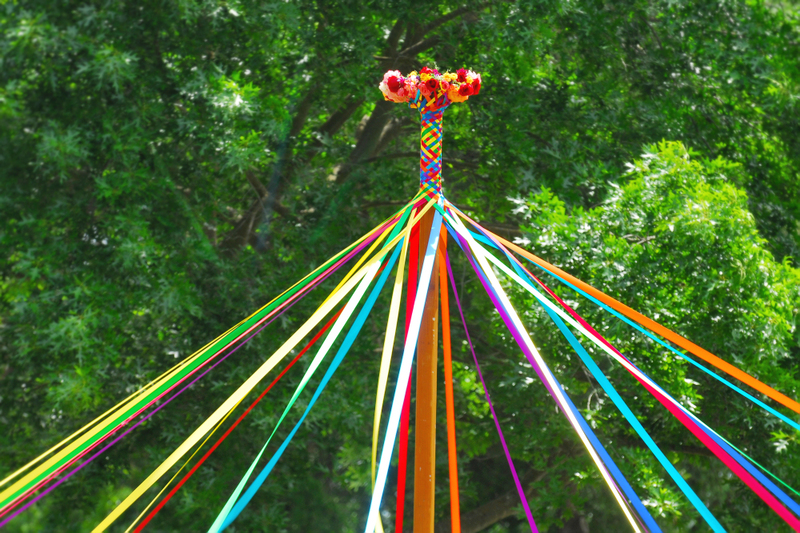
This is also the time of year for a Maypole, a tall, decorated pole with ribbons hanging from the top. A ceremonial folk dance is usually performed — dancers grab the ribbons and circumambulate in opposing directions. This creates an intricate weave of ribbon that moves down the pole.
Thinning of the Veil
On the Wheel of the Year, Beltane sits directly across from Samhain. These are two points where the veil between worlds is very thin. People generally associate this with communicating with the dead, but it’s also a great time to speak with the fae.
I’ve found that the faeries appreciate offerings of mugwort, cream, and shiny things.
Music
Bonfires, dancing, and maypoles just aren’t complete without a little bit of music. The easiest way to add some sonic flare to your Beltane festivities is with drums. Seriously, just grab a drum and start banging!
Irish folk tunes have an excellent vibe for the Maypole Dance.
If you’re looking for background music for a Beltane ritual, anything folky or irish without singing seems to work well. That is based on my personally belief that vocal lines tend to distract from the ritual itself. Unaccompanied drums also work well.
Instruments
We don’t necessarily have full knowledge of instruments used by the Ancient Celts. Archaeology attests to the Carnyx, an f-shaped battle horn, but I have a hard time picturing that being used outside of the battlefield. It would have had a piercing sound, which I doubt would have been appropriate for ritual celebrations. Celtic mythology also provides evidence of the harp, as Dagda had a magical one.
When selecting an instrument for use in Beltane festivities, it’s probably better to look at traditional Irish folk instruments. This isn’t meant to be an exhaustive list, but should definitely be a good starting point.
- Harp – possibly the most iconic instrument on this list, made of a wooden frame and sound box, this stringed instruments was plucked
- Bodhran – (pronounced “bow-rawn”) a frame drum with a stretched animal skin (usually goatskin) on one side
- Violin (fiddle) – a bowed instrument with four strings
- Flute – traditional woodwind instrument
- Whistle – Tin Whistles, Low Whistles, etc
- Uilleann Pipes – the Irish version of the bagpipes, the air is supplied by a small bellows that hands by the player’s waist
- Accordion – like a small organ, notes are played by a keyboard and buttons, an internal bellows is operated by pulling and squeezing instrument, hence the nickname “squeezebox”
- Banjo – a 5 string instrument with a resonator body, can be plucked or strummed
- Mandolin – like a small lute, typically with 4 sets of doubled strings, usually strummed
- Guitar – the standard acoustic guitar has 6 steel strings and can be plucked or strummed
What’s your favorite music to listen to on Beltane? Please share in the comments!
Note: This article is part of a series. Want to continue reading?


 Aerik Arkadian
Leave a comment