
Home » Magick » M3 Episodes » Season 1 » Oracle Hekataios, The Dead, and Gender Identity in the Craft – Ep. 4
Oracle Hekataios discusses his background, working with the dead, gender identity in the craft, and more! Oracle is a priest of the goddess Hekate, craft elder, and an author. He’s been initiated and trained in many traditions, including Alexandrian, Gardnerian, New York Wicca, and the Minoan Brotherhood.
What may not be completely obvious by this multitude of initiations is that Oracle actually started off as a Christian minister. He even had his own radio show and was being groomed to be a televangelist! After studying the Bible in the original ancient languages, he felt a calling to the divine feminine. All of these experiences led him to eventually found his own tradition: Strix.
Strix Craft
If you’re looking to find out more about Strix, this book will definitely be a good starting point for you. According to Oracle, this is somewhat of a reclaimed term, as many women from ancient times were accused of “strix” and then killed for their crimes. Today, the word best translates to “witch.”
The Strix path balances research and personal inspiration. You can easily see both on just about every page, as Oracle’s revelations are backed up by his studies (and vice versa).

The mythos begins with Orphic mysteries surrounding the goddess Nyx. It’s a beautiful story and you can hear Oracle explain it in the interview. He says that the goal of the Strix is Nyx knowing herself in all her being.
Strix takes some cues from a variety of ancient magicks, trying to reimagine how they would be performed today if they had survived to modern times. In addition to Orphic mysteries, Oracle also describes Hekatean and Dionysian mysteries as being central to the practice.
Blending Traditions
Oracle has never been a stranger to blending traditions. Even as a child, his household was mixed between Christianity, Lucumí, and some paranormal/occult interests. It should be no surprise, then, that later in life he become part of several different offshoots of BTW (British Traditional Witchcraft, but why did I even bother with the acronym if I was going to spell it out for you in parentheses anyway?) – Gardnerian, Alexandrian, New York Wicca, and the Minoan Brotherhood. And that was all after a stent in Druidry.
Hey, do you know who else had a wide exposure to different traditions that included Druidry? Gerald Gardner. Yep. It’s true. You can look it up. OTO, Druids, Rosicrucians, Freemasons… he took concepts from all over the place. So let me tell you this: great things can come from the melding of ideas.
Some people are of the mindset that you should pick one path and stick with it. I get it. I don’t agree, but I also won’t argue. In my eyes, a better way of thinking is that you should master one path before moving on to another.
Different traditions will sometimes gripe over small details. For example, let’s say that my tradition says North is Green, but yours says that North is Black. If you’re a beginner, switching back and forth every ritual will confuse the brain’s visualization processes. It doesn’t allow enough time for neural connections to form and really sink in. It’s better to stick with one until you’re really comfortable with it, then try the different way and see how it feels.
When I asked Oracle how he reconciles competing ideas between traditions, he gave me an excellent answer. I’m almost tempted to tell you “watch the video to find out,” but it’s too good to hide in such subterfuge. For him, these ideas are not so competing. He describes different traditions as pieces of the same puzzle — and being a part of all these groups has given him a better view of the much bigger picture.
Want to hear about future posts? Subscribe to get notifications delivered straight to your inbox.
Gender Identity in the Craft
This section of the interview, you are pretty much going to have to listen. I feel like I would be doing everyone a disservice if I reworded, summarized, or in any way condensed Oracle’s experience as a nonbinary person in the craft. It deserves to be heard in full.
Here’s what you should know. Not everyone in the craft is LGBTQ+ friendly. Not everyone in the craft accepts the ideas of being gender fluid, nonbinary, or trans. Some people even go very far out of their way to create toxic environments. But don’t worry, we won’t be naming any names.
This is an issue that proves difficult to discuss without taking some sort of stance. It’s really divisive, even amongst friends or coveners. I try to be as nonpolitical as possible, but I’m happy to tell you that I side with Oracle here. Selene and I have made some modifications to our rituals in an attempt to be inclusive. We don’t have all the answers, but we’re doing the best we can. And the idea of folks using any type of gender identity or sexual orientation as a barrier to worshipping the gods certainly does not sit well with us.
Working with the Dead
I usually find that when the dead really want to be heard, they begin to speak through others. Unsurprisingly, when I was talking to Oracle about topics of discussion in our pre-interview, he told me right off the bat that he wanted to talk about the dead.
For a beginner, he suggests setting up a space for your dead with a white altar cloth, white candle, bell, and a glass full of water. The water represents life force, so the glass should always be filled and clean. You can ring the bell to alert them, then leave them small offerings like coffee. An important thing to remember here is that anything you use for the dead is only to be used for the dead. You would not, for instance, give them coffee from a cup and then later on drink from that cup. To do so, warns Oracle, would invite death energy into yourself.
Oracle also suggests adding some pictures to your altar, but again warns that the pictures should only be of those who have passed. If you put a picture of the living on your ancestor altar, you’re basically saying “hey, be ready to receive this person!”
And it’s that simple! Once you have this in place, you can start talking to grandma, grandpa, or whoever else has passed away. Begin forming that relationship so you can call on them to help you with magick later on.
So what qualifies as an ancestor? Who do we choose to venerate?According to Oracle, this could be a blood relative or a friend. But it doesn’t have to include everyone. If Uncle Joe was an abusive jerk, you don’t have to venerate him. Dying does not necessarily bestow wisdom. Someone who was a nuisance in life can continue to be a nuisance in death — you might not want that energy.
He also keeps a separate altar for the mighty dead – these are the dead witches within our lineage who might be called upon to join our rituals. If you’re part of an initiatory tradition, whether or not you can recite your lineage, everyone who has gone before you is part of your mighty dead, up to and including the founders of the tradition themselves. For a Gardnerian, that could include Gerald Gardner. For an Alexandrian, it could include Alex Sanders.
Strix Craft has an entire chapter dedicated to this subject, including a very interesting ritual that involves using a black mirror. That’s a teaser. You can buy the book if you’d like to get the whole thing.
How to Find Oracle Hekataios
Are you trying to find Oracle? Well, here’s how! He gives readings locally, working out of the Sea Witch of Cocoa Village in Cocoa, FL. He also frequents festivals, so you’ll probably be able to find him at Summer Magick Fest and FPG Beltane next year. Aside from that, be sure to check out his Facebook page for more info on his whereabouts.
On the Sea Witch’s website, you can go to the appointment’s section and book directly. You could also email Oracle at oraclehekataios@gmail.com.
Oracle does a 7-month course on Strix Craft that you can attend both in-person or virtually. At the time of writing this article, I believe he is about halfway through the current session, but you can always contact him to catch up on material you might have missed.
Sounds of Trance
Oracle says “sound and music are integral” parts of his practice. Beyond the use of aiding meditation, trancework, or setting the atmosphere for ritual, he describes how he uses binaural beats to help draw down deity. He says this is backed up by certain instruments like flutes being used in Ancient Greece and India to help induce trance.
I’m wondering if the aulos might have been used in this way.
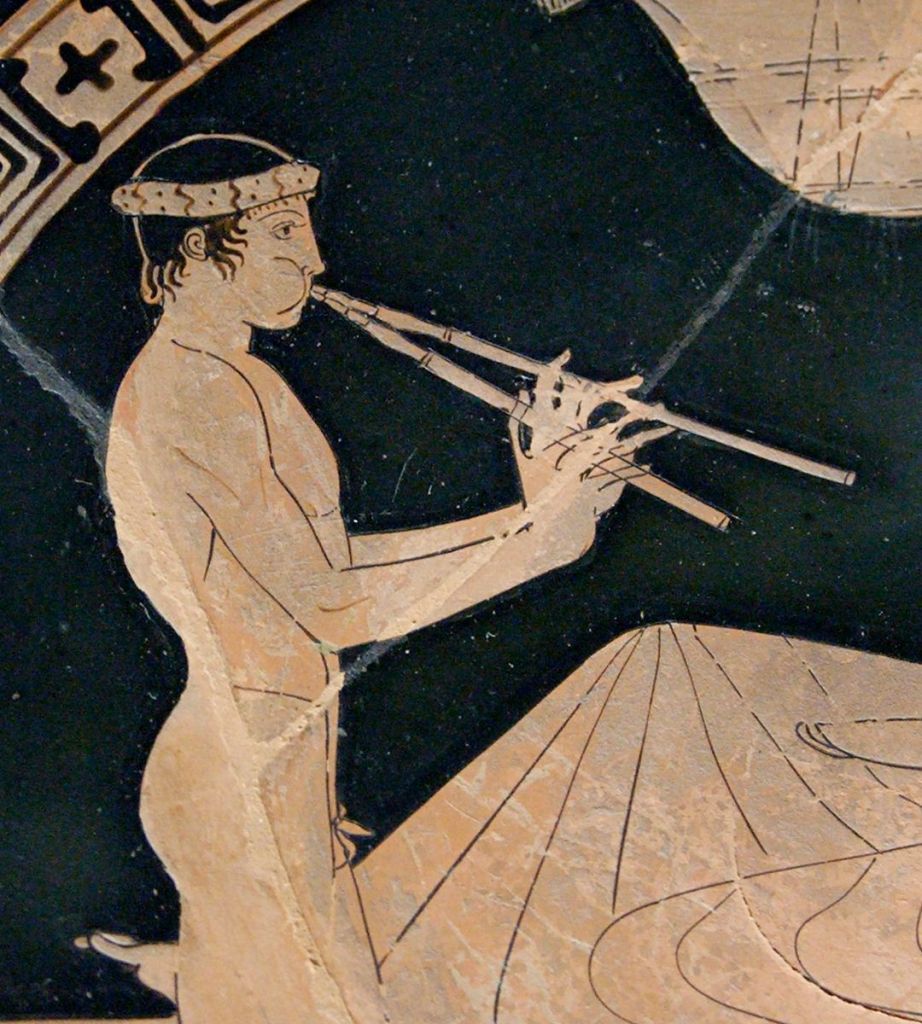
Public domain. Image courtesy of wikipedia.
The aulos is an ancient Greek instrument, sometimes called a “double-flute,” but it was actually a reeded instrument, so it’s more closely related to a clarinet. The musician would play through two pipes at once, so it would totally be possible to create sustained, competing tones for trancework.
The fun part is that none of these instruments actually survived to modern times. We only know about them because they’re described in ancient texts or featured in artwork, like the picture above.
Conclusions
I had a great time talking to Oracle. I really appreciate his openness and willingness to talk about all of these things! I can only hope that this helps his message be heard.
Do you know someone that has interesting things to say about using music in ritual? Maybe they should be a guest on M3. If so, feel free to contact me.
Also, have you subscribed to M3 on YouTube? If you go do that right now, it’ll make me seriously happy.
Wait a second, you’re still reading? Even after I asked you to subscribe to something? Well, props to you because you’ve found the fine print. I use Amazon referral links in this article. If you use one of those links to make a purchase, the Amazon Associates program pays me a small commission. Don’t worry, it doesn’t cost you anything extra. And it’s seriously small. You’d probably have to buy like 1000 books before I could even use that money to take my wife out for dinner or something. But I’m not complaining. Thus endeth the fine print.

 Aerik Arkadian

Leave a comment