
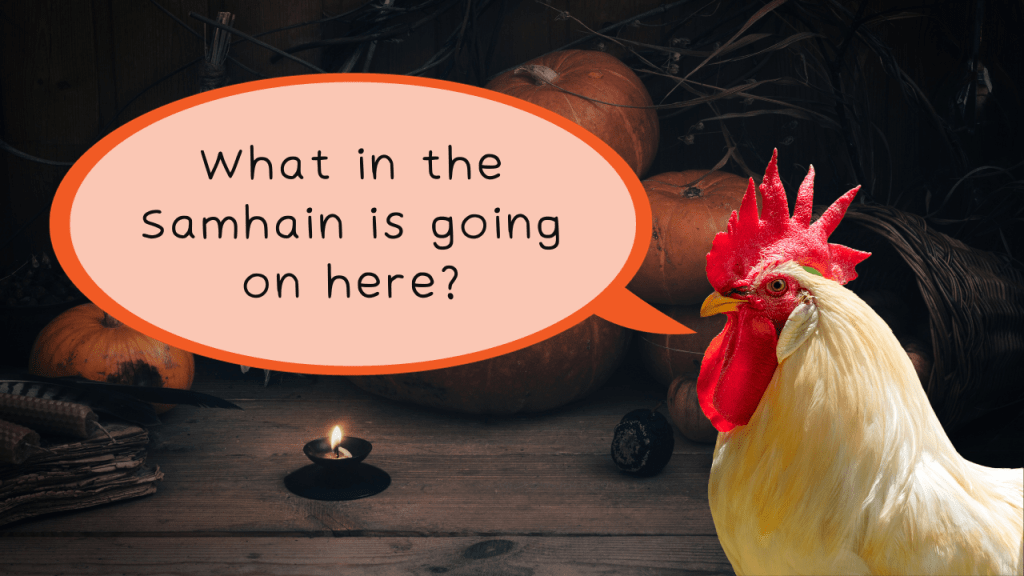
When I first the word “Samhain” as a kid, I thought I knew exactly what was being talked about. I figured it was some sort of euphemism, a censored swear word, just like “dagnabbit!” and “consarnit!” In fact, even today I can hear it in my head being said in Foghorn Leghorn’s voice: “Boy, I say, boy, what in the Samhain is going on here?” Oh fudge was I wrong! It took a significant portion of my adult life to understand that this was not part of a catchphrase from Looney Tunes.
The above paragraph might make more sense if I tell you that I had always heard it mispronounced as “SAM – HANE.” It’s probably more likely that I was confusing this with the phrase “What in the Sam Hill” throughout my entire flipping childhood, which has its own interesting origins that lie far away from the scope of this article. Cheese and crackers, I sure had things mixed up!
It’s quite shocking when you learn that a word you’ve been hearing for decades doesn’t mean what you think it means. It’s also quite shocking to find out you’re saying it the wrong way.
Samhain, which is properly pronounced as “SOW – in” isn’t a doggone euphemism or a goshdarn catchphrase. It’s a holiday.
Brief Summary
I like to think of Samhain sort of like New Year’s Eve. The ancient Celts used this time from Oct 31 to Nov 1 as a division between the light and dark half of the year. It also marked both the end of the harvest season and the end of the year. In our tradition, this is the start of the “Dark Time” which takes place between Samhain and Yule. We choose to not perform rites of dedication, initiation, or elevation during these dates.
On the modern wheel of the year (which is two different calendars thrown on top of one another), Samhain is one of three harvest festivals. Lughnasadh celebrates the harvest of grain, Mabon celebrates the harvest of fruits and veggies, and Samhain celebrates the harvest of soylent green.
Come on everyone, where is your 1973 sci-fi knowledge? Soylent Green is PEOPLE!
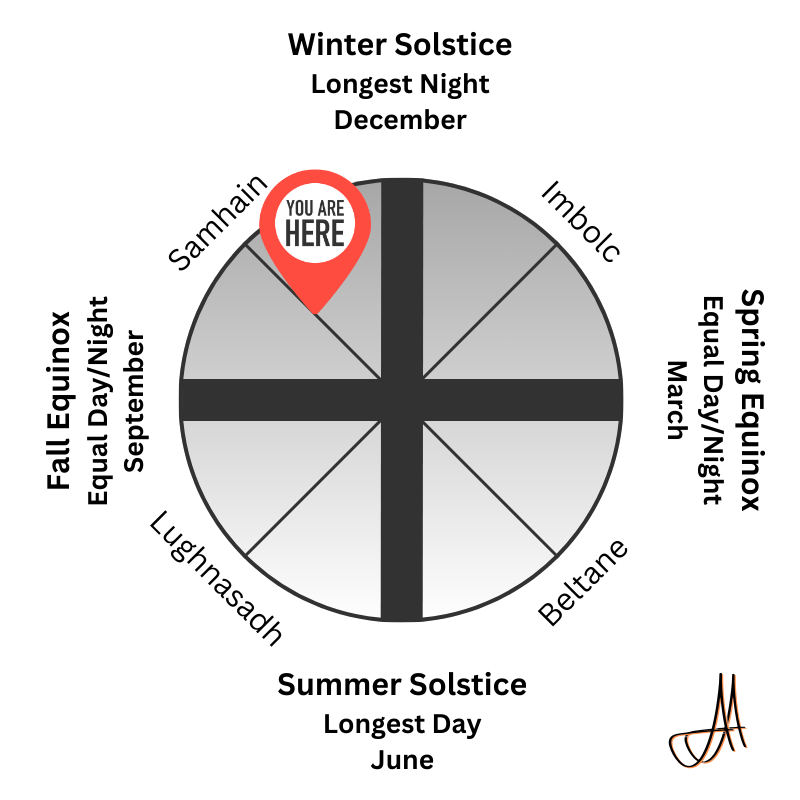
Wait, what? We’re harvesting people? Well, maybe. Sort of. Yeah. But we’ll come back to that later. For now, please just refer to the handy YOU ARE HERE marker on our calendar graphic so you can relax and get settled in.
Although the Celts (and some modern witches) used the Samhain-Beltane dividing line to mark their halves of the year, I personally prefer a split between the equinoxes. It just makes more sense to me to look at it from a solar perspective rather than an agricultural one.
Associations
- Dates: Oct 31 – Nov 1
- Colors: black, orange, red
- Flowers: roses, marigolds
- Herbs: mugwort, rosemary
- Crystals: obsidian, bloodstone, jet, smoky quartz
- Foods: meat, apples, pumpkin, squash
- Instruments: drums
Etymology
The word “Samhain” is Gaelic. I’ve probably mentioned many times that I don’t speak Gaelic; however, I do have two hands and can type things into Google with very high accuracy. According to my research, it might have originally been spelled as samain, samuin or samfuin, which were probably contractions of these two words:
- sam – “summer”
- fuin – “end, sunset”
Quite literally, this translates to “the end of summer.” You may or may not know that the Ancient Celts only recognized two seasons – summer and not summer (read: winter), so it makes perfect sense to use that phrasing for the end of their year festivities.
Well, that’s one opinion, anyway. Other linguists argue for some different meanings, like “assembly of the living and the dead,” which also sounds pretty cool.
Today, you might hear these dates called names like All Saints Day, Hallowmas, Hallows Eve, or… dare I say it? Halloween.
Want to hear about future posts? Subscribe to get notifications delivered straight to your inbox.
What the god and goddess are doing?
Before we get too much further into the holiday festivities, let’s take a quick look at what the god and goddess are doing around this time of year.
The goddess is heavily pregnant. At the next sabbat (Yule), she’s going to give birth!
The god has become the sacrifice. He dies. Or at least, one form of him dies. As he begins to assume his new role as the god of death in the underworld, he also becomes the perfect person to call upon to open the door and let us communicate with the dead.
Culling of the Herd
One of the reasons for all the death imagery and associations around this time of year is the simple fact that it was literally happening everywhere in the ancient world.
Do you have any crops left? Nope. They’ve all been harvested or they’re about to die from the cold.
Will your livestock make it through the coming winter? No? Great, let’s slaughter and eat them so we can have more food.
Is your horse sick? Sorry, but you’ll need to kill it so we can give more food to the healthy animals.
Winters were hard. Food was limited. It was certainly a time of difficult decisions. For some of the ancient tribal cultures, these tough choices might have extended to choosing people as well. There is it least one document suggesting that children were ritually killed at Samhain to appease an angry deity, but it was written by Christian Monks, so take that with a grain of salt. The Ancient Celts did occasionally practice human sacrifice, yes, but it’s far more likely that the more widespread slaughtering was limited to livestock.
So let me return to my previous question. Soylent Green? Are we harvesting people? Well… maybe. But meat? Definitely.
Traditions and Celebrations
Aside from thinning the herd, the world gives us some wonderful, beautiful, and fascinating traditions that take place this time of year.
The oldest and simplest of Samhain traditions is probably that of building a bonfire. The Ancient Celts were pretty epic bonfire builders. Their fires probably contained sacrifices of crops and livestock (which made them actual bone-fires, see the history of the word in my Beltane article). This central bonfire was sacred and an excellent time for divining the future. In fact, they supposedly even wore costumes of animal heads and skins as they performed these activities. If you throw in some candy, that sounds a lot like dressing up to go “trick or treating” to me. Once the festivities were over, each house would relight their hearth from the communal fire.
Just about everyone is familiar with the act of pumpkin carving, but you might be surprised to find out that this tradition stems from an older practice of carving turnips. Ancient Celts would hollow out a turnip and light a candle inside to protect them from unwanted apparitions. One such creature from Irish mythology was named Stingy Jack, a malevolent spirit who was banned from both heaven and hell. The “lantern” could protect you from “jack” and thus we have a “Jack-o-Lantern.” When Irish immigrants came to America, they switched from turnips to pumpkins, but they named stayed the same!
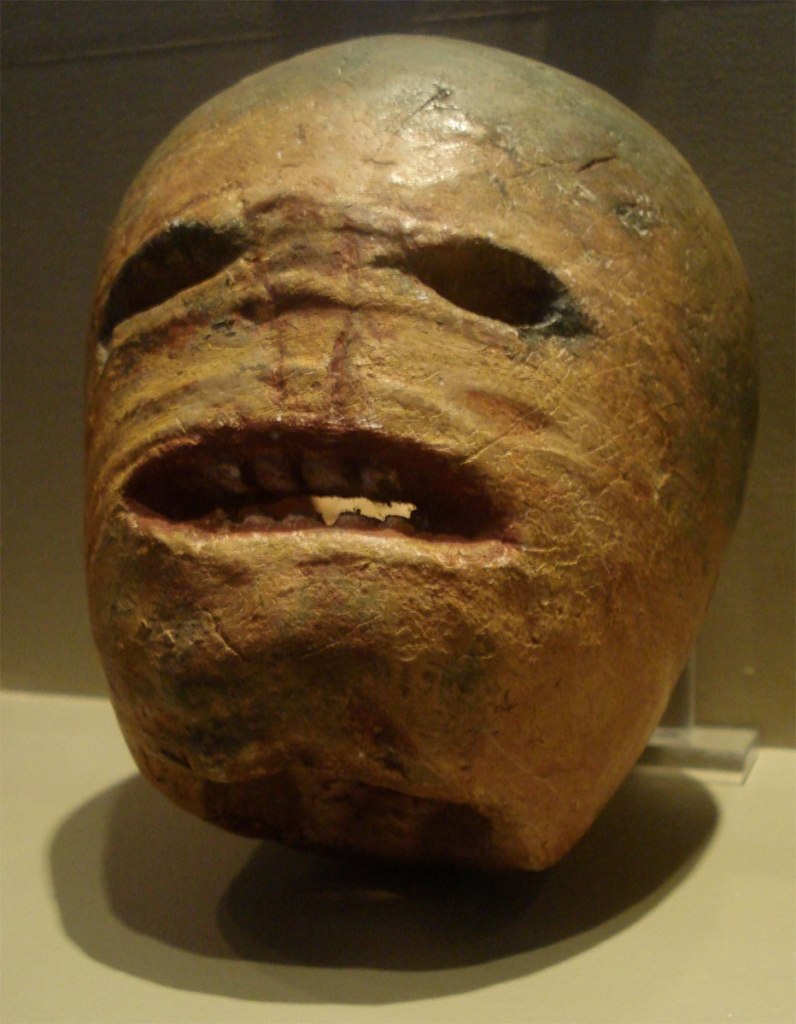
A carved turnip. Rannpháirtí anaithnid at English Wikipedia, CC BY-SA 3.0, via Wikimedia Commons
Today, you can find patterns to carve a pumpkin in just about any design your heart desires, but most people definitely use them more for decoration rather than protection from evil.
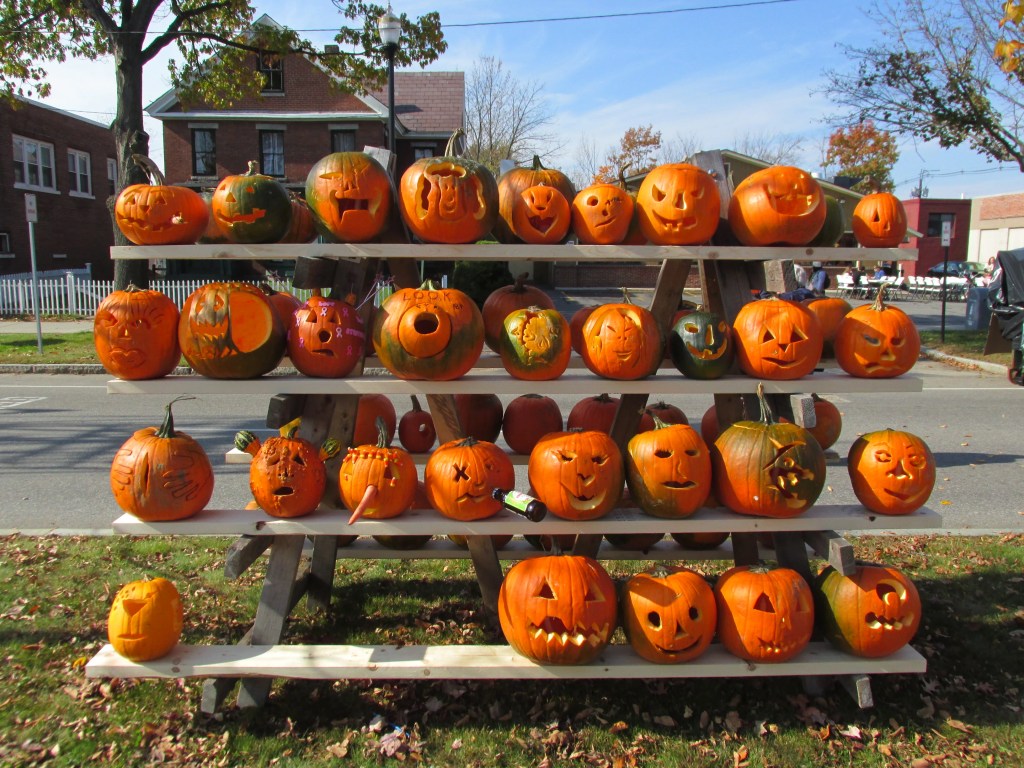
Rack of Pumpkins. Photo By John Phelan – Own work, CC BY-SA 3.0. Image courtesy of Wikipedia.
The Roman empire, which ruled most Celtic land by the year 43 CE, celebrated the holiday of Feralia at the end of October to commemorate the dead. Romans also had a day that honored Pomona, the goddess of fruit and trees, around this time. One of Pomona’s symbols is an apple, so this is possibly the origin of bobbing for apples at Halloween.
In Rome during the 8th century, Pope Gregory III built a special chapel and set aside Nov 1 to honor the saints. In later years, the celebration was extended throughout the entire Holy Roman Empire and eventually spread to all of Europe. Today, All Saints Day is celebrated by Catholics everywhere. It’s a “holy day of obligation,” just like Christmas or Easter, so Catholics are required to attend mass. I think it’s hilarious how things get Christianized. Do you know what saints are? They’re dead people. You can call it by a different name, but Christians are just honoring their dead.
And let’s not forget Dia De Los Muertos, which originated in Mexico and is now celebrated all over Latin America with the building of brightly colored altars, called ofrendas. The bright colors help the dead find their way back. Don’t worry, I won’t claim any Celtic origins for this one!
Thinning of the Veil
Samhain is usually thought of as “the thinning of the veil.” The veil in question here is the one that separates our realm from others, like the realm of the dead. This happens at exactly one other point during the year, which is the sabbat directly opposite from Samhain. Can you guess which?
Well, you could scroll up and refer to our handy wheel of the year chart or I could just tell you that it’s Beltane. There is one small caveat here, however. Beltane’s thinning is most frequently associated with faeries coming through rather than the dead, but that’s not a reason so skimp on the ancestor veneration!
Ancestor Veneration
Within the past two weeks, I posted an entire article on Working With the Dead, which was based mostly on Selene’s research, but also had a dash of discussions we had within our coven, the interview with Oracle Hekataios, and my own personal experience and opinions. While I don’t want to spend too long on rehashing this information, I do want to share a song that I wrote to call in the ancestors during ritual. It has a tune, which maybe I will record and share with you all at a later time, but it can also be used as a simple chant or spell while dancing.
Call to the Ancestors by Aerik Arkadian
I call to the ancestors
Spirits of old
We welcome you now
And we seek to behold
Your wisdom and guidance
And messages, too
We open the door
And invite you through
I’ve used this before at Samhain, but it’s also appropriate for any other ritual during the year where you’d like to welcome your loved ones.
Ritual
Building an ancestor altar and performing an act of divination are probably the two most popular ritual ideas for modern Wiccans. At our coven’s Samhain celebration, which we observed a bit early to accommodate all of our busy schedules, we did both!
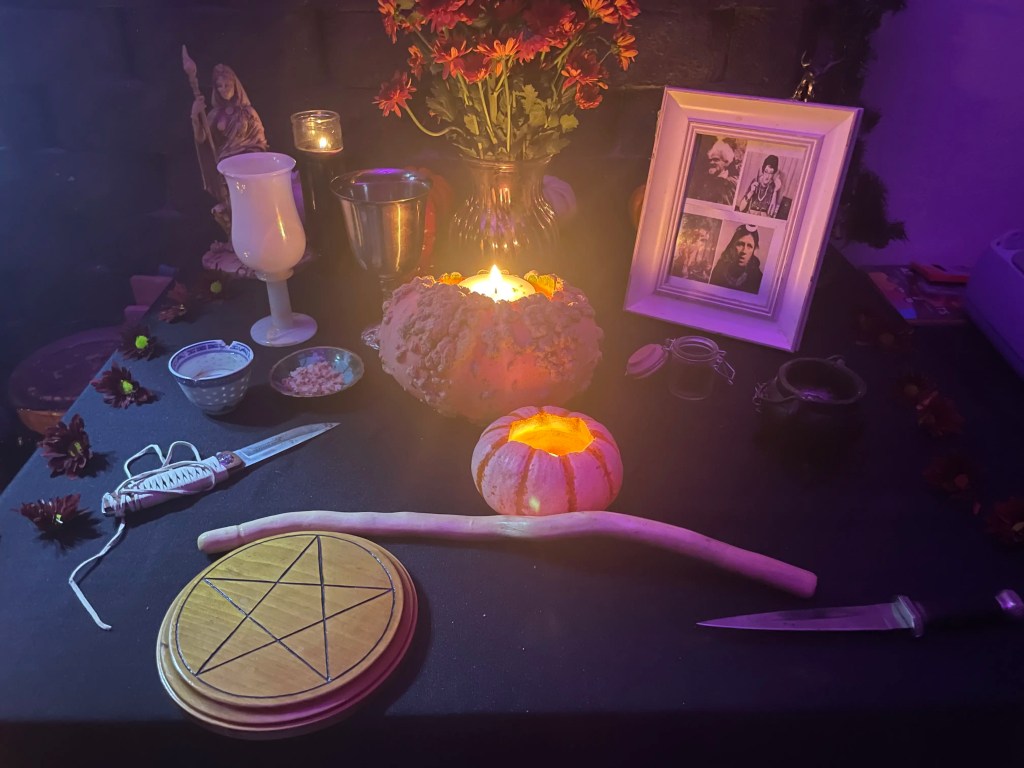
Itzel’s Samhain Altar. Original image.
Itzel, one of our priestesses, wrote and lead a beautiful ritual for us. You can see from the picture that the altar setup is a bit different than usual. There are extra flowers, pictures of our Mighty Dead (as gards, this includes GBG and his HPS’s), black candles… not to mention a big glowing pumpkin in the middle to represent the central bonfire of the Ancient Celts. We also built a separate altar to honor our ancestors.
If you’re looking for some Samhain ritual ideas, stick with some of the classics!
- Build a bonfire – emulate the ancient celts! Stare into the flames and do some fire scying.
- Leave offerings – add some extra goodies to your ancestor altar. Your dead are close by, so they deserve some treats, too!
- Perform divination – grab a pendulum, tarot deck, pen and paper, or any of your other favorite divinatory tools. The dead almost always have messages. It’s time to listen!
- Carve a pumpkin – leave a jack-o-lantern on your doorstep for some added protection, but carve with intention. Consider throwing in some sigils or sacred symbols.
The Dumb Supper
You might also choose to hold a Dumb Supper, a ritual where you prepare a plate of food for yourself and your dead, then eat in silence. It’s most common to do this on Oct 31 or Nov 1, but it’s still possible to have a successful one within a couple weeks of these dates. Remember that the veil does not just instantly get thin — it’s been thinning since Lughnasadh and will take time to build back up to its high point at Imbolc.
Perhaps one day I will share an entire ritual script with you, but for now I’ll give you the highlights:
- Create sacred space
- Call to your favorite death deities
- Prepare a place at the table for you and your dead, including plates, food, utensils, and chairs
- Eat in silence, opening up to receive any messages or just enjoy the time
- Say goodbye, close ritual, and clean up
Music to Raise the Dead
The right music can put you in a trance that is perfect for seeing beyond the veil. And if your ancestors are like mine, they might enjoy a good tune as an offering every now and then.
But what if you’re just trying to set the tone and honor the time of year? Here are a few suggestions that, to me, just scream, “SAMHAIN!” Well, they might not literally do that, but they do cue my mind into knowing what time of year it is. To be fair, these aren’t all my ideas. I also “polled the audience.” Thanks Sarah, Michael, and others!
Not to mention David Bowie’s Scary Monsters or Michael Jackson’s Thriller… or any of the many, many other songs that have somehow formed neural connections in my brain between these concepts. Once you extend the requirements to not just be about Samhain, specifically, but to include anything that triggers your brain into thinking about this particular time of year, the list becomes rather expansive!
Conclusions
If you carved a pumpkin this year, you can thank the Ancient Celts. If you hung out at a costume party in October, you can thank the Ancient Celts. If you took your kids to trick or treat (or, heck, if you went yourself!), then you can thank the Ancient Celts.
Maybe now if someone asks you a question like, “where in the Samhain did Halloween come from,” you’ll have a good answer for them!
However you choose to celebrate this time of year, make sure to say hello to your ancestors, keep an eye out for Stingy Jack, and eat a boatload of candy… but most importantly, have a beautiful and blessed Samhain!




 Aerik Arkadian

Leave a comment