

Jump to Lesson:
- Part 1 – Why Volunteering Is Important (current lesson)
- Part 2 – How to Get Started
I remove my belt and my shoes. My pockets are empty. My jewelry, cell phone, and wallet are locked away outside in the car.
I step through a metal detector. It doesn’t go off. A guard motions to keep moving.
Another guard comes up from behind and gives me a pat down.
“Right foot,” he says. I lift it up, exposing my sole. I guess this is a common place to smuggle in contraband.
“Left foot,” he says. I shift my weight, alternating feet as if it’s some strange little dance.
We’re clear. Belt and shoes are returned. We’re each handed a “personal panic button,” a small black box about the size of a pager [read: antiquated technological device] which has to be securely fastened to clothing. It has a small string that loops around my belt. The other end of the string is attached to a pin that will easily pull out if, and I quote, “anyone tries to forcibly wrestle it from you.” Should that pin be removed, or if I press the button, alarms go off and guards swing into action. I mean, that’s what we’re told anyway. I usually have a strong compulsion to press buttons, but I resist the urge this time.
Another guard behind thick glass stares at us while the giant metal security door slams open, revealing a small hallway with more doors. We step through the threshold.
This particular architectural feature is sometimes called a “mantrap.” It’s designed to control entry and, well… to prevent escape. The hallway itself is about 6 feet wide. There’s a door on each side, but only one can be opened at a time. And you can’t unlock them from the inside. Someone in the control room has to do that for you.
“Did I actually remember to lock the car?” I wonder.
But it’s too late for that now. The door slams shut.
And thus begins yet another volunteer visit to prison.
Want to hear about future posts? Subscribe to get notifications delivered straight to your inbox.
Why Should You Volunteer?
If you haven’t heard me mention this before, Selene I volunteer regularly at a local correctional institution in order to bring Wiccan services to inmates. It is difficult sometimes, yes, but it’s very rewarding. It’s also an excellent way to give back and serve the craft.
It’s weird. I get it. Most people don’t choose to spend their weekend at a prison. And certainly not for free.
But the need for these services is high. And it isn’t simply a matter of “if we don’t do this, then someone else will.”
The reality is that if we don’t do this, it’s pretty likely that it just won’t be done. I’d even venture a guess that many people aren’t even aware that it can be done or that the opportunity for this type of service exists. Hence, I’m writing this article. It probably shouldn’t come as a huge surprise that Wicca is significantly underrepresented in the prison system.
Why are we underrepresented? Because religion itself within the prison system, fundamentally speaking, seems to be Christian. Albeit with some exceptions, the chaplain is usually a priest or some other sort of ordained Christian minister. Most of the available reading material is Christian. The facilities themselves are even reminiscent of your typical church auditorium with scattered crosses or other church iconography. And you know what? There’s nothing inherently wrong with that.
It’s just unbalanced.
I took a list of recurring events from our local facility’s chapel schedule and tallied them up by religion.
- Asatru Services: 1
- Christian Services: 30
- Buddhist Services: 1
- Jewish Services: 3
- Humanist Services: 1
- Muslim Services: 2
- Wiccan Services: 1
- Non-Religious Services: 6 (AA, Art Class, Public Speaking, Guitar, Veterans Services, and Library Study Time)
Here’s what that looks like in pie-chat form.
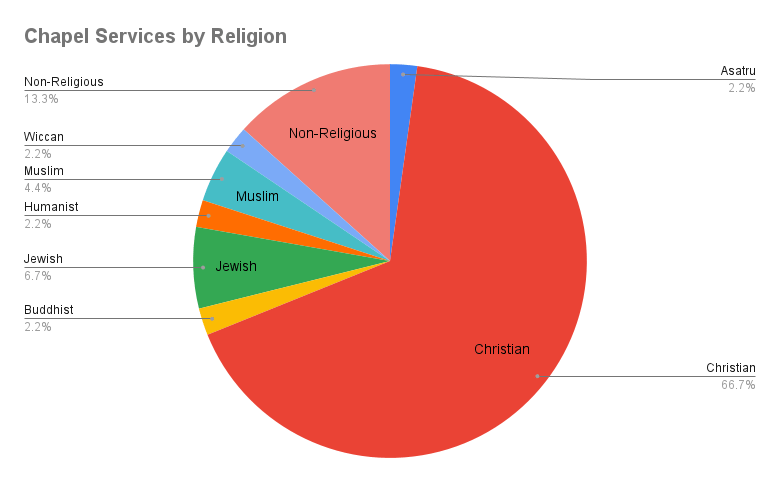
All religions likes pie.
Is this a fair or scientific study across multiple control groups? Of course not. I only have access to information from the particular facility that we volunteer at. Still, these numbers don’t lie. And without us, that little slice of Wicca in the pie chart disappears completely.
Put yourself in this position for a moment. You are Wiccan (or at least think you might be), but you don’t have access to any reading material. There’s no copy of “Wicca: A Guide for the Solitary Practitioner” nearby to read. What would you do? If you were serious, you might seek out a group to learn from. But what if there was no group? And what if access to the internet, and all other forms of communication were severely restricted? And to top it all off, your only faith-related contact is a Christian minister who doesn’t have the answers for you — at least not the type of answers you’re looking for.
This is where volunteers come into play. We help bridge the gap between a largely Christian-populated institution and individuals of other faiths. We can hold Wiccan services, teach instructional classes, or simply create a safe place for discussing the god and goddess that otherwise would not exist.
What you may not know about certain religious activities within the prison system is that the presence of a “sponsor” (volunteers like us) is often required for the group to be able to meet. In plain terms, this means that the ten [or so] Wiccan inmates at our facility can’t gather, use the chapel facilities, or do any sort of group activity/ritual unless we’re there.
There is also an arbitrarily-enforced regulation which states that inmates may only attend services that match their chosen religious affiliation. If you write “Wiccan” on your paperwork, for instance, then you might be barred from attending Christian events. But if there’s no Wiccan events for you, then you might not be able to attend anything at all. To me, this seems rather divisive. I’m not sure how this helps anyone improve their life, but who am I to question the infinite intelligence of the Department of Corrections.
Who Should Volunteer?
Now that I feel I’ve adequately explained why volunteers are needed, let me shift gears and start talking about who should be considering volunteering.
For starters, if anything I said in the above paragraph resonated with you, made you feel empathy, or otherwise sounded interesting, then you’re probably the type of person that would be a good fit.
I have my own opinions for who should not do something like this, but I don’t want to impose my personal limits on others. This is something that ultimately needs to be worked out between you and the gods. What I’m going to try to do is explain, in my experience, what types of skills are required so that you can be the judge of whether or not you fit the bill.
While being part of an initiatory practice is in no way required for volunteering, I do happen to work within one and I believe our degrees can serve as a practical benchmark. In our coven (and in many others), a good sign of “readiness” would be second degree. (Side Note: Yes, I know some third degrees that would do poorly here and first degrees that would excel. This is only an approximation.) You should be comfortable teaching classes and running rituals on your own.
On your own? Yes. On your own. There’s no lifeline. You will be your own sole resource while inside a correctional facility. You won’t have a phone to call your high priest[ess], upline, coven mate, friend, spiritual support, or anyone else for that matter. You won’t have a computer or Google to search for answers to questions. You’ll need to comfortably know a reasonable amount of information off the cuff. You’ll be answering questions and need to present yourself with confidence (but not arrogance).
Experience leading public ritual or teaching a group class will be a great asset here. This is a little bit different than leading a ritual or teaching a class within your coven. When you teach something to your coven — or even to friends who share the same beliefs as you, you’re usually operating within one main set of ideas. On the other hand, when you teach a public class, you’re dealing with a mixed bag of traditions and sometimes opposing ideas.
That’s the beauty of Wicca, right? There’s not one set of rules that everyone has to follow. Even if you’re a part of one particular tradition, there are many people who are not — and you need to be okay with that. In a group of Wiccan inmates, just like in most groups of people, you’re going to find that people think differently. For this very reason we were actually asked to hold the most “generic” services as possible so that no one feels left out.
If you don’t feel like you’ve got enough experience under your belt for something like this, don’t let that hold you back completely. Find someone who does and convince them to team up! Going in a small group has another giant advantage: it’s less lonely. It also gives you someone to plan rituals and lessons with, but we’ll talk about that a little bit later. There’s a few other things to get out of the way first.
Finding Opportunities in Your area
You can’t volunteer unless you have a place to go, right?
For this, you’re going to have to do a little bit of legwork. I wish I had a “Master Contact List of Prison Chaplains” to give you here, but I don’t.
Selene and I were lucky in the sense that one of our friends works within the prison system, had started a volunteer group, and heard about another facility near us that was asking for something similar. We were handed the email of a prison chaplain, which eventually lead to a phone call and then a face-to-face visit.
I can give you a couple of places to get started, but it’s going to vary depending on your area.
- You can check out the website for the Bureau of Prisons — this is at the federal level and there are usually multiple facilities in each state.
- You can check out your state’s index of prisons. For us in Florida, this is the Florida Department of Corrections.
Some websites will directly list the contact number for the main chaplain, but other’s do not. Some have forms to fill out. Some have email addresses. Look at this as the first link in the chain, but you’ll have to forge several more. Don’t stop if someone doesn’t answer. Don’t stop if you’re told no. Keep asking and eventually you’ll get to the right person. In my experience, some days they won’t even answer the phone… so try not to get discouraged.
I will tell you this… if you are serious about volunteering, but keep coming up short, message me. I can’t make any guarantees, but I will pool whatever contacts and resources we have over here to at least try and help get you on your way.
Once you do find the perfect opportunity, there are a few more steps you’ll need to go through before you’ll be able to officially get started.
Next Up
In the next installment, we’ll take a little bit of a deeper look at exactly what the process involved for both me and Selene from start to finish. There’s paperwork, appointments, approvals, and other “official” bureaucratic procedures to follow, which at times is tantamount to a giant pile of confusion. I’ll also be discussing how to [sometimes] successfully operate within the system, what you can [possibly] expect from your volunteer sessions, and some ideas for what type of group work you might plan on doing.
As always, if you have any specific questions about this topic, you can drop them in the comments below. Stay tuned for more info!
Yep. You’re here. I hope that since you’ve read this far, you’re also searching for volunteer opportunities near you. While you’re busy doing that, I’ll just point out that there is an Amazon referral link on this page. As part of the Amazon Associates program, I get paid a small commission if you make a purchase using that link. There. That’s it.






 Aerik Arkadian
Leave a comment