
Home » Magick » M3 Episodes » Season 2 » Nathan M. Hall, Mushrooms, and Animism – Ep. 1
Nathan M. Hall is a witch, animist, an initiate of the Anderson Feri Tradition, and a member of the Temple of Witchcraft. He’s also the author of Path of the Moonlit Hedge.
In this episode, Nathan and I discuss animism, mushroom talismans, musical instruments, the soul, his book, and more!
What really is animism, anyway? Can you be an animist and a polytheist? What about an animist and an atheist? Watch the interview or read on to find out!
Getting starting on his path
Nathan grew up in a small town that was surrounded by cornfields and built on top of an abandoned coal mine. He feels like old coal mining towns typically have a higher rate of spirit activity — in fact, hauntings and spirit encounters seemed like a pretty common occurrence throughout his childhood.
He says that he feels like he was born an animist, and in his teens got his hands on a copy of Uncle Bucky’s Big Blue Book and the Satanic Bible. He resonated with Buckland’s work, but not so much with La Vey’s.
Today, Nathan is part of the Feri tradition and the Temple of Witchcraft. He says the Temple of Witchcraft is a “surprisingly complete education, magickally” and that it taught him “how little [he] knew.” After being with the Temple for a while, Nathan ended up meeting a teacher from the Feri tradition and was really attracted to energy, which he says awakened his animist heart.
Path of the Moonlit Hedge
Path of the Moonlit Hedge is not just a book about animism, so much as it is a journey into it. There are personal stories, exercises, and a thorough exploration of important topics that sometimes don’t get talked about enough.
But before the book delves too much into things you can gain from the practice, like making spirit allies, there is a good portion spent dealing with healing the inner self. It’s kind of like “this is the type of work you should do before attempting magick,” which is refreshing, seeing as many folks these days are quick to only jump into things they can gain externally.
There are sections that explain the Three Souls Model, rewilding the soul, making a connection to the spirit of the land in general, and finding spirit allies.
As Christopher Penczak points out in the book’s forward, Path of the Moonlit Hedge “encourages you to get outside and experience your place, time, environment, and most importantly, your relationship to it.”
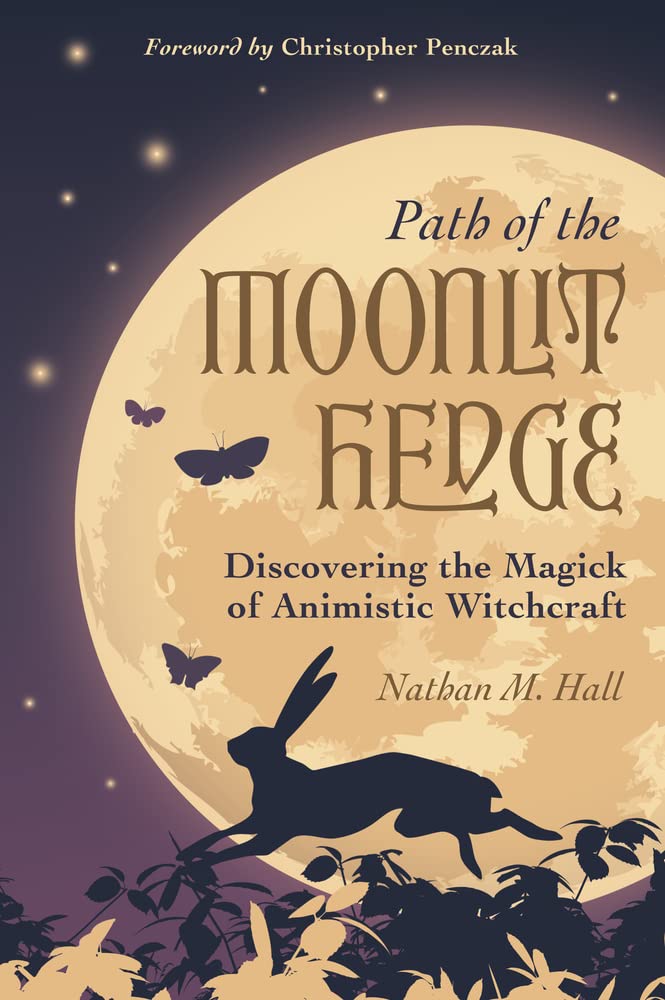
Path of the Moonlit Hedge by Nathan M. Hall
I particularly enjoyed Nathan’s thoughts on time — and how technology and refined methods of measuring are causing it to slip away from us more quickly than ever before. It’s a whole chapter, actually, which… thanks to the precise measurements on my iPhone, felt like it only took minutes to get through.
All in all, this is definitely a book I would recommend for anyone who is looking for some practical ways to connect with spirit — in its many forms — around them.
What is Animism?
There are a lot of definitions for animism. Nathan says when you try to put words to it, you’re cutting out some things that should be included. I guess that’s a common failure of language. Nonetheless, we’re going to try!
Animist views hold that everything is enspirited — meaning the universe itself (stars, planets, black holes), things on the earth (rocks, streams, trees, us), and even particles have a spirit. Literally everything — Material or immaterial. Nathan also offers another definition of “source code of the universe.”
I asked Nathan if animism was compatible with polytheism. From his perspective, it is! In fact, he says you could even be an animist and an atheist. The belief (or disbelief) in god(s) does not necessarily preclude that of things around you having spirits.
To get started with animist practices, try talking to your plants! This is something I’ve been doing ever since I started gardening years ago. Actually, at this point I pretty much talk to everything… trees, plants, squirrels, birds, dragonflies, bees, and whatever faeries might be hanging out in my backyard.
Nathan also suggests that you simply walk the land. Get to know it. Open up your psychic senses and observe what’s there around you. Honestly, a lot of this seems like being aware and spiritually present. As witches, shouldn’t this be a basic part of our practice?
Want to hear about future posts? Subscribe to get notifications delivered straight to your inbox.
Personal Resonance
As you get to know the spirits of things around you through animism, you might start to develop a personal resonance with certain herbs or crystals. Nathan calls this a spirit partnership and one practical application is that it can give you deeper insight into substitutions for magickal spells or recipes. As a simple example, Wormwood and Mugwort could be substituted for each other. Extending this line of thinking a bit, you could also look between “kingdoms” — Rosemary could substitute for a Citrine crystal, for example, if your personal resonance between the two feels similar. I had never really thought of substituting an herb for a crystal, so I found this all very interesting. It’s probably best to use this sparingly, however, always trying to keep the original intention of the recipe in mind.
Nathan has a lot of experience with this sort of thing because he loves to cook and he’s used to making substitutions on the fly. He compares it to music and jazz where you’re improvising. It made me think of a musical metaphor, too, but moreso along the lines of what instruments you choose for a specific sound quality. Definitely give this part of the interview a listen.
Healing, Rewilding, and the Soul
Nathan describes rewilding the soul as “touching that animist part of you.”
But before you get too far into the whole rewilding thing, you need to do some healing work! That’s why in his book, healing is one of the first things he talks about — and it’s packed with exercises to help you get started.
Some of Nathan’s exercises were inspired by Tsultrim Allione, who wrote Feeding Your Demons, a book that explains simple methods of shadow work where you start conversations with other parts of yourself, find out what they need, and begin the healing process by nourishing them.
Check out these parts of the interview to hear Nathan explain his interpretation of the Three Souls Model as well as his viewpoints on why healing is such a necessary part of basic practice.
Mushrooms
Once upon a time, Nathan found a small patch of mushrooms growing near his house. As all good animists do, he paid attention to them. Through observation and keeping an open mind, he felt like they were trying to communicate, so he formed a partnership with them by regularly watering the area where they were growing.
All of this eventually inspired a mushroom-based talisman, detailed instructions for which can be found in the book. Mushrooms are basically kings of decomposition and recycling in nature. It makes total sense that they could be used to recycle spiritual energy as well!
Where to find Nathan
Want to find out more about Nathan? I don’t blame you.
You can start by grabbing a copy of his book, Path of the Moonlit Hedge. Next, find him on social media:
- Facebook – @MoonlitHedge
- Instagram – @MoonlitHedge
Go sign up at his Substack — he sends out regular newsletters, so you can keep in touch, but it also gives you a way to help support him.
You can also find Nathan in person this year at the following festivals:
- TempleFest, Aug 3 – Sep 2, 2024 (Charlton, MA)
- Mystic South, Jul 26 – 28, 2024 (Atlanta, GA)
Music
When I ask him about using sound in his practice, he describes how he feels the different parts of the soul resonate with a different frequency. Look everybody, if you want me to understand something, please use musical metaphors like this — thank you!
Nathan has also started using a wind wand during certain rituals. This was a new instrument for me, but I absolutely want one now. It’s basically a stick with a rubber band stretched around it — you spin the stick and it makes this haunting, vibrating noise.
Definitely go watch this part of the interview.
Hey nerds, I’ve got a bonus surprise for you. Nathan inspired me to research the wind wand. I discovered that the sound effect for the Ornithopter in Dune was created by recording multiple wind wands. You know… those crazy dragonfly-looking ships?

Image Credit – GameRant.com
Yeah. Those. I had a pretty big geekout that day.
Conclusions
I definitely learned a lot by reading Nathan’s book, but I learned even more after speaking with him. Go make a cup of tea and watch the interview. You’ll enjoy it.
I think I have the next three months of episodes booked right now, which is pretty cool, but if you know someone that would make a great guest in the future, please contact me!
If you enjoy these articles and videos and would like to help show your support, please make sure you’re subscribed on YouTube, hit the like button, and leave a comment. And while you’re at it, check out my Patreon!
Alright guys, listen. I don’t have a lot of time because unfortunately, I have to go pack some clothes and spend the weekend at Disney World. Before I head off to the unmagick kingdom, I’d just like to point out the fact that there are Amazon affiliate links within this post. If you use one of those links to make a purchase, like to buy a book or something, Amazon will pay me a small commission. How many books do you think you’d have to buy before it would fund the cost of one meal at Disney World? Probably all of them. All of the books. That place is expensive, dude.


 Aerik Arkadian
Leave a comment