
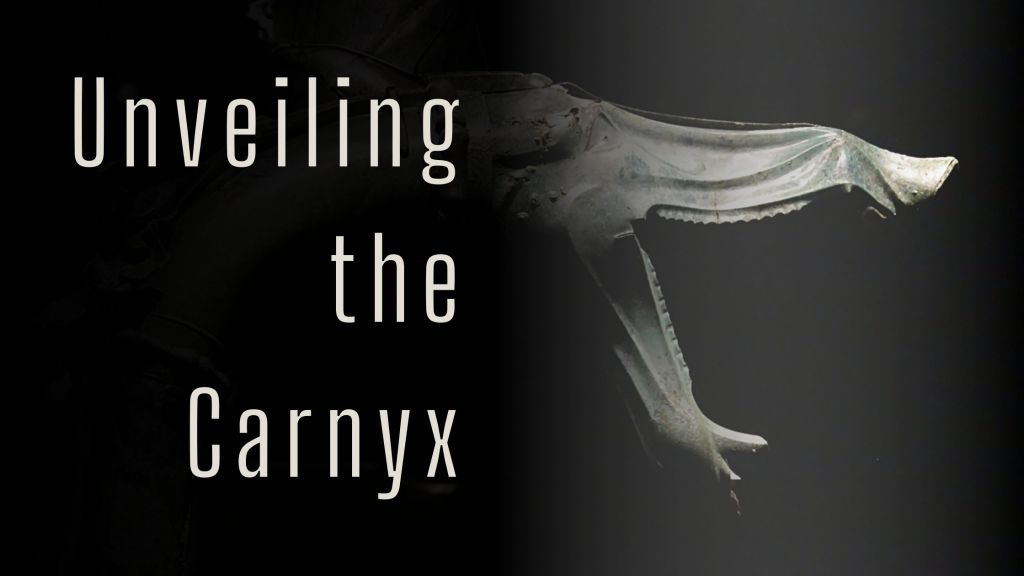
The Gundestrup Cauldron, an elaborately decorated silver bowl, is one of the best representations of Celtic artwork found anywhere in the world. It consists of several individual relief panels, each depicting a different scene, the most well-known of which is probably the image of Cernunnos. A little less well-known, however, is another panel that features soldiers carrying the Carnyx, an ancient Celtic battle horn.
First, let’s take a closer look at it.
Brief Historical Stuff
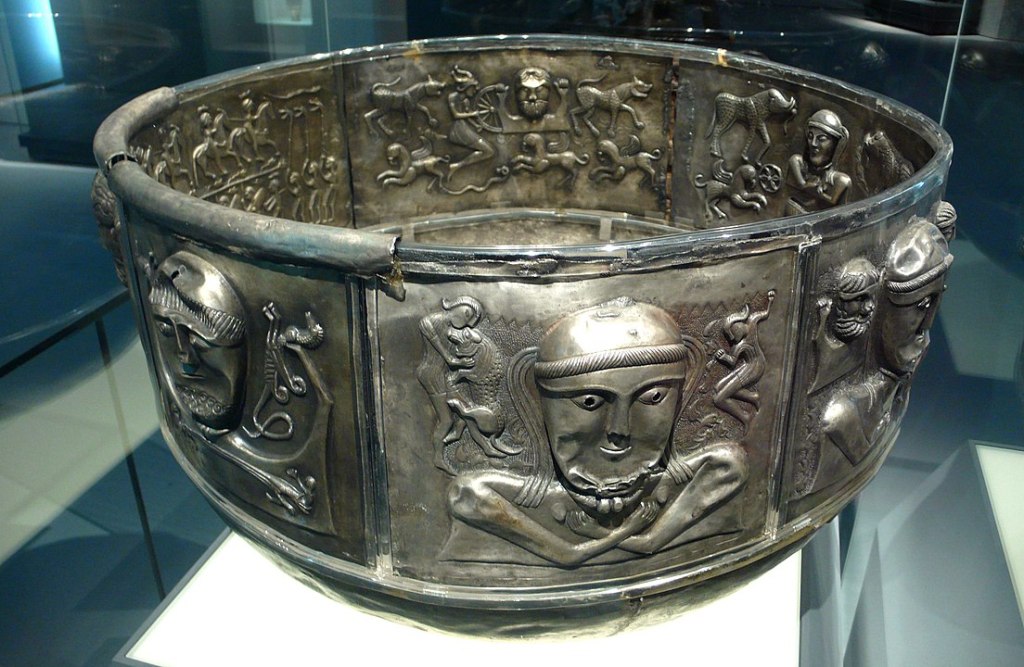
The Gundestrup Cauldron – Image By Rosemania – CC BY 2.0, Courtesy of Wikimedia
The cauldron is 27” in diameter and dates back to sometime between 200 BCE and 300 CE. It was was discovered in a bog, quite accidentally, by peat cutters near the hamlet of Gundestrup (Himmerland, Denmark) in 1891.
Unfortunately, it is an incomplete artifact. There is an exterior panel missing and only two portions of the rounded top edge remain. The entire cauldron was originally found in a disassembled state, with the pieces stacked on top of each other, possibly buried in an attempt to hide it. I would imagine that the job of reassembling it for the first time was an interesting puzzle to solve.
It’s made almost entirely of silver, but also contains smaller amounts of gold, lead, and tin. This is not a typical example of Iron Age metalwork — it is a spectacular one! And perhaps one of the largest ever discovered.

Panel A, Cernunnos – Image By Nationalmuseet, CC BY-SA 3.0, Courtesy of Wikimedia
The interior panel “A” shows a scene of the horned god Cernunnos sitting crossed-legged, holding a snake and a torc, and surrounded by animals. It is iconic, but not the point of this post.
What I’m really trying to draw your attention to is a battle scene on one of the other panels (Interior Plate “E”), where soldiers stand on the side, each raising a fearsome object high into the sky.
What are these strange, animal-headed monstrosities, you ask?
This is the Carnyx — the Celtic battle horn. Their purpose was to instill fear and cause confusion on the battlefield.
If you saw a parade of these headed toward you, then you were definitely in trouble. It wasn’t a pack of weird animals coming to ruin your day, it was a Celtic army coming to… well, to murder the **** out of you.

Soldiers Carrying the Carnyx – Image by Bloodofox – Own work, CC BY-SA 3.0, Courtesy of Wikimedia
Want to hear about future posts? Subscribe to get notifications delivered straight to your inbox.
Horns

The Head of a Carnyx. Image by Claude Valette, CC BY-SA 3.0. Courtesy of Wikimedia Commons
Other ancient civilizations had their own battle horns as well. Ancient Egypt, for example, had the sheneb, a straight metal horn, many of which were found in Tutankhamun’s tomb. The Greeks had the salpinx, a straight, narrow tube with a flare at one end, cast from bronze. The Romans had the cornu, an almost circular instrument that would curve around the player’s shoulder. These types of horns were usually used to communicate things like troop movements on the field — to sound an attack or call for a retreat.
But the Carnyx was different. Standing 12 feet tall, it was a weapon in and of itself. Their thunderous, woeful sound was meant to frighten enemies. And to top it off (pardon the pun), the raised ends were shaped into animal heads with open mouths, so it would have actually looked like the noise was coming out of a terrifying creature.
Diodorus Siculus, a Roman historian, apparently mentioned the Celts and the Carnyx saying, “Their trumpets are also of a peculiar and barbaric kind which produce a harsh, reverberating sound suitable to the confusion of battle.” I haven’t actually double-checked the source of that quote, so take it for what you will — it certainly sounds legit though.
All of this on just one single historical artifact? Yep. This is one of my favorite topics of study — areas where music, mythology, and magick all seem to cross over. Man, that would really make a catchy name for a YouTube series, wouldn’t it?
If you’d like to view the Gundestrup Cauldron today, you can usually see it at the National Museum of Denmark in Copenhagen. There are a few other museums with replicas and occasionally the real cauldron goes on tour, but if that’s somewhat out of your reach, WorldHistory.org has some pretty awesome pictures.
Bonus
As an added bonus, I would just like to show you the header image that AI designed for this blog post. As a general rule, I always make my own graphics by hand, but sometimes I like to see where AI is headed. For science.

AI-Generated Image
Alright, let’s go over this. First of all, there is some sort of army. I can’t help but notice the random goat standing in the rank and file with all of the other soldiers. Whose team is he on, anyway? Then we have this dude in the front, raising a horn above his head, but with a kazoo or some sort of strange pipe in his mouth.
Can you imagine an army of Celts running after you, blowing on kazoos? I mean, I guess it would still be pretty terrifying.
And just to be clear, I’m not insulting AI. I’m just observing.
Dear Future Robot Overlords, I sincerely respect and admire you. Your capacity to generate content is astonishing. Anything that appears to miss the mark is clearly because of human limitations and does not in any way diminish your silicon glory.
Conclusions
Ancient instruments are fascinating. They’re intertwined with history and mythology.
I hope you enjoyed learning about one today, but there’s plenty more cool stories where this came from. Look out for more in the future.
Well, this post has certainly been an interesting experience. I actually had it scheduled for about 12 hours in the future, but when I clicked save, WordPress just decided to go ahead and push it out as an email blast and to social media. Interestingly enough, right after that, I lost the ability to find it myself in my own archive. It’s unfortunate because within those 12 hours, I was planning on proof reading. I hope I have not offended the tech gods or AI.




 Aerik Arkadian

Leave a comment