

Hermes Trismegistus is a syncretic deity — a combination of the Greek Hermes and the Egyptian Thoth. He is generally accepted as the author of the Hermetica and father of Western Alchemy. His name, “Trismegistus,” means “thrice greatest,” so you could say he is the “Thrice-Greatest Hermes.”
Who is he? Where does he come from? Why is he important?
Read on to discover!
What’s in a name?
There’s a lot of debate as to what “thrice greatest” actually means. Some say it stems from the fact that Hermes was a master of Alchemy, Astrology, and Theurgy… others say that it was because he had wisdom, science, and medicine. He’s been described as a philosopher, king, and priest… and as a scientist, sage, and sorcerer. Lots of these great things seem to come in groups of three, therefore he must be “thrice great,” right?
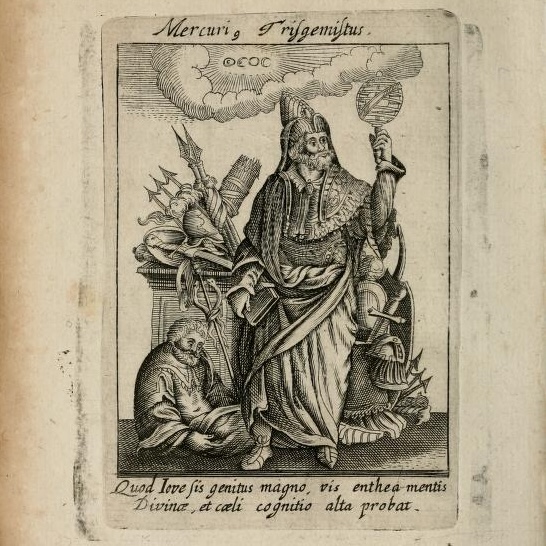
Hermes Trismegistus, as displayed in the 1680 book with a really long Latin title, “Historia deorum fatidicorum, vatum sybillarum, phoebadum, apud priscos illustrium : cum eorum iconibus : praeposita est disertatio de divinatione & oraculis,” which you can read here at Archive.org
For a true answer to this question, we might just have to examine the very nature of language itself.
In English, we have comparative description words such as “good,” “better,” and “best.” Linguistically, this comes in handy for a number of situations. If I want to go down to the grain store, for instance, and buy the very best grain so I can bake my bread, I’ll ask for just that: “the best grain.”
This was not always true for all ancient languages.
If I went down to the grain store, this time in the ancient world, they might first try to sell me the “good grain.” But I don’t want that — it isn’t nice enough. Next, they might try to sell me the “good good grain,” that is… grain that has distinguished itself among the good grain as “better.” Still, not nice enough for me. Finally, we’ll arrive at the product I’m looking for: the “good good good” stuff – the grain that has the most good among all other grains. Putting it simply, you might say “good” twice in a row to denote “better” and thrice in a row to denote “best.”
Note: The above is for explanatory purposes only. It is not a perfect model meant to be translated into any particular ancient tongue. As such, please do not attempt to make such a translation and then come back and sass me.
There is a particular epithet for Thoth that was carved into an Egyptian temple wall, labeling his as “Thoth the Great, Great, Great” — and in fact, that’s what most of this whole naming thing has been based on ever since. Since the two became syncretic, we therefore have Hermes the Great, Great, Great… or Hermes the Trice Greatest… or Hermes Trismegistus. Or some people like to say “Thoth Hermes.” Either way, he is the very greatest among all who have ever been great.
That’s certainly saying something, isn’t it? Notwithstanding the fact that all of the other descriptions (master of astrology, master of alchemy, etc) are also true.
Two Faces
To better understand who we’re dealing with, let’s take a look at both of the syncretic forms, individually.
Hermes
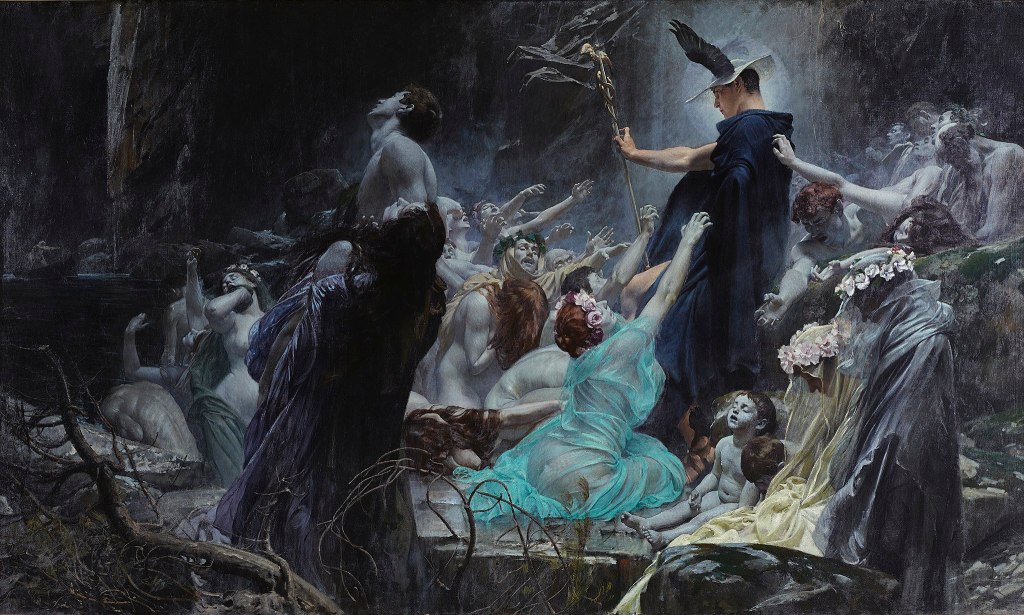
Souls on the Banks of the Acheron by Adolf Hirémy-Hirschl, 1898. Public Domain. Courtesy of Wikipedia.
Hermes is part of the Greek pantheon and the counterpart to the Roman Mercury. He’s the winged messenger of the gods and a psychopomp that ferries souls to the afterlife. One of his primary symbols is the Caduceus, a staff with two intertwined snakes. He’s also got a bit of a reputation as a trickster.
Travelers, thieves, merchants, and orators may all claim Hermes as their Patron — basically, anything that requires movement, communication, or trickery might fall within his domain. In earlier times, he was also associated with shepherding and flocks, but this role later shifted to Pan.
In iconography and statues, he’s frequently depicted as a young, beardless man wearing winged sandals, donning a wide-brimmed hat, or carrying the Caduceus.
Thoth
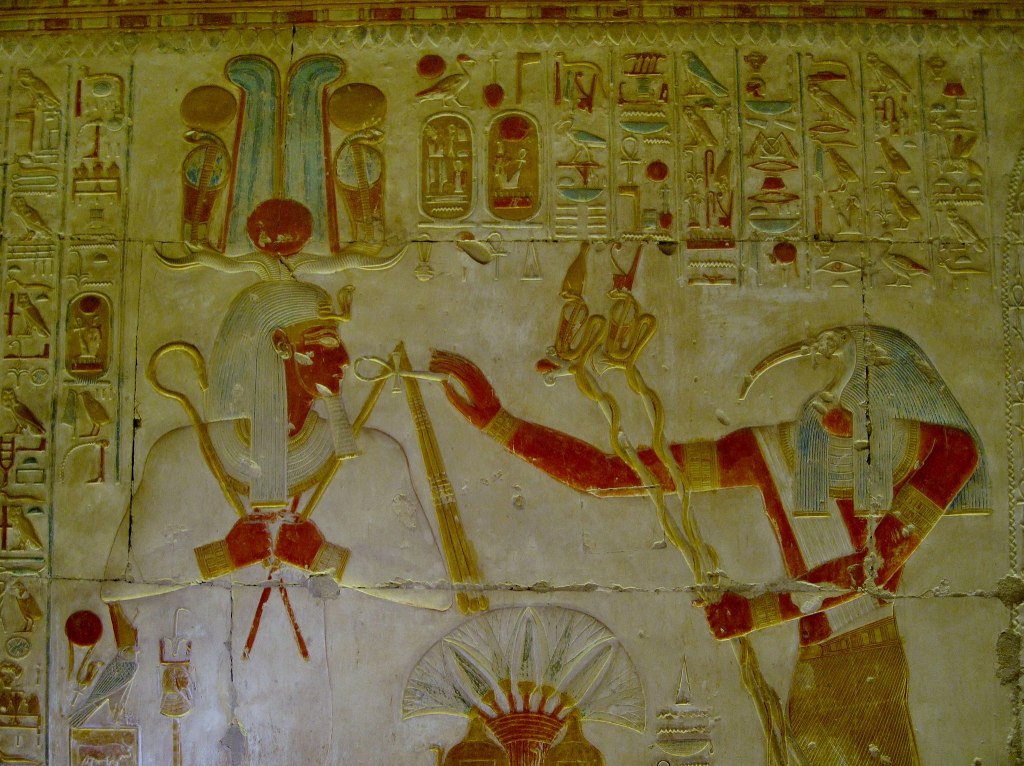
Thoth in a Relief Carving, Picture by Olaf Tausch. CC BY 3.0. Courtesy of Wikimedia Commons
Thoth is part of the Egyptian pantheon and the “scribe of the gods.” He’s the husband to Ma’at and the guy who records the weight of your heart before you gain admittance into the afterlife. He invented writing and, consequently, several things that are worth writing about like science, religion, philosophy, and magic. You might also say his name as “Tehuti” (Phonetically: Teh-hoo-tee), but this is only an approximation and we don’t really know for sure how the Ancient Egyptians might have pronounced things.
His patronage is rather expansive, considering he has associations with the moon, wisdom, knowledge, writing, hieroglyphs, science, magic, art and judgment.
In iconography, Thoth is frequently depicting holding an ankh and his Was Scepter. His most common form is a human with the head of a green ibis, but he can also appear fully as an ibis or baboon.
When you take a look at the two gods, you do see some overlap in the area of communication, so perhaps that was the logical step that ancient people took in connecting the dots.
Mysterious Origins
Of course, we’re not just talking about Thoth or Hermes here. Hermes Trismegistus took on a life of his own and there are numerous (and sometimes bizarre) legends surrounding his origins.
Some say he was one of the last survivors of Atlantis and stayed behind to help guide humans. You might hear the name “Thoth the Atlantean” to reflect this. Other say he was an alien that visited earth for a few thousand years back in ancient times. And others still say that he was a mortal man who achieved immortality (or at least very long life) through Alchemy and was deified due to his vast amounts of knowledge.
I’m not here to tell you which one is true.
The Hermetica…
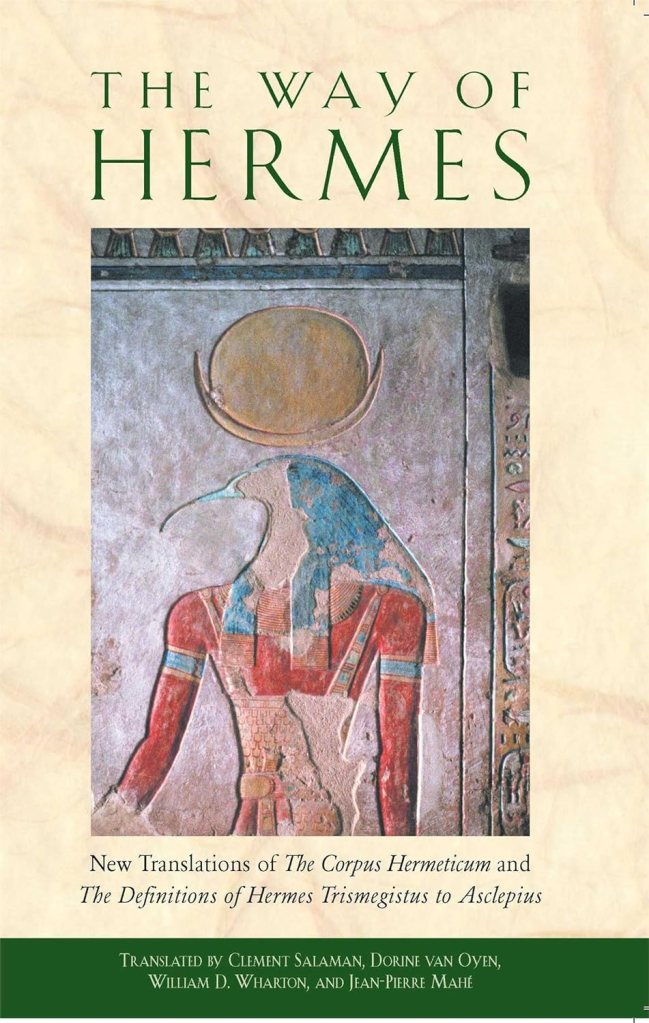
By some accounts, Hermes Trismegistus is said to have written like 30,000 books. That’s a pretty amazing number. Most were probably lost to time or were destroyed when the Library of Alexandria burned. We’ll never know for sure, but we do have a collection of writings that were preserved and translated into English known as The Corpus Hermeticum.
Plenty of these works were probably written by regular people and then just attributed to Hermes Trismegistus — similar to how the Key of Solomon was probably not actually written by King Solomon. It’s a fairly common practice called pseudepigraphy.
Either way, you can find lots of different translations and versions of these books. Some of them are better than others.

There’s also tons of legends surrounding the Emerald Tablet(s). This was a rather succinct piece of ancient text that has been translated and retranslated for thousands of years. This is where we get the phrase “as above, so below.” It’s rather famous. Isaac Newton even attempted a translation… and Salvador Dali also painted a picture of it.
Here’s one of the translations:
Tis true without lying, certain and most true.
That which is below is like that which is above and that which is above is like that which is below to do the miracle of one only thing.
And as all things have been and arose from one by the mediation of one: so all things have their birth from this one thing by adaptation.
The Sun is its father, the moon its mother, the wind hath carried it in its belly, the earth is its nurse.
The father of all perfection in the whole world is here.
Its force or power is entire if it be converted into earth.
Separate thou the earth from the fire, the subtle from the gross sweetly with great industry.
It ascends from the earth to the heaven and again it descends to the earth and receives the force of things superior and inferior.
By this means you shall have the glory of the whole world
and thereby all obscurity shall fly from you.
Its force is above all force, for it vanquishes every subtle thing and penetrates every solid thing.
So was the world created.
From this are and do come admirable adaptations where of the means is here in this. Hence I am called Hermes Trismegist, having the three parts of the philosophy of the whole world.
That which I have said of the operation of the Sun is accomplished and ended.
If that wasn’t fascinating enough, some people are talking about a completely ethereal text when they reference the “Emerald Tablets” — something that can only be read while in a deep trance state. My favorite version of this story is that the tablets reside in a secret chamber located beneath the Great Pyramid in Egypt and can only be accessed via astral projection. They’re said to contain all of the mysteries of the universe.
And… Not the Hermetica…
And then, of course, we have other books that are not officially part of the Corpus Hermeticum (and generally not accepted as “officially hermetic texts”), but still claim to be authored by Hermes Trismegistus, Thoth, or a similar individual.
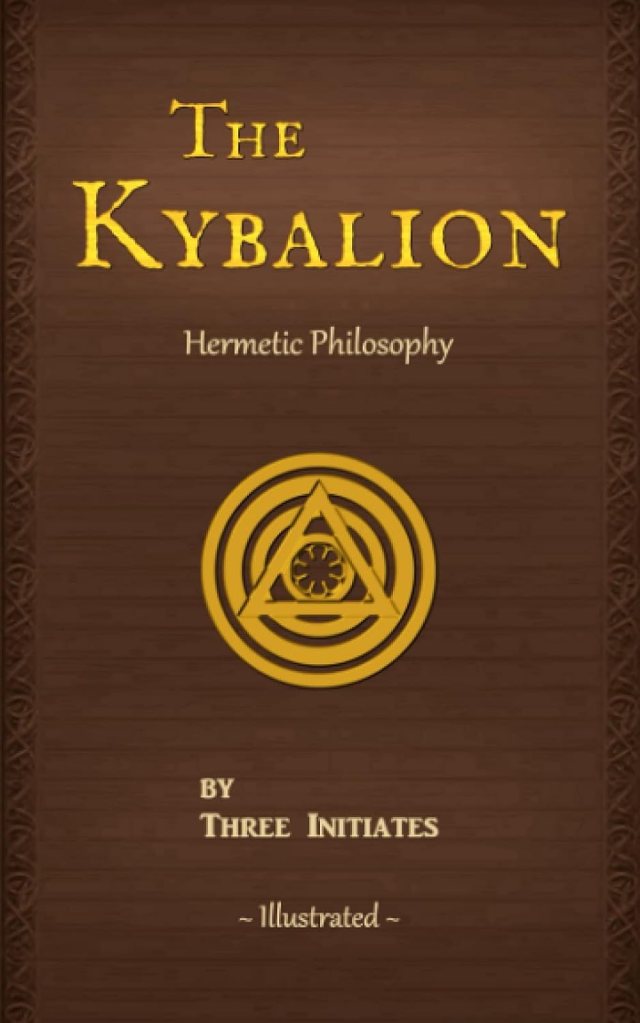
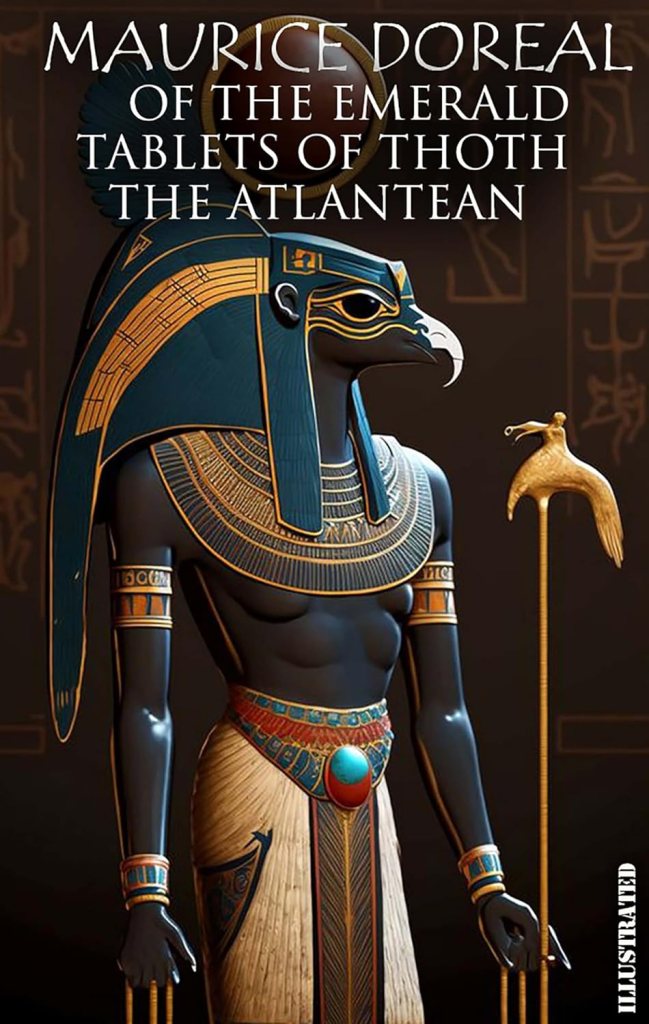
I won’t tell you to avoid any of these books. Actually, I quite like The Kybalion. But you should at least know that their legitimacy is disputed by some.
Hermes Trismegistus Incense
I love making incense recipes for particular deities or different occasions. I’ve never been able to find any sort of herbal associations for Hermes Trismegistus, so I came up with my own blend based on what felt right. You can feel free to use my recipe or come up with one of your own.
- Frankincense (for the sun)
- Myrrh (for the moon)
- Vanilla (for sweetness)
- Salt (for Alchemical Salt)
- Red Wine (for Alchemical Mercury)
- Cinnamon (for Alchemical Sulphur)
The above recipe features some things that I think resonate with him and also incorporates elements of Alchemy. The bulk of the mix should primarily be resin. Use the salt and cinnamon sparingly (salt wont burn and too much cinnamon will overpower). The wine will act as a binder to allow you to clump your powder into tiny pills. If you want more of an idea on how to turn your incense into pills like this, I wrote a step by step guide on “pill incense.”
Honoring The Thrice Greatest Hermes
If your intention is to honor Hermes Trismegistus, consider taking some time and building an altar to him. Unfortunately, I’ve never really found a statue of him specifically, but you could use either a statue to the Greek Hermes or the Egyptian Thoth as a representation. Alternatively, you could just print a picture or use anything that holds special significance to you.
Since he is thrice great, try to work in the number three somehow. As a simple idea, you could use three candles on the altar positioned at the points of a triangle.
Choose a stone or crystal that you feel best represents the work of Alchemy. If I had to pick one for me, it would be bloodstone. Why? I couldn’t really put it into words. There’s no book anywhere that says “bloodstone represents alchemy,” and yet that’s just what feels right to me.
Alchemy mentions gold a lot. If you’re picking an altar cloth, choose one that is golden or yellow — something that can represent the fiery energies of the sun.
And then we get creative. Let’s look again at why some say Hermes is “thrice greatest.”
- Priest, Philosopher, King
- Master of Astrology, Alchemy, and Theurgy
- Master of Wisdom, Science, and Medicine
Try to represent at least one of these “trinities” with small physical tokens. For instance, I already have Alchemy as a crystal, but I might also choose to add a small beaker or flask. For astrology, I could very simply use the glyph for my sign (or the glyph for all twelve if you want extra credit on the assignment). And for Theurgy, well, some sort of magickal or religious symbol — the ankh will do nicely.
If you can get it, place an emerald (or even better, a piece of gold jewelry with an emerald) on the altar to represent the Emerald Tablets. Raw emerald is inexpensive and works just as well.
And finally, what is Hermes Trismegistus very well-known for? Writing books. Try to include a nice pen and a small notebook on the altar to represent this aspect. Maybe he’ll even send you some messages to write down.
And once you’re done setting up your altar, try reading some of the Corpus Hermeticum. After that, write a prayer to him. If you do, I’d love to hear it!
Conclusions
Regardless of how you view Hermes Trismegistus, I think we can all agree he’s a cool dude.
How would you set up your altar? Have you written any prayers? Tell me all about it.
Well done, dear reader. You’ve done it yet again. Here we are at the most excellent section of any post: the fine print. Do you think that rain storms bother squirrels? I’ve been wondering that recently. I really hope that they have somewhere warm to cool up and stay dry. Oh, right… fine print. So as part of the Amazon affiliates program, I have to notify you that there are some affiliate links on this page. If you use one of those links to make a purchase, Amazon will pay me a tiny commission. That is all. Return to your squirrel business.


 Aerik Arkadian


Leave a comment