
Home » Magick » Basics of Magick » Color » Color Magick, Theory, and Correspondences – Part 1
Jump to Lesson:
- Color Magick, Theory, and Correspondences – Part 1 (current lesson)
- Color Magick, Theory, and Correspondences – Part 2
Today we’re going to go over the use of color in magick.
At some point in our magickal career, we’ve probably all consulted a color correspondence chart. We’ve asked questions like “what color candle do I use for this new job spell?” What I’m about to show you can pretty much be found in any basic beginner book on magick or anywhere else on the internet.
The difference here, however, is that after I tell you about all of the basic correspondences I can think of, I’m also going to tell you more about color than you probably ever wanted to know. Including science.
As there is so much to go over, this will be a multi-part conversation. It’ll have to be split into two posts.
Let’s get to it.
Basic Color Correspondences
Black
Banishing, grounding, uncrossing, scrying, things that are hidden, protection
White
All purposes, cleansing, purification, truth, balance, purity, unity
Purple
Spirituality, higher self, intuition, knowledge, connection to source or spirits
Indigo
Divination, psychic abilities, meditation
Blue
Communication, calm, peace, flow, patience, water magick
Green
Prosperity, money, abundance, healing, luck, growth, plants, self love, earth magick
Yellow
Happiness, joy, success, self-confidence, travel, learning, air magick
Orange
Expression, creativity, trade, legal matters, business, career growth
Red
Passion, creativity, will, vitality, fertility, conflict, strength, fire magick
Pink
Romance, love, friendship, harmony, compassion
Brown
Earth magick, physical goods, grounding, stability, practicality
Gray
Balance, neutrality, stability, middle ground
Silver
Moon magick, intuition, dreams, meditation, divine feminine
Gold
Solar magick, self, fortune, prosperity, health, divine masculine
Did I leave anything out? Hopefully not.
There’s not a lot of hard and fast rules for color correspondences like this. You’ll find a lot of these are pretty standard, but some of it is bent slightly in favor of my own practices — it’s hard to make a full color chart without at least some overlap into personal preference.
What you should really do is spend some time making your own. Think about all of the different keywords and decide which color they feel like, write it down, and then stick it in your own Book of Shadows. It’s pretty much something you only have to do once.
There are some pretty basic color associations that I left out of my chart, like red for anger, because I don’t usually do anger magick. If you wanted to do a candle spell to banish anger, however, you could use either black to represent banishing or blue to represent anger’s opposite, peace. As such I don’t find things like that necessary to record in my chart.
Want to hear about future posts? Subscribe to get notifications delivered straight to your inbox.
Elemental Colors
One of the first set of color correspondences we typically work with in a ritual setting is that of the Four Elements — Fire, Water, Air, and Earth. We might use colored candles in the quarters to represent this or visualize certain ritual actions in different colors.
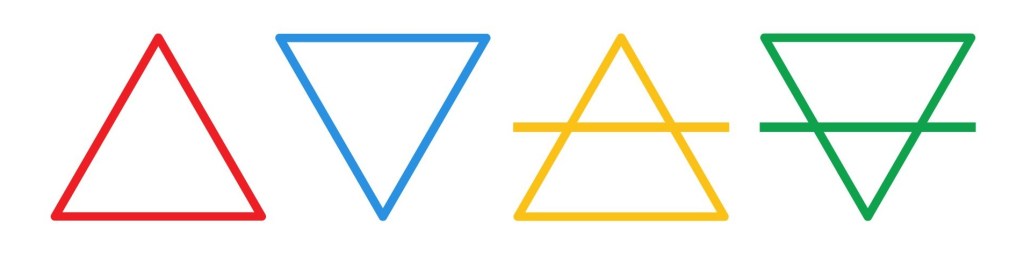
Color-Coded Alchemical Symbols for the Four Elements
The fun part is that not everybody agrees on what colors these should be. That’s fine. Just stick with one and work with it until you’ve developed the neural pathways to operate intuitively, then you can start experimenting with other lists. A common place to start is red for Fire, blue for Water, yellow for Air, and green for Earth… but if you’re already part of a tradition, it’s probably best to first learn whatever colors they assign.
The Golden Dawn, for instance, uses a combination of two colors at each quarter.
- Air – yellow with violet letters
- Water – blue with orange letters
- Earth – black with green letters
- Fire – red with green letters
For a slightly different approach, you could also take a look at the Tattva (sometimes spelled “Tattwa”) system, which has been used in India for thousands of years. It was probably first incorporated into Western Occultism by Franz Bardon in Initiation Into Hermetics.
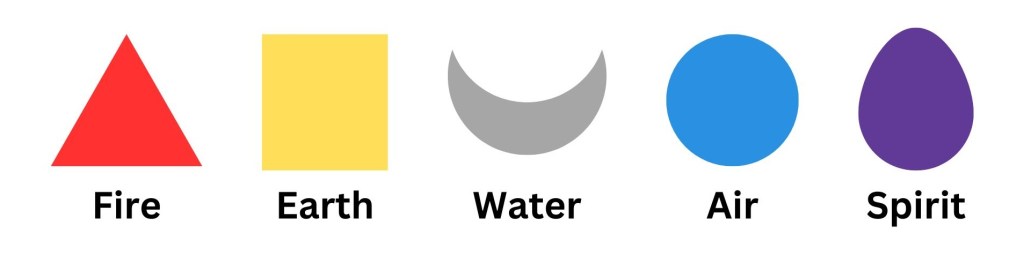
Tattva Correspondences
With the Tattvas, each Element has a shape and a color — a red triangle for Fire, yellow square for Earth, silver crescent for Water, blue circle for Air, and purple egg for Spirit.
Each one of these systems is a completely valid approach.
Basic Color Theory
When I was in 5th grade, I took an art class in school and we learned about this dude named Roy G. Biv that had invented color theory. Through some sort of divine providence, Roy’s initials just happened to be laid out in the same order as the visible light spectrum. It’s almost like he was fated to study color.
Okay. None of that is true. But I actually believed it for a few years. Perhaps my elementary school didn’t have the greatest teachers…

A Rainbow. Duh.
In truth, ROYGBIV is just an acronym for remembering the order of colors within the visible spectrum of light – Red, Orange, Yellow, Green, Blue, Indigo, and Violet. You can see this naturally occurring as a rainbow.
That’s a happy picture, right? Who doesn’t smile when they see a rainbow?
Are you in a good mood now? Good. Get ready for some science.
Warning: Science, Math, Numbers, and Formulas
Light is an electromagnetic wave. Visible light is only a tiny fraction of the spectrum and it is flanked on either side by invisible things like ultraviolet and infrared. We measure the visible portion in Nanometers, which is unimaginably small. If you’d like to try to imagine how big a nanometer is, just picture a millimeter and then go a million times smaller.

The Visible Spectrum of Light
Human eyes can generally interpret light somewhere between 380nm and 700nm.
What we’re actually measuring here is the wavelength. Through some other calculations, namely the formula Wavelength = Velocity / Frequency … (or spelled out with cool symbols as λ = v / f) … we can figure out the frequency of each color. Remember, the speed of light is always a constant 299,792,458 m/s. Frequency is measured in Hz, or “cycles per second” — which is basically just saying how many times a thing repeats within a set period of time.
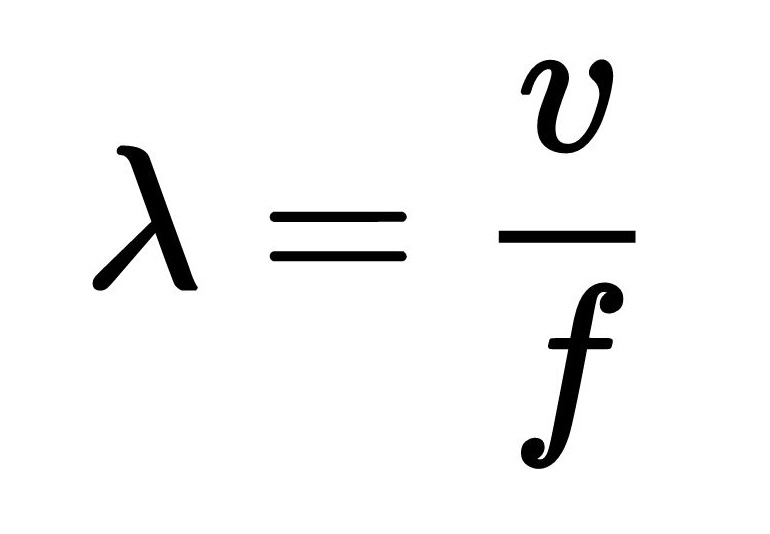
Wavelength Formula
Red, at around 700nm, has a frequency of about 430 terahertz (or 4.28 × 10^14 Hz).
Let’s do that math.

Calculating the Frequency of Red Light
Solve for F.
Violet, at around 400 nm, has a frequency of about 750 terahertz (7.5 x 10^14 Hz). Don’t worry, I won’t bore you with more calculations.
The overall point here is that longer wavelengths have lower frequencies and shorter wavelengths have higher frequencies. And now you can actually like… prove that with math and stuff. Lower frequencies feel heavier and more solid.
Keep all of that in mind for later. Right now, I’m going to take a break from all of this science and we’re going to go back to pretty colors.
If you take the visible spectrum of light and curve it into a circle, you create the color wheel. Plenty of artistic concepts — even things like graphic design or web design — revolve at least partially around how each color is situated on the wheel. Of course, if you’re actually designing something, you’ll probably use a more detailed version, but for our purposes today, this simple one on the right will suffice.
Colors that are directly across from one another are called Complementary Colors — this means they create lots of contrast when used together. Purple and Yellow, for instance, are complementary.
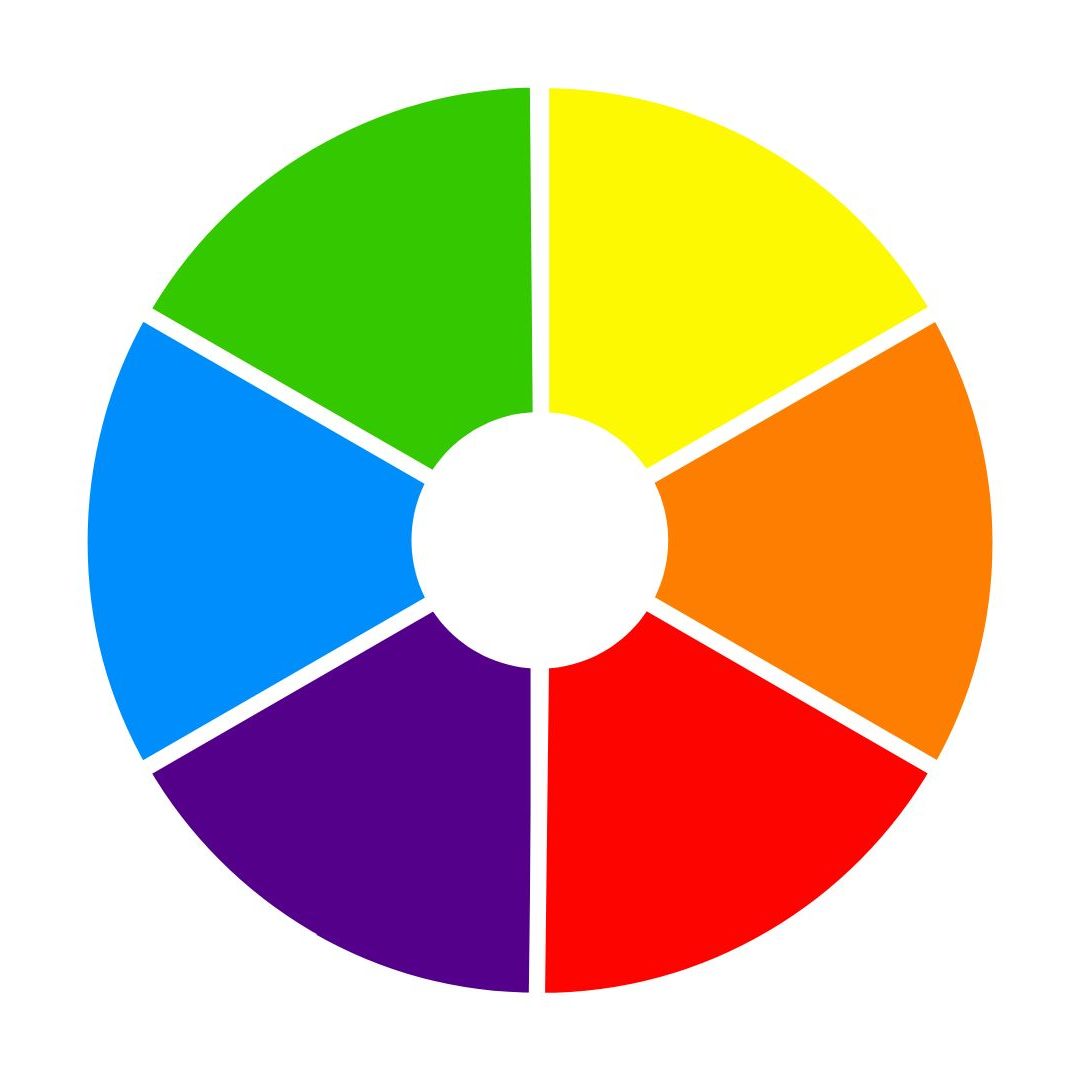
The Color Wheel
On our simple color wheel, let’s say that Red, Blue, and Yellow are our three primary colors. If you mix any two of these, you create a secondary color. The wheel also shows these relationships — for instance, green sits between yellow and blue because it is a mixture of the two.
I’m sure you probably knew most, or all, of that already… but it’s still worth pointing out because we’re going to start applying some of that in our next correspondence set.
Planetary Colors
One of my favorite uses for color is as a representation of planetary energies. A simplified and modern interpretation of this pairs each planet with a primary color, then assigns a complementary color based on the color wheel.
| Planet | Primary Color | Complementary Color |
| Saturn | Black | White |
| Jupiter | Blue | Orange |
| Mars | Red | Green |
| Sun | Yellow | Purple |
| Venus | Green | Red |
| Mercury | Orange | Blue |
| Moon | Purple | Yellow |
If you were to draw all of this out, it might look something like the following.
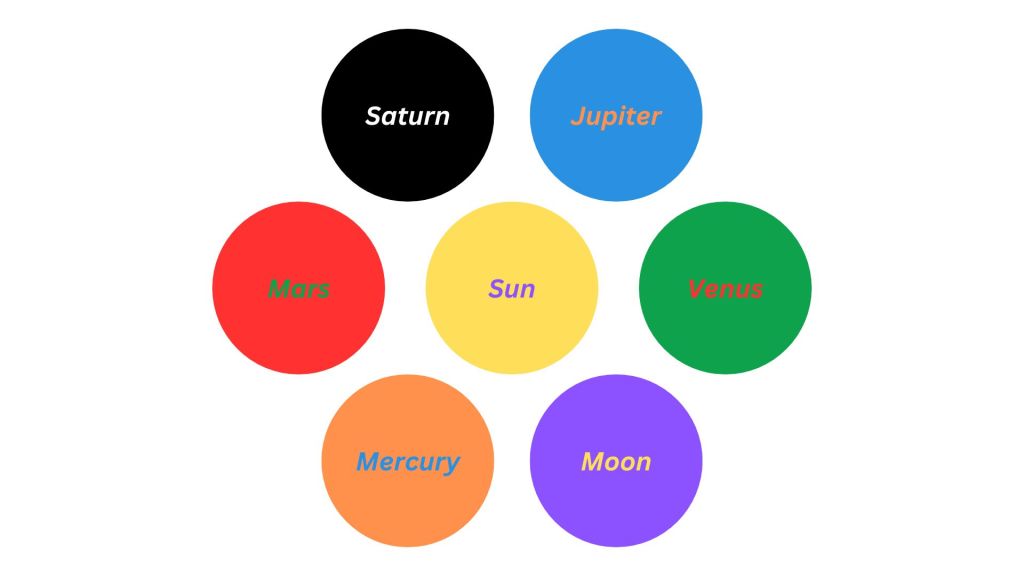
Modern Planetary Colors
These combinations totally work, but just like assigning color to the Elements, there are multiple approaches for exactly how to do this.One of the most tried and true methods involves using the Qabalistic correspondences for planetary colors, but that’s its own separate conversation. Actually, it belongs to its own section.
And with that, we end Part 1. Because there’s a lot more to say.
Conclusions
What else is there to say about color? Well, aside from the Qabalistic correspondences, we’ve got to talk about the chakras, seasonal colors, history, more color theory, and applications for how to use this in a ritual setting! And between now and when I write the next part, maybe I’ll think of some other topics as well. If I’ve neglected anything, please feel free to let me know.
Until then, let me know your favorite way to use color with your magick. Is it a candle spell? Is it ritual attire? Is it an altar cloth? Tell me all about it.
You know something? I have a lot of fun feeding my squirrel friends outside. I usually give them crackers, but I got this big bag of peanuts the other day, so I decided to share some with them. What I failed to realize, however, was that either my fingers look like peanuts or that squirrels just have really bad aim when they lunge for food. Anyway, one of them accidentally bit me. It’s okay though, I think we both learned a valuable lesson. The squirrel, at least, learned that my finger is not a peanut. I think. Actually, I don’t know. But I got the whole thing on video. Anyway, what are you doing down here?




 Aerik Arkadian
Leave a comment