
Home » Magick » Basics of Magick » Color » Color Magick, Theory, and Correspondences – Part 2
Jump to Lesson:
- Color Magick, Theory, and Correspondences – Part 1
- Color Magick, Theory, and Correspondences – Part 2 (current lesson)
Welcome back to another installment on Color Magick. In the first post, I promised to give you more on color than you ever wanted to know, so naturally that had to be split up into multiple parts. We first talked about basic color correspondences, theory, elemental, and planetary assignments. We also touched on the topics of science and math.
Today, we’ll start out by looking into history.
History of Color
The first known theory of color was probably developed by Aristotle in the 4th century BCE. He suggested that all colors stemmed from a mixture of black and white. But we’ve been using color in society since way before his time.
Somewhere close to 40,000 years ago, humans started producing the first pigments. By today’s standards, it was nothing fancy — probably a simple palette of red, yellow, brown, black, and white. Some ancient civilizations eventually developed ways to make more vibrant colors.
The first synthetic pigment was actually made in Ancient Egypt using a combination of silica, lime, copper, and an alkali. The scientific name is “calcium copper silicate,” but the Romans came to know it as “caeruleum.” Today it’s commonly called “Egyptian Blue.”
Just imagine, for one moment, that all you had ever seen your entire life was people wearing drab red clothes… and then all of a sudden, these dudes show up wearing some vibrant blue threads. You’d be like, “Whoa, these dudes are probably important or something!”
Color has also denoted rank, wealth, and privilege. In the Bronze Age, purple was the color of royalty and nobility. Purple dye was exceedingly difficult and expensive to produce, so its possession would have been restricted to the wealthy. Side note: “Tyrian purple” was made from the mucus of sea snails — gross. It would take up far too much time to list every civilization’s views on color, but suffice it to say that it has almost always been an integral part of religion, government, culture, and more.
Aristotle’s views on color theory held up for about 2000 years until someone proved him wrong.
Enter: Sir Isaac Newton, an alchemist and chemist, who in the 1660s successfully demonstrated that white light was composed of seven other colors. Alchemy had taught Newton that things could be broken down into their core components, so he used prisms to separate white light into red, orange, yellow, green, blue, indigo, and violet.
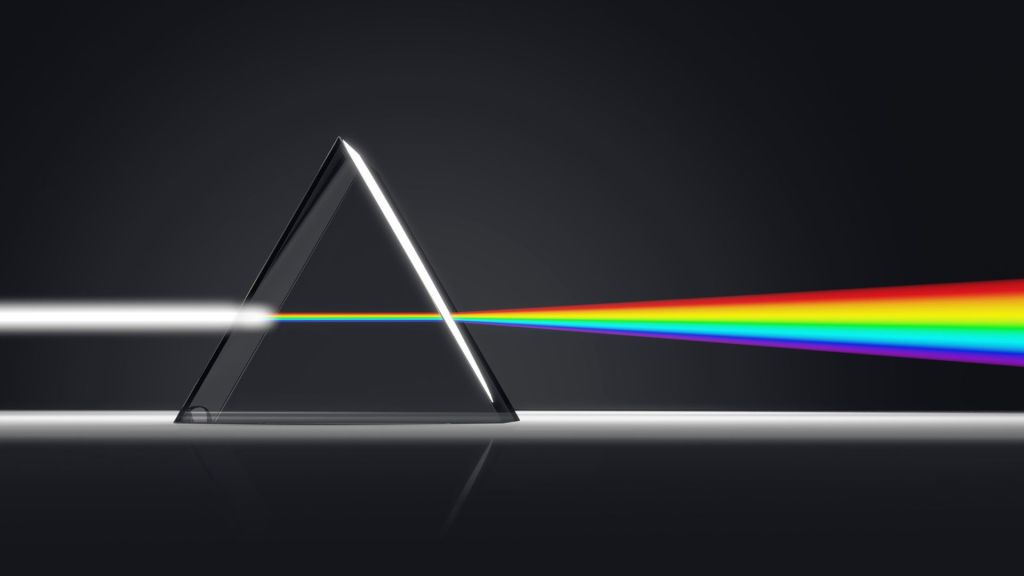
Not quite a Pink Floyd album cover, is it?
Those colors sound familiar, right? On top of being the rainbow, that whole ROYGBIV acronym is something we discussed in Part 1.
And that’s the basis for color theory as we know it today. I think you know most of the rest of the story.
Evolving to See Color
But actually, maybe we should go back even farther. Way before Isaac Newton. Before Aristotle. In fact, before humans existed at all.
It’s been theorized that some of our earliest mammalian ancestors (I’m talking like 90 million years ago) were nocturnal creatures that saw the world in two colors — red and ultraviolet. Seeing in the UV spectrum would have been cool for night vision, but wouldn’t have been terribly helpful with daytime activities.
So eventually, and maybe over the course of 60 million years, we dropped the ultraviolet receptors and replaced them with the wider range of what we see today. It was actually an important adaptation.
Why? Because seeing green let us see the trees. And more importantly… we could distinguish the colors of fruit from the color of the tree line.
Want to hear about future posts? Subscribe to get notifications delivered straight to your inbox.
Chakra Colors
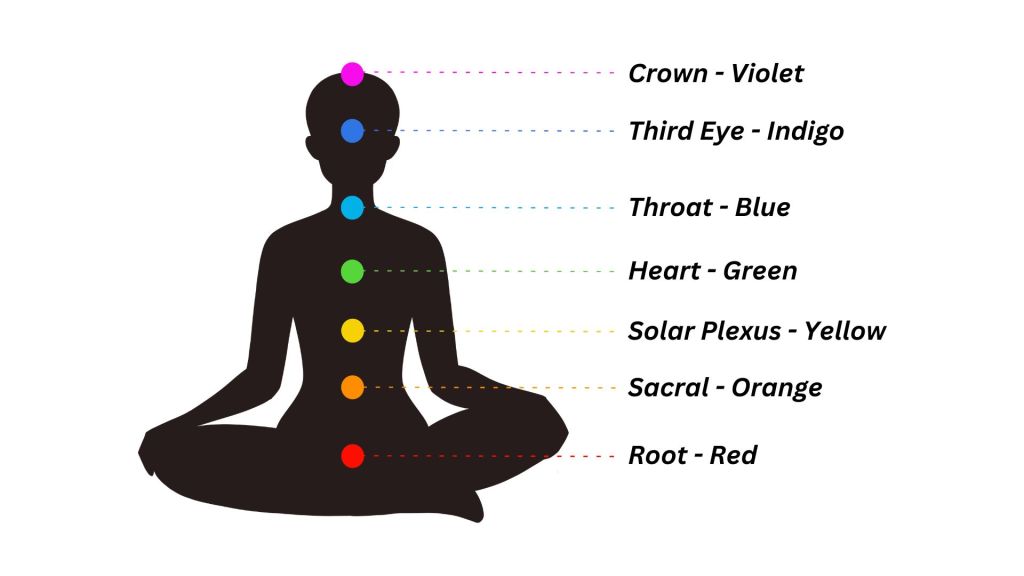
Remember how red has the longest wavelength of light in the visible spectrum? And how longer wavelengths have lower frequencies? And how low frequencies feel heavier? It’s only natural then, that the system of the Chakras has color associations that reflect this. The lowest Chakra is red. We might say it’s the heaviest, or our base… or root chakra. The energy is refined as it rises up the kundalini and, as such, the colors of our energy centers change, following the progression of ROYGBIV.
People love to say stuff like “the crown chakra has a higher vibration.” Well, this is literally why you can say that from a more scientific standpoint. Frequency is a measure of vibration. Violet light is the highest frequency.
Seasonal Colors
Perhaps one of the more natural uses of color is how they change seasonally. This occurs in nature around us as we progress through the wheel of the year.
Even in the mundane world, we have seasonal colors. Red and green are Christmas. Black and orange are Halloween. Pastels are for Easter. Don’t wear white after Labor Day… and all that jazz.
But from a more magickal approach, we have specific color associations with each of the eight sabbats. Here’s a chat to show you what I mean…
| Sabbat | Colors |
| Samhain | Dark Red, Orange, Black |
| Winter Solstice | Dark Red, Dark Green, Silver |
| Imbolc | White, Pink, Silver |
| Spring Equinox | Pastel Pink, Yellow, Lavender |
| Beltane | Bright Red, Green, Yellow |
| Summer Solstice | Yellow, Red, Green |
| Lughnasadh | Light Brown, Orange, Gold |
| Autumn Equinox | Gold, Dark Red, Dark Brown |
That’s not an “official” list. Actually, very few of our sabbats have an official set of colors — white for Imbolc comes to mind here because of its associations with milk, Candlemas, and Brigid’s Day — but the rest of them are pretty arbitrary and can vary depending on who you’re talking too. Most of it is based on seasonal colors anyway — that is, colors we might expect to find within nature during certain times of the year, including fallen leaves, snow, blooming flowers, and sunny skies.
As such, I generally prefer to think of things seasonally when making ritual color theme choices. I don’t really ever think “what are the colors of Beltane?” Instead, I think “what feels like a summer color palette?”
My high priestess also used to use a combination of two altar cloths at most rituals — one as the main tablecloth with a color that represented the earth and the other folded as a runner with a color that represented the sun. During the springtime, for instance, you might have a vibrant green cloth with a yellow runner. During the fall, you might have a brown cloth and an orange runner.
Why do we do all of this? It isn’t just for fun decorations. The turning of the wheel reflects cycles of change that occur both in the macrocosm of nature and the microcosm of our individual psyches. Keeping appropriate colors around us during ritual is one of the simplest ways to help represent that and keep us in sync with the rest of the earth.
Qabalistic Colors
The Qabalistic Tree of Life is basically one gigantic correspondence chart. Okay, I mean, it’s way more than that — and if you want to learn more right now you can go listen to Jack Chanek or Deb Lipp talk about it with me. Alternatively, you can check out some of these books.
There’s ten spheres and there are multiple colors associated with each. We’re going to look at colors from the Queen’s Scale, which is the most frequently used, but there are more if you really want to go deeper — there’s a color scale associated with each of the Qabalistic worlds.
Queen’s Scale of Color
- Keter: White Brilliance
- Chokmah: Grey
- Binah: Black
- Chesed: Blue
- Gevurah: Scarlet Red
- Tiferet: Yellow (Gold)
- Netzach: Emerald
- Hod: Orange
- Yesod: Violet
- Malkuth: Citrine, Olive, Russet, and Black
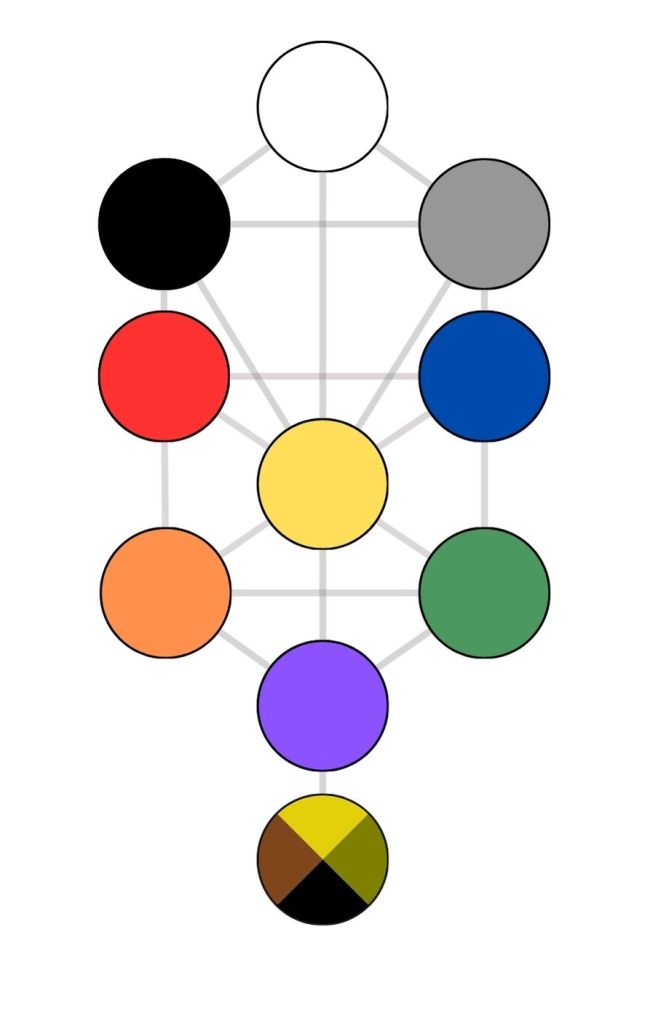
This goes pretty deep. Like way deeper than you’ll ever need. I usually reference Aleister Crowley’s 777 whenever I need to pull a Qabalistic color value… because that entire book is just one giant correspondence table.
P. S. – This is also where the planetary colors come from that I gave you in Part 1.
Ritual Attire
Alright, that’s enough complicated stuff. Let’s talk about something simple for a moment.
What are you going to wear to ritual tonight? Yeah, I know that your robes are black because black goes with everything, but maybe you want to go a little deeper than that.
Different traditions might use colored clothing to represent certain aspects of rituals. Heck, even the catholic church changes up their attire seasonally.
So while your black robes are great, you might want a set of orange robes if you’re doing a ritual for communication. Mercury, after all, governs communication… and is associated with the sphere of Hod, which you can see has the color set as orange in the Qabalah chart above.
Franz Bardon actually talks about this type of thing quite a bit in his second book, The Practice of Magical Evocation. In one chapter, he describes what robes to wear based on what type of spirit you’re trying to conjure up.
A wealthy magician may choose, for his robes, colours analogous to the individual spheres of the planets he works with. Thus he will take for:
      beings of Saturn - dark-violet
      beings of Jupiter - blue
      beings of Mars - purple
      beings of the Sun - yellow, gold or white
      beings of Venus - green
      beings of Mercury - opalescent, orange
      beings of the Moon- silver or white
Of course, only the prosperous magician will be able to afford such expenditure. A magician not so prosperous will get satisfactory results with just one robe in a light-violet colour. His cap or magus-band should be of the same colour.
-The Practice of Magical Evocation, Franz Bardon
Bardon kind of uses his only color scale sometimes, but it’s still pretty cool. According to him, it’s not black that goes with everything… it’s light-violet. I don’t know about you, but I’m pretty convinced I’d rock a violet robe coupled with a violet “magus-band” (which is basically an embroidered silk belt tied around the forehead). I’d feel like a magickal ninja.
More Color Theory
As our last part of color theory, let’s look at took models of color synthesis.

The first model, RYB (and also CMYK) is for Subtractive Color Synthesis. This is the typical theory we’re taught in grade school when mixing paints, ie – “yellow and blue make green.” Adding colors together in this fashion actually causes more and more frequencies of light to be blocked, until we ultimately arrive at black. This is also the type of color profile used when printing.
The second model, RGB, is for Additive Color Synthesis. This is the theory for mixing colored light. You might not think we mix a lot of light in our daily lives, but you’re actually looking at an example right now as you read this. If you enlarge the pixels in your display screen, you’d see they’re each made up of three individual parts — a red light, a green light, and a blue light. By adjusting the brightness of these three lights, the screen is able to display the full spectrum of color. When all three lights are at full brightness, it makes white. When all three lights at off, it makes black. And if you need to see this in action, just look at the difference in light that is emitted when viewing a fully black image vs a fully white image.
What does this have to do with magick? Well, possibly nothing. But also… maybe a lot, depending on your visualization abilities.
I tend to work with the Additive model in my head while performing ritual. That might sound weird at first, but here’s a simple example. Any given circle usually contains at least one set of color correspondences, even if all we’re doing is calling the quarters. Every quarter call is like a colored light turning on. Once all the colored lights are on, they combine to create the white light of source or deity. If you can successfully maintain that visualization for the entire ritual, you might just find it enhances whatever else you’re doing.
Shifting to meditation, there’s an almost unlimited amount of exercises you could perform. Visualize your chakras glowing and combining. Go on a journey through the spheres on the Tree of Life. Combine color visualization with the intonation of words of power. Get creative with it and see what works for you.
Applications
Applying color to your magick is one of those things that’s only limited by your imagination. Nonetheless, I’m going to give you some examples to help start your endeavors.
Candle Magick: The color candle you choose for a simple candle spell could be reflective of elemental, planetary, or even Qabalistic powers.
Talismans: You can use colored paper or colored clay as a base for your talismans, then paint or markers to draw symbols in contrasting colors.
Altar Cloths: A well-chosen altar cloth can set the proper tone for a seasonal ritual.
Attire: We’ve already decided that light-violet goes with everything, right?
Visualization: Don’t just see the color in front of you physically. See it in your mind. When you perform a ritual action, I hope there’s some color attached to it.
Further Reading
If you’d like to learn more about this topic, or at least how you can further apply these types of color-related ideas to magickal purposes, perhaps you might find one of these books helpful.

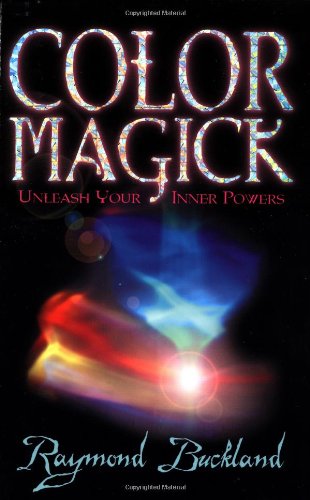
Disclaimer: They look interesting, but I haven’t read either of them.
Conclusion
That’s all for now on color. I can’t think of any other major topics at the moment, but if I do, I’ll be sure to write another update to this series. And if you think of something that I let out, please be sure to let me know in the comments.
Aside from that, tell me your favorite way to use color correspondences!
It just wouldn’t be a complete post without a disclaimer, would it? Listen, yesterday a squirrel followed me to the front door, so I went to grab a peanut for her. I wasn’t paying attention to the fact that Loki, our cat, was quickly deciding squirrels are not his friend. He dashed out the door and chased after her… and of course I had to run and collect him so that he wouldn’t harm any of our other furry friends. Do you think I should put up a disclaimer sign that says “beware of cats” so that the rest of the squirrels know? Anyway, there are a couple Amazon links in this post. If you use one of those links to make a purchase, Amazon will pay me a tiny commission.



 Aerik Arkadian
Leave a comment