

Home » Music » Songs » Unwinding the Witches’ Reel: History, Lyrics, and Meaning
This is the story of how bad weather turned into a series of witch trials.
In the late 16th century, King James VI waited in Scotland for his new bride to sail from Denmark, but she was significantly delayed by stormy seas. Who was responsible for such an inconvenience? Well, witches, of course. Or at least that was eventually the claim.
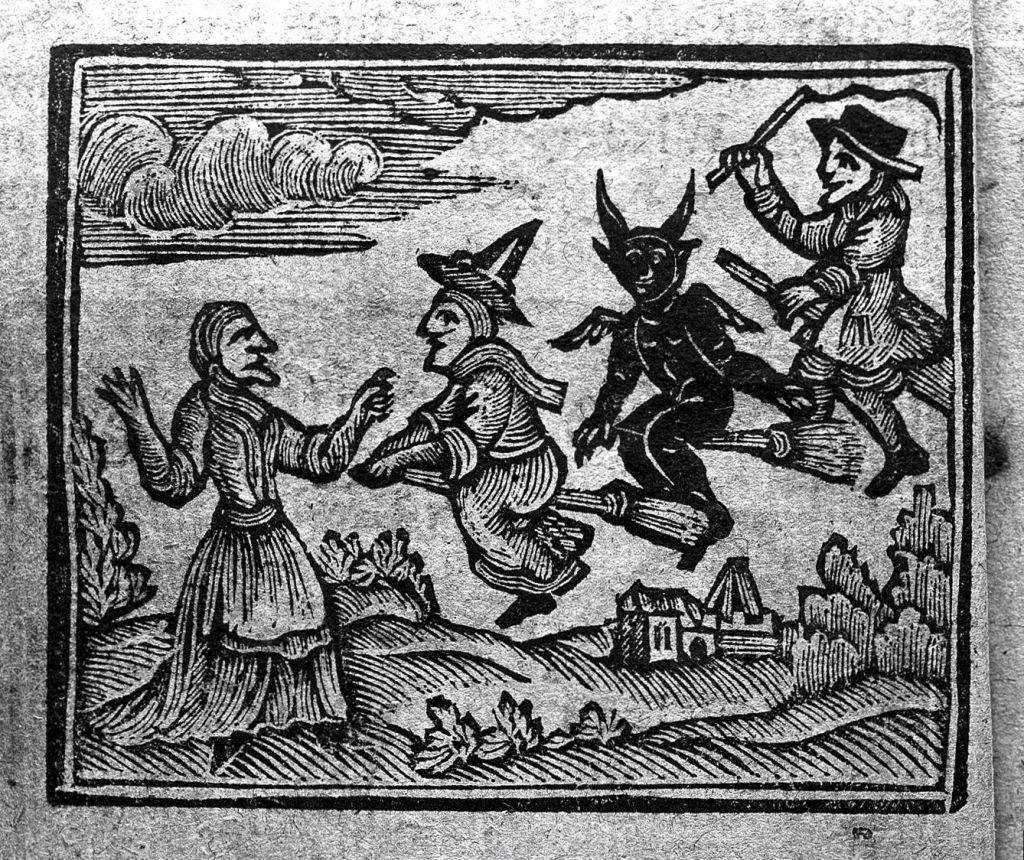
Woodcut depicting witches flying on broomsticks from The History of Witches and Wizards (1720). Public Domain. Courtesy of Wellcome Collection.
What followed was the first major witchcraft persecution in Scotland. And from all of this mess, we’ve gained a tune. Supposedly, lyrics from a song called “The Witches’ Reel” actually come directly from transcripts of trials held in the 16th century. Is that really true? We’ll talk more about all the history and stuff later, but first… let’s look at the song itself.
The Witches’ Reel (or “Gelie Duncan’s Song”)
The Original Lyrics
Cummer gae ye before, cummer gae ye,
Gin ye winna gae before, cummer let me,
Ring-a-ring-a-widdershins
Linkin lithely widdershins,
Cummers carlin cron and queyn
Roun gae we!Cummer gae ye before, cummer gae ye,
Gin ye winna gae before, cummer let me,
Ring-a-ring-a-widdershins
Loupin’ lightly widdershins,
Kilted coats and fleein’ hair
Three times three!Cummer gae ye before, cummer gae ye,
Gin ye winna gae before, cummer let me,
Ring-a-ring-a-widdershins
Whirlin’ skirlin’ widdershins,
De’il tak the hindmost
Wha’er she be!
The Modern Lyrics
Cummer, go ye before, cummer, go ye
If ye willna go before, cummer, let me
Ring-a-ring-a-widdershins
Linkin’, lithely widdershins
Cummer, carlin, crone and queen
Roun’ go weCummer, go ye before, cummer, go ye
If ye willna go before, cummer, let me
Ring-a-ring-a-widdershins
Loupin, lightly widdershins
Kilted coats and fleein’ hair
Three times threeCummer, go ye before, cummer, go ye
If ye willna go before, cummer, let me
Ring-a-ring-a-widdershins
Whirlin’, skirlin’ widdershins
De’il tak’ the hindmost
Wha’er she be
Translation
The original lyrics are in Scots. Some of the words are a little hard to identify or make sense of. The modernized version of the lyrics still contains some of those references.

Online translation tools might even make a few mistakes as well, like translating cummer to “come.” In actuality, cummer meant “woman.” Carlin, crone, and queyn (or perhaps cwene) also reference a woman or girl, but in this specific context would more accurately have been slang terms for a witch. That leaves us a with a few choice words that still require identification.
- ring-a-widdershins = go counter-clockwise in a circle
- linkin’ lithely = join arm in arm
- loupin’ = jumping
- skirlin’ = screaming or howling
- de’il = the devil
I lifted this translation of the lyrics from the internet. It can be credited to user tdwarms on LyricsTranslate.com.
Woman, go before, woman go on,
If you won’t go before, woman, let me
Ring-a-ring-a-counter-clockwise
Linking hands nimbly counter-clockwise
Lady’s old lady crown and queen
Around we go!Woman, go before, woman go on,
If you won’t go before, woman, let me
Ring-a-ring-a-counter-clockwise
Dashing lightly counter-clockwise
Tucked-in coats and loose hair
Three times three!Woman, go before, woman go on,
If you won’t go before, woman, let me
Ring-a-ring-a-counter-clockwise
Whirling, shouting counter-clockwise
Devil take the hindmost
Wherever she be!
I agree with most of the above, except the choice of “crown.”
Is it a perfect translation? No. But it should give you a general idea what is being sung about: women linking arms and dancing in a circle. And that’s pretty much where the name comes from. The Witches’ Reel.
Want to hear about future posts? Subscribe to get notifications delivered straight to your inbox.
Reel?
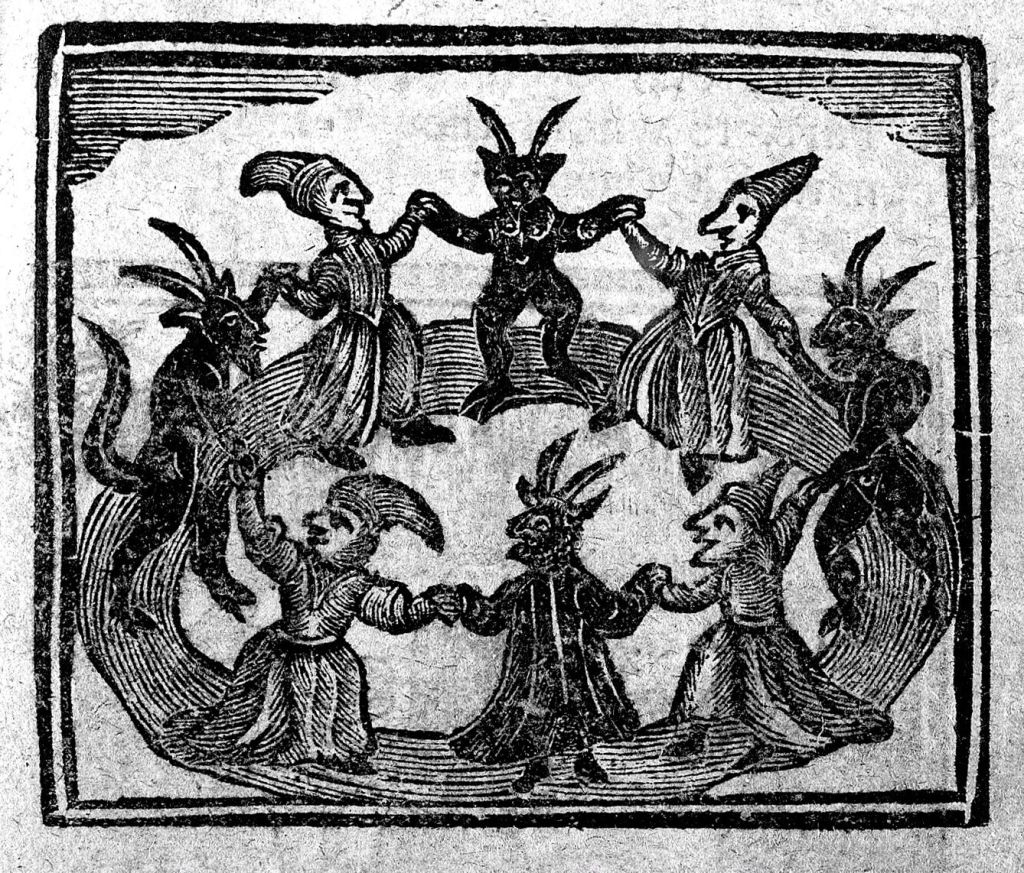
Woodcut, depicting witches dancing in a circle with demonic figures, from The History of Witches and Wizards (1720). Public Domain. Courtesy of Wellcome Collection.
A reel is a traditional dance where people move about in a circular fashion. The difference, here, is that the “witches’ reel” discusses dancing in a counterclockwise direction, which was generally seen as bad luck. In fact, any kind of counterclockwise movement, such as going around a building, might have been met by superstitious eyes. For that reason, most reels were probably danced clockwise.
This means that The Witches’ Reel, which instructs its participants to move widdershins, is particularly taboo. Oh. Em. Gee. Careful which way you walk, y’all. You don’t want to inadvertently trigger a witch hunt.
Real?
Pardon the upcoming play on words, but as I mentioned in the introductory paragraphs, there are claims floating about on the internet that the lyrics to our song actually go back to transcripts from witch trials. A very legitimate question must then be asked: “is this reel actually real?” There’s plenty of misinformation out there, especially on the topic of witch trials. And there’s also plenty of legends that were invented to give songs and chants more credibility.
In this particular case, my research shows that it is true. At least, part of it. The opening couplet (the first two lines) is taken from transcripts of actual witch trials in Scotland. One version of events, which was basically a 1590s press release titled “Newes from Scotland: A true discourse, Of the apprehension of sundrye Witches lately taken in Scotland: wherof some are executed, and some are yet imprisoned. With a particuler recitall of their examinations, taken in the presence of the Kinges Maiestie.“is available on sacred-texts.org and various other archive and library sites. Yes, the title of that document is very long.
The account in Newes from Scotland states that there were witches “singing all with one voice, Commer goe ye before, commer goe ye, Gif ye will not goe before, commer let me.” It also states that a woman (an accused witch) named Geilles Duncane lead the group in the song by playing it on a “Iewes Trump” — an instrument that would commonly be called a “jews harp” today… or perhaps more correctly a “jaw harp.”
It is also attested in other works, such as an 1861 book by E. Lynn Linton called Witch Stories, which is freely available on Archive.org.
I blurred the irrelevant parts because they’re distracting, but you can read for yourself on the page to the right. The basic idea is that 200 witches got drunk and met the devil. A woman named Geillis Duncan was said to have led the whole group in a dance where the same words were chanted to the tune of a song called Gyllatripes. This story was told by Agnes Sampson, who was another accused witch, in one of her confessions.
So… what is the tune of Gyllatripes? Your guess is as good as mine. Was it the same melody that we sing for The Witches’ Reel today? That’s possible, but unlikely.

Excerpt from Witch Stories
Aside from the opening two lines, the rest of the song is most likely a modern or semi-modern recreation. But those first two lines are legit… and that keeps things interesting.
Interesting enough, at least, to dive back in for a deeper view of events. And it all starts with King James VI. Let’s rewind the clock about 400 years.
The Full Historical Background
You might know King James from the Bible — or at least, from the KJV or King James Version that was translated and published in 1611 under his auspices. He was both King James VI and King James I… how does that work out exactly? It sounds like he was his own great-great-great-grandfather.

King James portrait by John de Critz, circa 1605. Public Domain. Courtesy of Wikipedia.
Nothing so strange, actually. He was just the ruler of a lot of stuff. In 1567, and at the age of only thirteen months, he acceded to the Scottish throne as King James VI. Later, in 1603, he became the first King James of England and Ireland… or King James I.
There were several notable events during his reign, such as the infamous “Gunpowder Plot” and the aforementioned Bible translation, but what we’re going to be concerned with was his keen interest in witches… more on that in a minute.
At some point in his adulthood, poor old Jimmy the King started feeling lonely and thought he needed a Queen to reinforce his rule. Fourteen-year-old Anne of Denmark was chosen as a suitable bride and the two had a proxy wedding in Copenhagen in 1589.
Proxy wedding? That means that one of the participants wasn’t actually present. Very romantic!
This is where it gets interesting. Shortly after their wedding, Anne set sail to Scotland to meet up with her new hubby, but her ship met with bad weather and was forced to harbor somewhere around the coast of Norway. That might sound like it isn’t a big deal, but there were like 18 ships in her party and some of them started leaking. I’m sure it was the talk of the town.
I’m really bad at geography, so… here’s an old map for you to look at for reference.
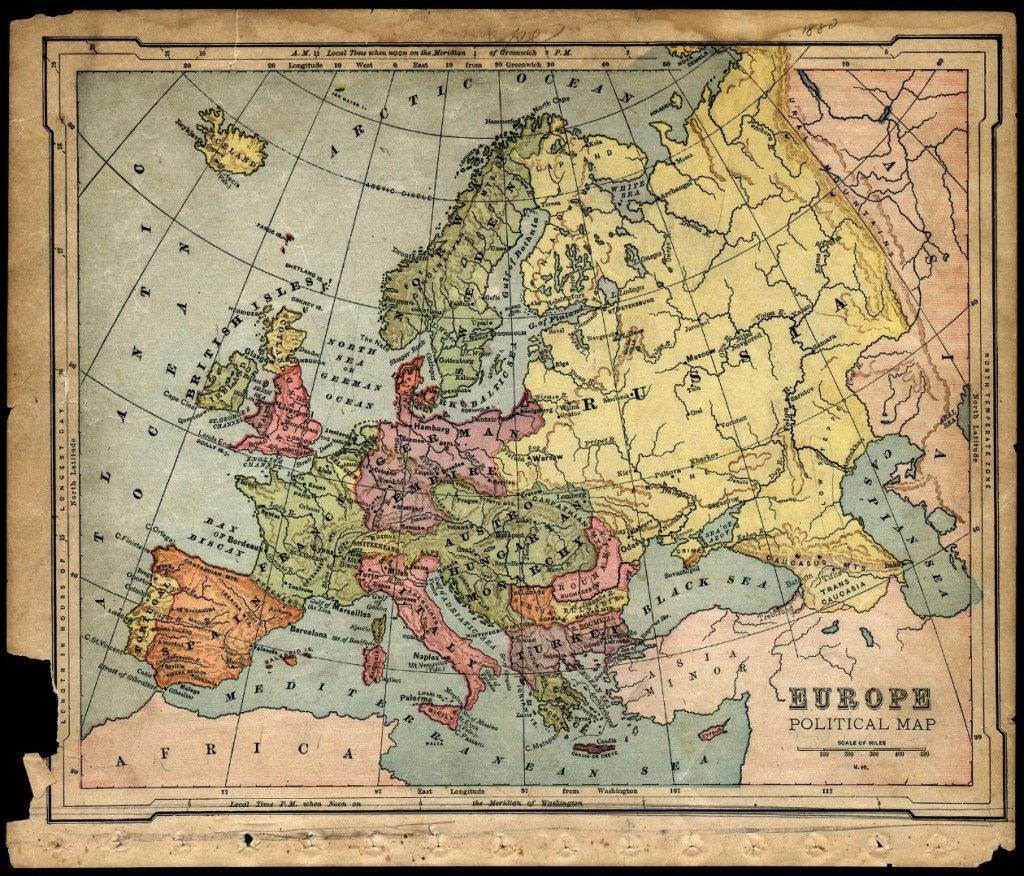
Scotland and Denmark are across the North Sea from each other. Norway was a significant detour.
When James found out that his wife was significantly delayed, he was bummed out enough to start writing angsty poetry. One of the first was titled “A complaint against the contrary Wyndes that hindered the Queene to com to Scotland from Denmarke.” Not kidding.
A complaint against the contrary Wyndes that hindered the Queene to com to Scotland from Denmarke.
From sacred throne in heauen Empyrick hie
A breathe diuine in Poets brests does blowe
Wherethrough all things inferiour in degrie
As vassals vnto them doe hommage showe
There songs enchants Apollos selfe ye knowe
And chaste Dianas coache can haste or staye
Can change the course of Planets high or lowe
And make the earthe obeye them euerie waye
Make rockes to danse, hugge hills to skippe and playe
Beasts, foules, and fishe to followe them allwhere
Though thus the heauen, the sea, and earthe obeye,
Yett mutins the midde region of the aire.
What hatefull Juno, Aeolus entiseth
Wherby contrarious Zephyre thus ariseth.-King James VI
I do find it interesting that James, who would later be such a proponent of Christianity, wrote lyrics that were so obviously influenced by non-Christian beliefs, but that is neither here nor there.
After the requisite amount of angst and poetry, James gathered up 300 soldiers and set sail himself to retrieve Anne. They were formally married (with both parties present this time) at the Bishop’s Palace in Oslo, Norway. An epic royal honeymoon ensued that took them around Denmark and the two finally returned to Scotland in late 1590.
The rest of their history, which is plentiful and significant, is also completely irrelevant to our purposes here. The important thing to keep in mind is that the Anne got delayed by a storm and everyone would have been talking about it because that big news in 1590.
The North Berwick Witch Trials
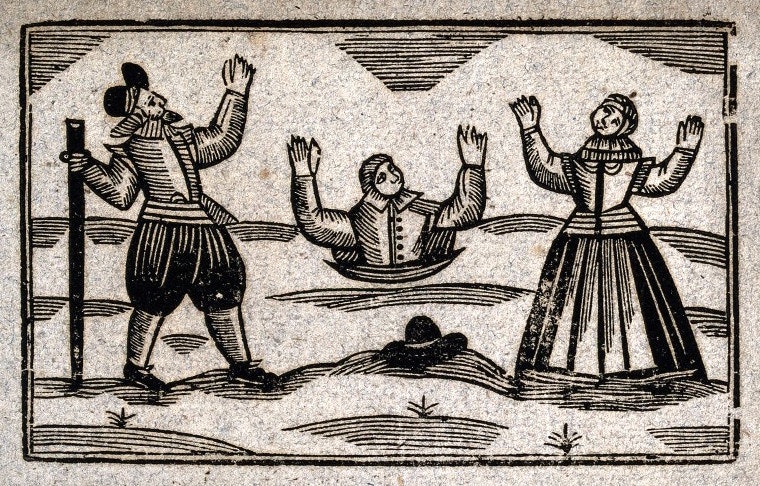
Woodcut, possibly depicting a tried and true way of testing if someone is a witch. Public Domain. Courtesy of Wellcome Collection
In Denmark, toward the end of the 16th century, there was a bit of suspicion and witch-related persecution going around because of the ongoing Witch Trials of Trier (which took place in modern-day Germany).
Peder Munk, who was admiral of the Danish fleet and the guy in charge of all the ships during Anne’s delayed voyage to Scotland, got into some arguments with officials in Denmark over the condition of the fleet. He basically said that the treasurer had failed in his duties to adequately equip the royal ships. The treasurer defended himself by saying it wasn’t his fault and quite naturally must have been witches; thus, the Copenhagen Witch Trials began in July of 1590. One of the first to be arrested was a woman named Anna Koldings. After being tortured, she gave up the names of five other women. They all confessed to using sorcery to summon storms that would hinder Queen Anne’s voyage… and also to sending devils or imps to climb up the heel of her ship on Halloween night. At least two women were burned at the stake.
Case closed? Hardly.
When James received word that all of this had transpired in Denmark, he must have thought something along the lines of, “That sounds like quite a splendid idea! I think I’ll have my own witch trials here in Scotland!” Because that’s exactly what he did.
The North Berwick Witch Trials, which started the first major persecution of witches in Scotland, were presided over personally by King James VI, who developed an almost obsessive paranoia that sorcery was being used to plot against him. Over 100 people were arrested during this time. Many of them were tortured. Some of them were killed. One notable victim of these events was a woman named Agnes Sampson, who was known to have healing powers and often acted as a midwife.
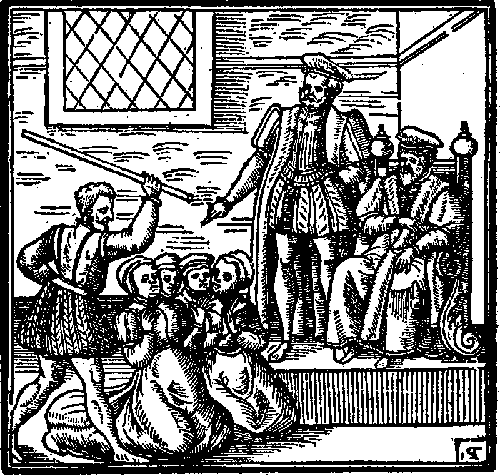
Witches kneeling before James VI from Daemonologie (1597). Public Domain. Courtesy of Wikipedia.
Agnes denied all charges, but eventually confessed after being tortured. Her statement revealed that she had attended a Sabbat with 200 witches, including Gillis Duncan.
Gillis Duncan (or Geillis Duncan, or Gelie Duncan – spelling was even harder hundreds of years ago) was a servant of a man named David Seaton. It was said that she had unusual healing abilities. When Seaton confronted her about this, she failed to provide an adequate explanation… so he had her tortured. She denied charges of witchcraft, but eventually confessed once a witch’s mark was found on her body. As I’ve shown earlier, Duncan was thought to be a ringleader (literally) of this whole plot, leading other witches in song. It’s also written that she actually sang for King James, much to his delight, during her trial. She later tried to retract both her confession and implication of others, but was executed.
Horrible, horrible things were done to these people, both men and women, who were accused of sorcery and witchcraft. In March 2022, the first minister of Scotland issued an apology for the persecution of alleged witches during the 16th, 17th, and 18th centuries. At least they apologized!
Let’s be honest. There is little chance that two giant groups of hundreds of intercontinental witches in the 1590s organized some sort of crazy magick ritual to slow down a ship. I mean, it’s 2024 and I sometimes have trouble getting just five or six witches together. The inquisitors and government officials were obviously looking for a specific story to be told to cover their own asses. Almost everyone accused denied involvement until after copious amounts of torture were involved. They would have all known that Queen Anne’s ships encountered storms and I’m pretty sure they eventually just got tired of the torture and said “I did it, just kill me.”
Enough Talk, Let’s Listen
Here are two performances of the song. When I have more time, I’ll record my own.
Side Note on Naming
Is it “Witches Reel” or “Witch’s Reel” or “Witches’ Reel”? I’ve seen it all three ways.
I assume the title of the song is referring to “the reel of the witches” in which case, “Witches’ Reel” as a plural possessive would be correct. You are free to write it and refer to it however you wish.
What’s It All Mean?
The first two verses of The Witches’ Reel are quite plainly about joining arms and dancing counterclockwise in a circle, letting your hair hang loose and leaving your shirt tails untucked.
But what about the last two lines? “Devil take the hindmost, wherever she be.”
This is one of the most interesting sections of the song and I believe it was specifically written to tie everything back to the alleged events — that is, the intentional slowing of Queen Anne’s ships.
If you recall from earlier, witches in Denmark confessed to sending imps or demons or some other nefarious forms of creatures to crawl up the heel of Anne’s ship. The heel of a boat could refer to its hindmost portion — ie, the rear.
Of course, I could be wrong.
Conclusions
I bit off way more than I intended to chew with this one. I originally just wanted to share some lyrics with you, but they made me curious and the story was interesting.
I hope you’ve enjoyed this historic diversion. And perhaps… if you chant or sing this song one day, it will seem just a little bit more significant to you. Maybe it’ll carry more weight and generate more power. After all, people died because of it.
Cheers!
There’s lots of links in this post. I’m tired and I can’t remember if any of them are Amazon links. If they are, it’s possible that they are affilate links. If you use one of those links to make a purchase, Amazon pays me a tiny commission.


 Aerik Arkadian


Leave a comment