
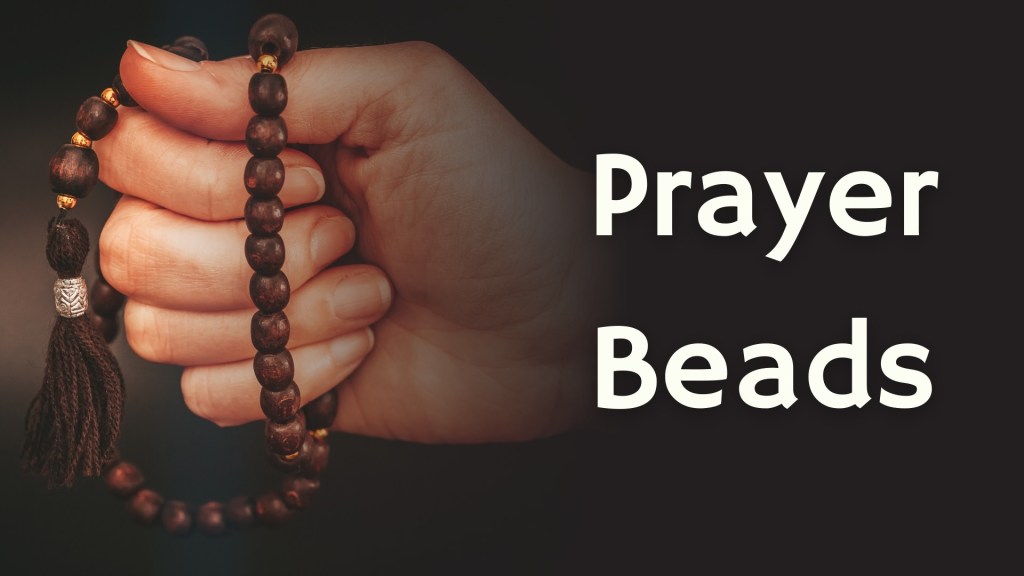
Prayer beads are so much fun to make and an incredibly useful tool. It doesn’t matter if you’re a Christian, a Buddhist monk, or a witch… they have a purpose that can fit right into your practice.
I can remember decades ago when a friend gave me a small bracelet with green wooden beads. He told me that they were called “prayer beads” and asked me if I knew the story behind them. This is what he told me…
Long ago, there was a man in a small village who became terribly depressed and no longer wanted to live. As a last resort, he traveled to a nearby town to seek the wisdom of a well-known sage.
“Master,” he said. “please teach me the secret of happiness.”
“I will teach you,” said the sage. “But first you must do something for me. In the next village, there is an old man who is too weak to plant his field. I cannot travel there myself, so you must go in my stead and help him. Once you have done this, return to me.”
With a sudden sense of purpose, the man journeyed at once to the next village. He knocked on the door to the old man’s house and said “Hello! I am here to plant your field for you!” The old man was confused, but let him in.
After a few days, the work was finished. The old man said “Thank you. I am very grateful. I wish I had some way to repay you. All I can give you is this wooden bead.”
The man expected no payment, but took the bead and returned to the sage.
“Master,” he said, “I have done what you have asked. Please teach me the secret of happiness.”
“Yes, yes…” said the sage. “I will teach you… but first… there is a woman who lives alone across the river. There was a storm that damaged her home and the repair is too much work for one person. Go there and help her, then return to me.”
So again, the man journeyed to help someone. He crossed the river and found the woman’s home. Together, they repaired the damage from the storm.
“Thank you,” said the woman. “I wish I had some way to repay you… but all I have is this bead.”
And again, the man expected no payment, but took the bead and returned to the sage.
This continued for months — perhaps for years. The man traveled far and wide, to every village where there was someone in need, and helped random strangers at the behest of the sage. For some strange reason, each person gave him a bead. Eventually, he had too many to easily carry, so he strung them together and wore them around his wrist. And every time he looked at this bracelet, he was reminded of the good things he had done.
Through all of his work, he had forgotten his original troubles. He no longer wanted to stop living. He decided to return to the sage one final time and let him know that he had cured himself of depression.
“Master,” said the man, “I no longer need your teachings. Through helping others, I have found fulfillment and happiness on my own.”
“That was the whole point, dummy.” said the sage.
Alright, I might have made all of that up. My friend did tell me some sort of story and it might have vaguely resembled what I wrote above, but this was probably two decades ago so the details are fuzzy.
If anyone else has been told a story like this, please drop a comment. I haven’t been able to turn up any official, verifiable, or historic accounts of this tale. In fact, I don’t think it actually has anything to do with prayer beads at all. It’s probably just a nice little anecdote that someone made up and told someone else. But don’t so many myths start off that way?
A Rose By Any Other Name…
Several cultures across the world have used strings of beads for the purposes of rituals, prayers, or chants… and they’ve been doing it for thousands of years. There are Christian rosaries, Hindu japamalas, Buddhist zuzus, and Islamic misbahas… and that just names a few.
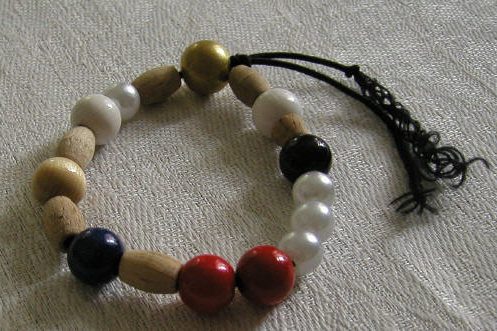
Wreath of Christ by Photographer, CC BY-SA 3.0 , via Wikimedia Commons

Zen Buddhist Juzu by ja:利用者:pack372sd, CC BY-SA 3.0 , via Wikimedia Commons
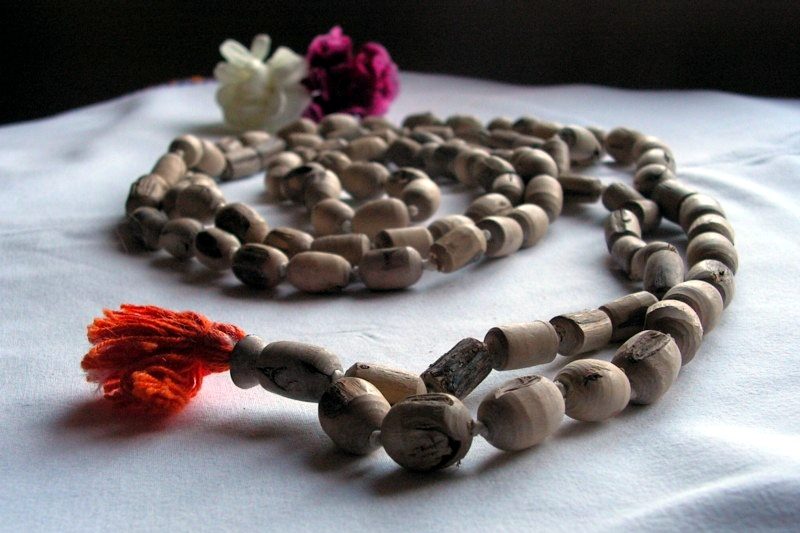
Hindu Japamala by GourangaUK., CC BY-SA 2.5, via Wikimedia Commons

Bahai Prayer Beads by Jeremyhanna, CC BY-SA 3.0, via Wikimedia Commons
Fun fact: beads are actually among some of the oldest archaeological finds in existence. We’ve found beads from 100,000 years ago. And quite recently, we may have found some that are almost 150,000 years old. So yes, we’ve been using beads for quite some time.
It doesn’t really matter what you call them once you string them all together, does it? And while different traditions will place their own emphasis on certain numbers of beads, the fundamental concept is always the same: you put beads on a string to help you keep track of counting.
Most people are familiar with rosaries (you know, since Christianity is one of the largest world religions and all). And within the pagan community, you’ll find that many folks are at least vaguely familiar with mala beads. In fact, you’re probably likely to find a set at your local occult bookstore or witchy shop.
Want to hear about future posts? Subscribe to get notifications delivered straight to your inbox.
Traditional Construction
A standard set of mala beads typically has 108 beads, although you might find smaller sets that are a subdivision of this number, such as 54 or 27. The number 108 is significant in many traditions, including Hinduism and Buddhism — some of the correspondences include the 108 Upanishads, the 108 names of the Buddha, or the 108 energy meridians in the body. As such, chanting a mantra 108 times is a fairly common practice.
You’ll also find a larger, 109th bead on most sets, which is frequently called the “guru bead.” Reaching this bead signifies that you have ended your chant session and also gives you a moment to send some gratitude to your teachers (your gurus!) or meditate on the value of the teacher/student relationship. Because people that teach you things are important.
I know it’s pretty obvious, but I’m going to explain… just in case anybody is confused. You start by putting your fingers on one of the beads next to the guru bead. You say one round of a mantra, then you move your fingers to the next bead. Repeat this until you’ve hit the guru bead. Since these sensations are all completely tactile, you can keep track of your chants without consciously counting — and without even looking. If you’ve done everything correctly, you’ll have repeated the mantra 108 times.
Similarly, Christian rosaries also use a mix of small and large beads. As you progress through the rosary, you’ll say different prayers depending on which type of bead your fingers land on.
Different versions of Christianity have come up with their own special type of rosary, but the “standard rosary” has 59 beads. The 6 large beads are used for the “Our Father” prayer, while the 53 smaller beads are used for the “Hail Mary” prayer.
Nontraditional Usage
I have a set of mala beads. They’re really cool. The beads are little carved skulls and they have a slight yellow tint. But I’ve never used them to count chants.
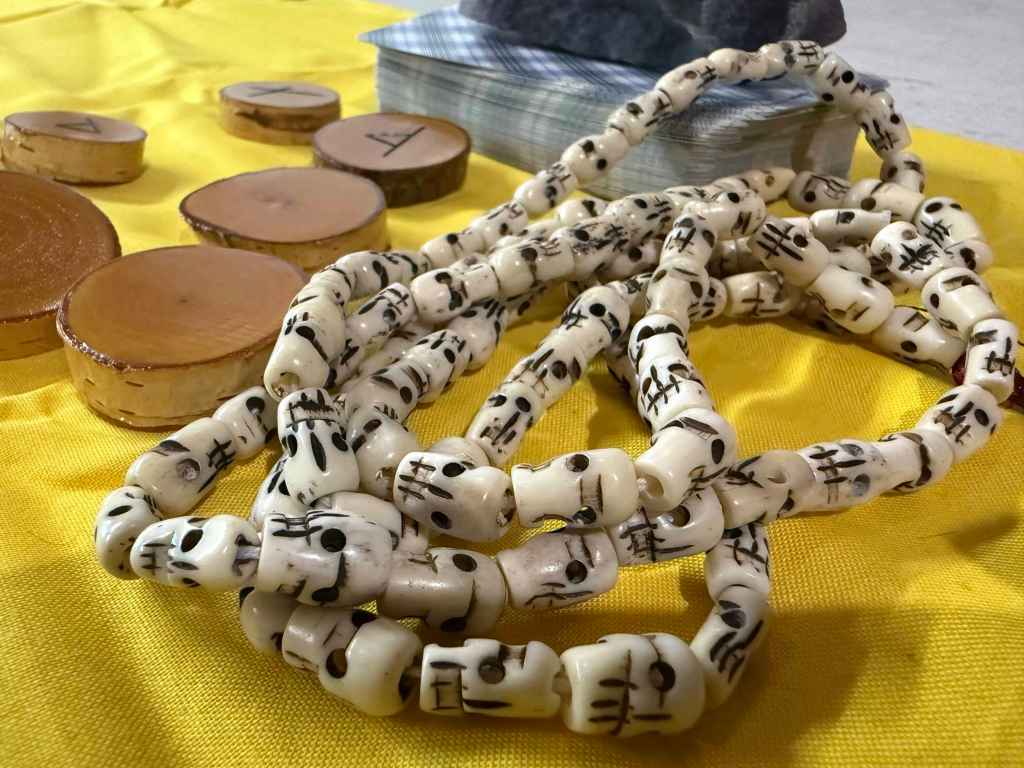
My Mala Beads
Once upon a time, I was in a deep meditation and I had a “vision” of Selene and myself teaching a class somewhere. She was decked out in priestess regalia and I was wearing a black robe with a long necklace of small, yellow skulls.
I told Selene about it. And quite naturally, she got me something that resembled the necklace in my vision.
So that’s why I own mala beads. It really doesn’t matter to me that it’s a mala or that there are 108 beads. It’s just an item of personal significance because my wife bought it to match something I saw in my dreams.
And like I said, I’ve never once used it to count mantras.
So what do I do with it? I wear it as a necklace during divination, like rune and tarot readings. It’s a conscious trigger. If the necklace is on, then the words I speak are from spirit. If I take it off, then I’m giving you my personal opinion. For any aspiring readers, this is an invaluable tool.
But definitely not your traditional use.
My Personal Endeavors
Sometimes, however, I find myself wishing I could keep track of my chants. I just don’t want to chant 108 times — it’s a cool number and all, but it doesn’t hold much significance to me personally.
When we chant during ritual (and by we, I mean our coven), we’ll frequently choose a number like 7 or 9. Those are witchy numbers. But I’m really bad at counting. Like, seriously, you want me to say words, bang a drum, focus on the type of energy we’re trying to raise, and keep track of how many times I’ve done it?
So I set off on a personal project to make my own set of witchy prayer beads. They use a mix of bead sizes to separate different sections. I’ve got two mirrored sides where I can count to 3, 7, 9, or 21.
Alright, enough talk. It’s time to go watch my video.
In the video, I speed through an overhead shot of me making my set. If you’d like to follow along, you’ll need some supplies…
Note: I wouldn’t recommend going smaller than 8mm for the smaller beads because it’ll be harder to feel, but you could slightly increase the larger bead size if you wish.
I start off by cutting a 3 or 4 foot section of beading wire. I string my leather tassel in the middle, then gather both ends and run them through a few beads — this will give me a clear starting point just like a guru bead in a traditional mala. It also splits the beading wire into two distinct sides, like a left and a right.
After that, I string each side individually. I make a section of 3 small beads, then add a large bead — first on the left side, then on the right. I do the same with 7 beads, then 9, and then 21.
I finish everything up with a couple of crimp beads in the back. To get a full view of the process, just watch the video. If a picture is worth 1000 words, then my video is worth at least 10,000 – I mean come on, it’s a bunch of pictures.
Here’s my finished product…

Witchy Prayer Beads
I’m pretty happy with the result. Since the beads are all crystal, it’s got a really nice heft and sturdy feel. I will never again lose track of our chants during ritual.
Just don’t ask me to count any number other than 3, 7, 9, or 21…. mmmk?
Alternative Methods of Construction
This is just one way to make a prayer bead necklace. There are tons of alternative methods. If you’re feeling lazy, you can just throw the beads right on a string, knot the ends, and be done with it. If you want a slightly more involved process, some people will tie a knot in between each individual bead. And if you want a mini version, there’s absolutely nothing wrong with going for a bracelet-sized set.
In truth, you can use any numbers that are significant to you, your beliefs, or your personal practice. If you like the number 10, then… great! Go and make something that reflects that.
Conclusions
Creating your own set of prayer beads is a fun process that let’s some of your personality shine through. You can choose the stones, colors, and numbers. The whole process only takes about an hour. In the end, you’ll wind up with a unique tool that isn’t like anyone else’s — and that makes it cool.
What are you still doing just sitting there? Go and string some beads! And then tell me about it in the comments.
Oh hey, actually, before you nosedive into the endless blackhole of bead shopping, let me just tell you something really quick. There are a few links on this page. Some of them are Amazon Affiliate links. If you use one of those links to make a purchase, Amazon will pay me a small commission. Don’t worry, it’s very, very small. So small, it almost doesn’t exist. This isn’t new information or anything, but I still have to say it every time. You’d think I’d just copy and paste the same disclaimer, right? Or maybe I’d program it into my website template so I never had to worry about it again. But no. You’d be wrong. I manually type it every time.



 Aerik Arkadian


_of_Tulasi_wood_with_108_beads_-_20040101-01.jpg)

Leave a comment