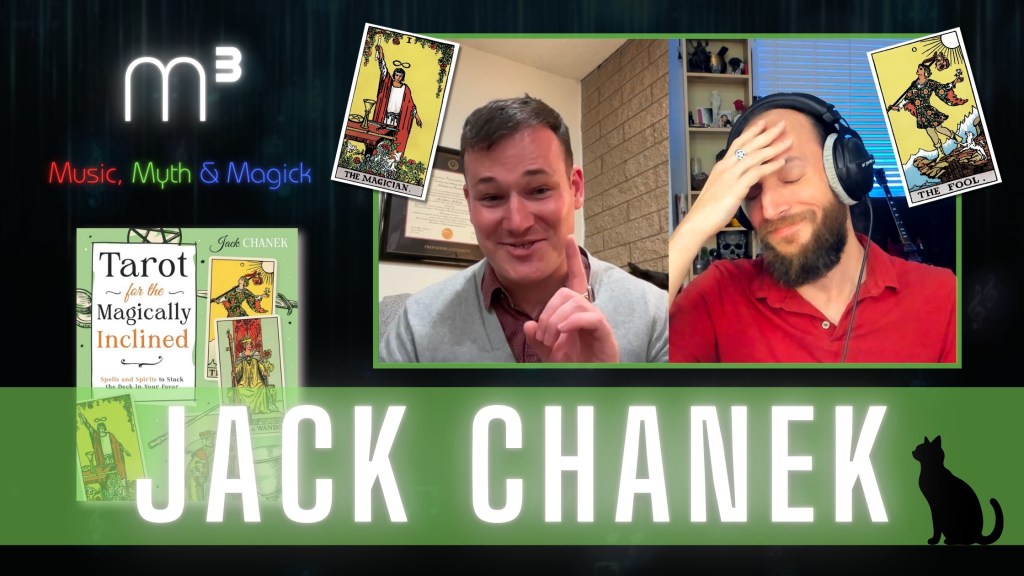
Jack Chanek is an author, a High Priest, and a returning guest to M3. Since his last appearance, he’s had a couple of new books come out.
In this episode, we dive into his latest book, Tarot for the Magically Inclined. I asked Jack some intense questions: What is magic? What is divination? And can Tarot really reveal knowledge of an unknown future? On the surface, those might seem simple to answer. After all, they’re sometimes things that we learn to understand implicitly. But when you try to articulate them into words? Well… that’s where it starts to get difficult.
I’ve got written highlights for you here. If you’re not a fan of brevity, I’d strongly suggest watching the full video on YouTube—it’s a good one!
Keeping Current
We’re gonna skip all of the background stuff because we spent a lot of time going over that information during Jack’s first appearance—you can still go catch up if you’re interested to hear how his love of Tarot was inspired by James Bond.
Last time, Jack made the claim of running the only Gardnerian coven in all of Utah. And you know what? That’s still the case. If you’re looking to learn traditional witchcraft in that neck of the woods, it’s a good bet you’ll wind up at Jack’s door (or… well, probably a more neutral location, but you get what I’m saying).
Jack is pretty open with his views on witchcraft, coven dynamics, and what it takes to run a group of spiritually like-minded individuals—you can find all of that on his YouTube channel.
And of course, he’s been writing. At the time of our last conversation, he had just finished a book called Queen of All Witcheries, but today our focus is his latest endeavor: Tarot for the Magically Inclined.
Tarot for the Magically Inclined
If you’re no stranger to Jack’s writings, then you should already know that he’s had a book on Tarot published, Tarot for Real Life, which is like a basic introduction to that world, covering topics such as how to choose a deck and how to perform a reading. Tarot for the Magically Inclined, however, takes a slightly different approach, viewing the divinatory art as an intersection to magic(k).
It’s intellectual. It’s practical. And it’s got just about the best reference lists for Tarot correspondences that I’ve ever seen—but more on that in a moment.
I’ve always loved the idea of Tarot magick ever since Selene and I started putting together our first altar. We didn’t have any deity statues back then, so our natural inclination was to grab The Sun and The Moon cards out of a spare deck and use them to represent the archetypes of god and goddess.
Beyond the context of divination, Tarot cards have real value.
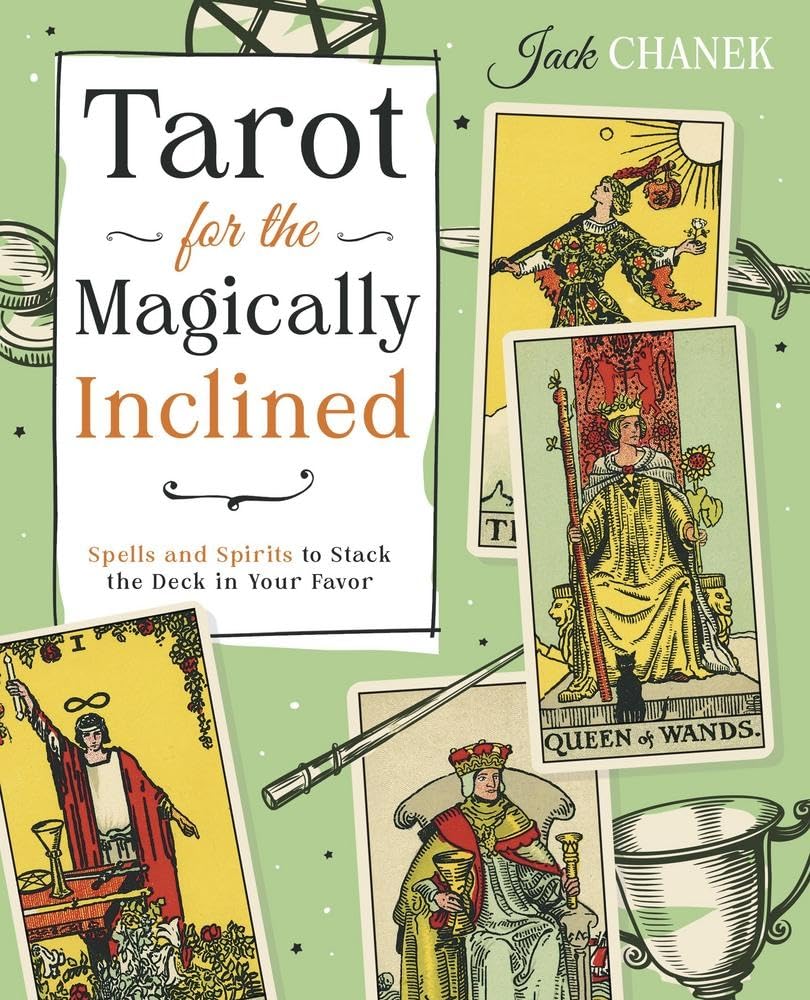
And Jack is going to walk you through all of the various applications, starting with simpler things like basic elemental associations, moving up to full-blown Tarot spells, and even covering advanced and technical topics like using cards to conjure the spirits of angels and demons. I bet you never thought you’d be using your Tarot deck to summon demons, but here we are…!
As you work through these skills, you’ll be reading about Tarot correspondences—elements, planets, zodiac, and just about everything else under the sun—why this card is like that thing and how we can use that knowledge to our advantage. But the real beauty is that it’s taught via application. Instead of just throwing list of facts at you, Jack shows you how to do things with them.
The book doesn’t skip divination, either. In fact, it presents some extensive information—it just assumes you know some of the prerequisites. You’ll find some interesting spreads, learn how to stack the deck, and even uncover ways to combat a bad reading.
All in all, Jack’s extensive knowledge, coupled with his awesome ability to relate complex topics, makes this an invaluable resource for everyone interested in Tarot. Actually, even if you weren’t interested in Tarot, you’ll still learn a considerable amount about magick itself, so you should still read it.
Magic(k) Defined
Jack talks a lot about magick in his latest book. After all, it’s written to the magically inclined, right?
So what is it? How do you define what magick is and what magick isn’t?
Aleister Crowley has the most popular definition: the science and art of causing change to occur in conformity with will. But Jack refines that to some degree.
Jack essentially says that if you’re explaining what you’re doing to someone who doesn’t believe in magick, and they think you’re full of shit, then it’s probably magick.
Just watch the short video to hear him say it!
The actual situation we discussed was this: say you own a company and you’re trying to get new customers. That’s something that happens every day, so it should be easily relatable. If you light a candle, say some prayers, and then suddenly see your sales increasing—well, that’s probably magick. But if you hire a marketing consultant to run a targeted ad campaign, then that probably isn’t magick.
What do you think?
In his book, Jack gives his own definition: “Magic is the practice of causing directed change through either sympathetic or intercessional means.”
But to fully understand that definition, you need to know about those other two key terms, sympathetic and intercessional.
Many of us are already familiar with the concept of sympathetic magick. It’s when a similarity between two different things, either assumed or actual, allows one to influence the other. This takes many forms, from the taglocks in poppets all the way to the Doctrine of Signatures in herbology. It’s the idea that like affects like.
Want to hear about future posts? Subscribe to get notifications delivered straight to your inbox.
Intercessional magick is different. It’s when you can’t do something yourself, so you employ, bid, or request someone else to do it for you—usually a spirit or deity or something. If you want to hear more about that, grab a copy of Jack’s book or listen to this section of the episode.
Divination Defined
Just like magick, divination can be pretty difficult to define.
Jack says: “Divination is a process whereby we attempt to gain either knowledge or interpretative insight into a situation by randomly generating a set of symbols and then interpreting them.”
Alright, that’s a pretty good definition! And I think it pretty much fits any form of divination I can think of. Generate symbols, then interpret symbols.
Some divinatory systems are pretty loose with how they generate their symbols. Tasseomancy (tea leaf reading), for instance, uses tea leaves that are swirled in a cup. Others, like I Ching and its defined set of 64 hexagrams, can be pretty strict.
Tarot seems to fall somewhere in the middle. There are a set number of cards, each of which has structure and meaning. We generate randomness by shuffling the deck, but we have a lot of leeway in terms of how we lay them down and interpret things.
Seeing the Future
So can we actually use that model to reveal the future? If we generate enough symbols… and then interpret them well enough… can we gain access to knowledge we truly didn’t have before?
Jack says: “Reluctantly, yes. I don’t like admitting that I think this.”
I’m in the same boat. I’ll be the first one to tell you that divination is primarily a tool for self-reflection. You can easily gain personal insight or solve problems, but only a fool would rely on cards to tell the future. And anyone who says otherwise is trying to sell you something…
…and yet…
It still happens. Sooner or later, if you do enough readings, you’re going to have a moment where something was completely and inexplicably revealed to you—something you couldn’t have possibly known, yet was accurate to the point.
Maybe it’s just coincidence, should you believe in such a thing. I’d venture a guess that most readers have a story to tell about this. Want to hear Jack’s? Watch the full episode and listen to him tell it.
Angels, Demons, and Bad Readings
For the rest of the episode, we dived into more Tarot topics. Jack sees each card as a distinct personality—a spirit that can be conversed with. This is something that he brought up in the last interview, but we talked about it here in more depth.
I always love hearing people’s ideas for fixing bad readings. Christiana Gaudet taught me the concept of pushing intention into a reversed card as you rotate it—literally and symbolically turning the situation around. Jack has a couple tricks as well.
In the episode, Jack describes a technique for card substitution. If you lay down your spread and see something negative, why not just change the worst card? But wait… there’s rules. You can only substitute cards when they have an affinity between them (like taking the 7 of Swords and switching it with the 7 of Cups or the 2 of Swords). I can imagine a great deal of thought has gone into mapping out exactly what things can substitute for other things—and if you want more info… yep, you guessed it, I’m going to point you to Tarot for the Magically Inclined.
Outside of divination, there are so many things you can do with a Tarot deck. On the more complicated and technical side of things, you can use cards to summon angels and demons. Look, I’m not even going to attempt to summarize the process here in this post, but Jack gives an overview during the interview. And should you wish to fully open that curiosity door, he gives the entire step-by-step process in his book.
More Books by Jack
If you’re looking for more books by Jack Chanek, may I recommend a few?

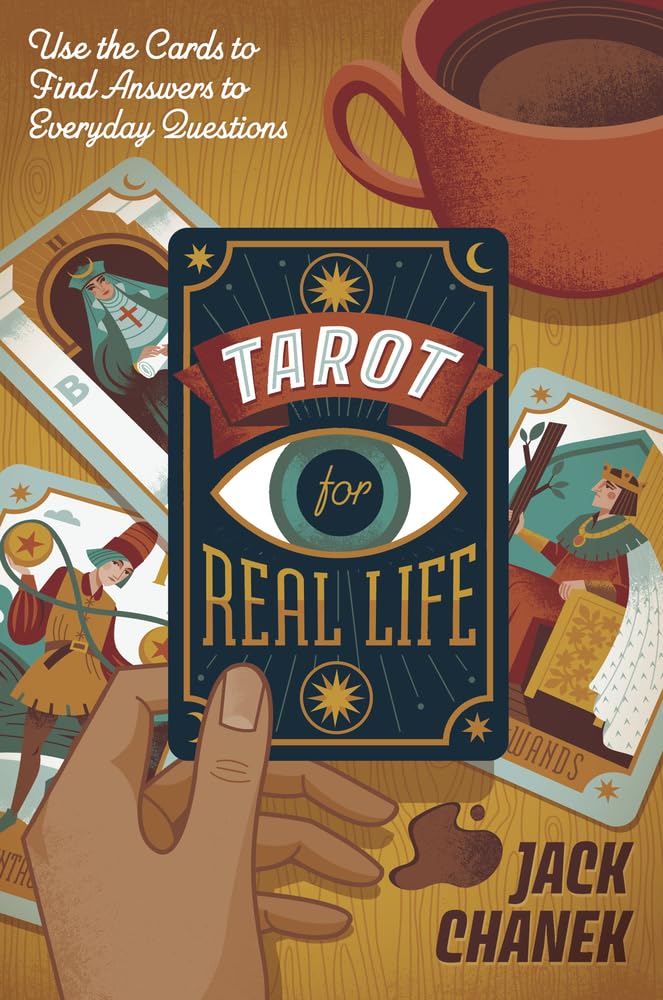
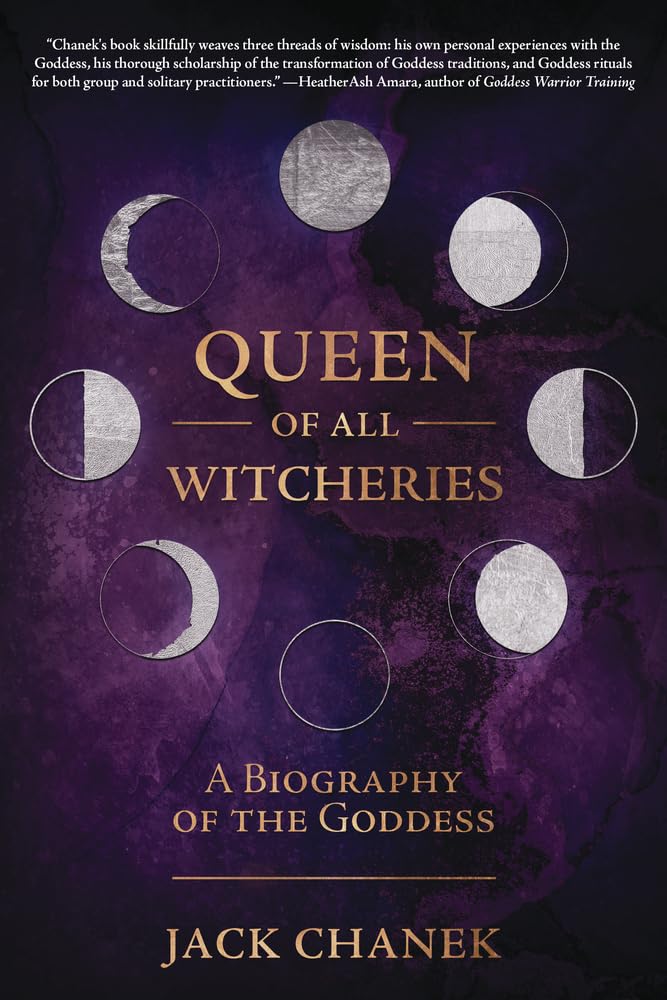
Once you’re done with Tarot for the Magically Inclined, those should keep you busy for at least a few days.
Finding Jack Chanek Online
And if you’d like to learn more about Jack, you can do so online. As I mentioned earlier, he posts about traditional witchcraft topics pretty frequently on YouTube.
- Website – https://jackofwandstarot.wordpress.com/
- YouTube – @JackChanek
- Instagram – @jack_of_wants
Don’t miss out. Here’s what’s coming up…

Signature Question, Take Two
Returning guests get a different signature question. I reserve the right to change this at any point in time, but I’m currently asking them about their favorite musical memory.
Jack told a story of writing a song for a music theory class. Was it a hit? You’ll have to listen to him tell it.
Conclusions
I’m always extra grateful when people decide to come talk to me again. I had a great time reading Jack’s new book, and as usual, he gave fantastic answers to all of my questions. I just hope he writes something else soon so I can invite him to return for a third time.
If you enjoyed this article, please consider subscribing to my website or to my YouTube channel. Drop a comment on the video or check out my Patreon page. Consider preordering my book. There’s lots of ways to help support, even if it means just sharing my content with another human.
If you’re subject to linear time, then you’re bound to find out this is the last episode of Season 3. I’m currently in the process of planning Season 4, so there are many more guests on the horizon!
Stay tuned for more soon!
Thank you for reading all the way to the end. I only have a couple of minutes left before I have to return to my homework, so I’ll be brief. I know, I know… an adult with homework? What’s the deal with that? Well, that’s what you get when you randomly decide to go back to school in your 30’s. It’s okay though because I actually enjoy learning now, so I’m probably having a way better college experience than I would have had in my 20’s. Or at least, that’s what I keep telling myself. Anyway, you came here for fine print and I promised to be brief, so I’ll have to get to the point eventually. If you’ve read the post with any amount of scrutiny, then you’ve probably noticed that there are several links. Many of those links go to Amazon products like books. If you use one of those links to make a purchase, Amazon will pay me a tiny commission. That’s all.

 Aerik Arkadian
Leave a comment