
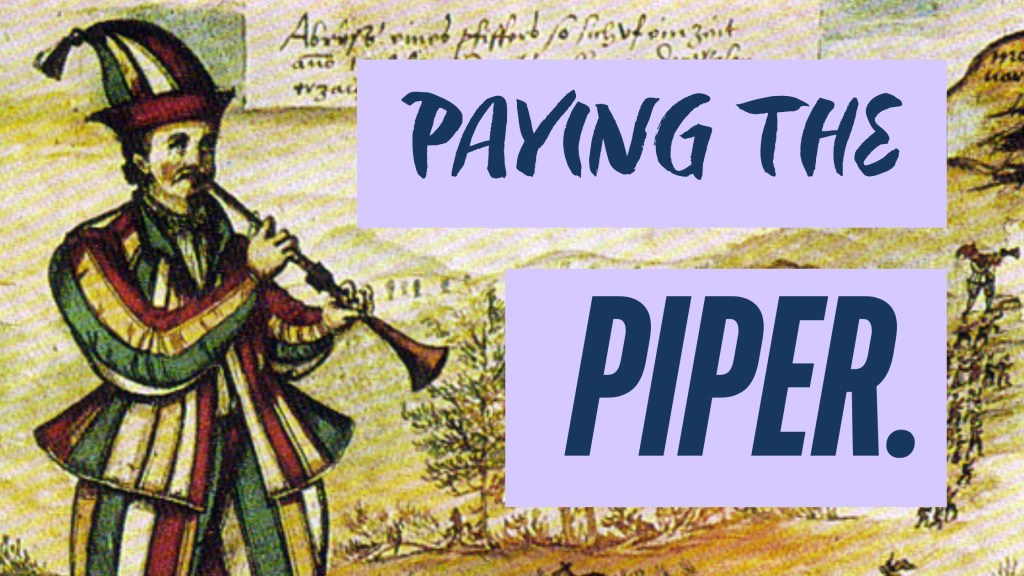
When does it become ominous and dangerous to owe musicians money? Why, when they steal your children, of course!
The common turn of phrase “pay the piper” means literally to “bear the consequences of an action or activity that one has enjoyed.” It originates from a 13th-century German legend, The Pied Piper of Hamelin, where a town refuses to pay a musician for services rendered, then loses all of their children in an act of revenge. In this brief article, we’ll take a quick look at these colorful characters. Was there any historical accuracy to the claims? Plus, what was the Pied Piper actually piping, anyway?
The Legend
I’d be surprised if you haven’t heard at least one version of this tale; nonetheless, I shall recant the details for you so we’re all on the same page.
In the year 1284, the town of Hamelin, Germany was plagued by rats. Or perhaps it’d be better to say they were besieged by rats. Yes, besieged sounds more intense.
Despite all of their best efforts to control the infestation, the rats were winning. They were ruining food supplies, gnawing on property, spreading disease, and making life generally unbearable for the inhabitants. Sometimes late at night, the rats would even crawl into the cribs of sleeping babies. I don’t know about you, but I think that sounds pretty awful.
On one fine day, a strange piper, dressed in colorful clothing and carrying a mysterious instrument, arrived at the town. He said “I can get rid of these rats for you!”
The town agreed to pay him 1000 guilders for services rendered. And with that, he played a haunting melody and marched off into the distance.
The rats, of course, followed. He led them to a river… and without any argument, they jumped in and drowned themselves.
Phew, no more rats.
But the town didn’t want to pay. In fact, they even accused the piper of causing the infestation in the first place. Furious with anger, the piper stormed off, vowing to later return and enact his revenge.
On June 26 — yes, a very specific date… the Feasts of St. John and Paul, the piper quietly walked back into town. He played a new melody, somehow more haunting then before, and this time it was the children that followed him.
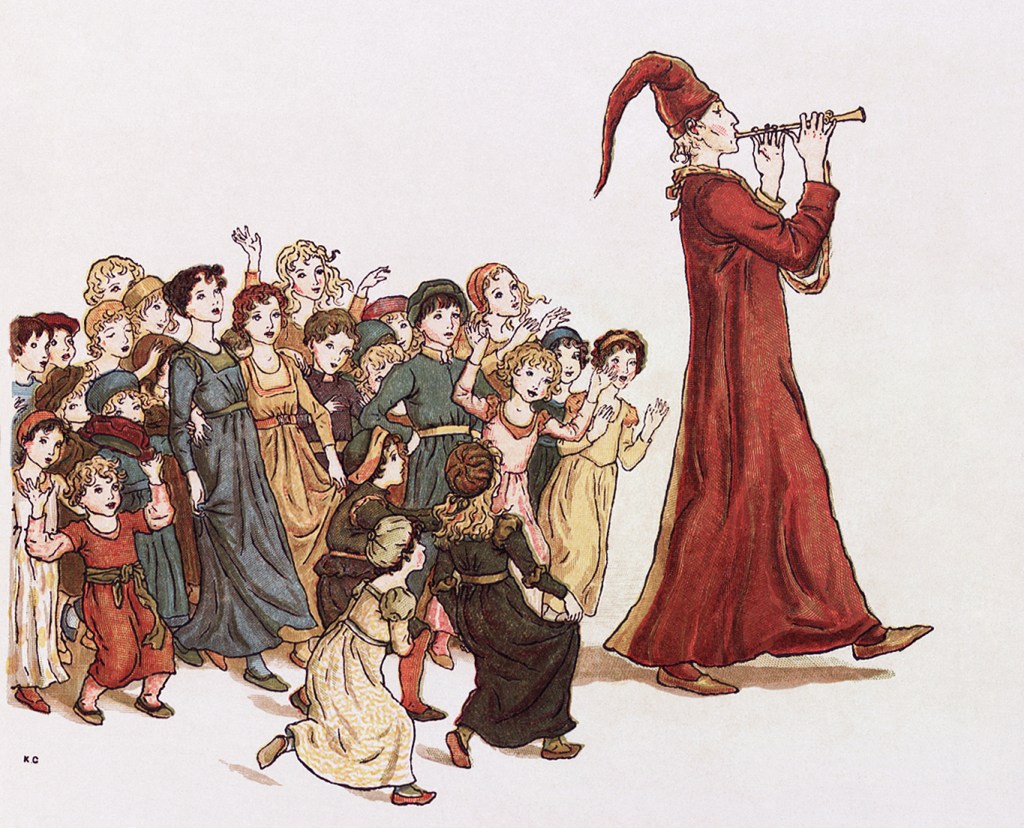
Bye bye, kiddos. Image courtesy of Wikipedia.
Sorry guys, there’s no happy ending, but the level of cruelty varies depending on which version of the story you read. In some accounts, the piper leads the children into a cave and they are just never heard from again. In others, they get the same treatment as the rats: drowned in the river.
The History
Hamelin is a real place. And 130 children were lost from the town.
In fact, the early town record, from 1384, states, “It is 100 years since our children left.”
Want to hear about future posts? Subscribe to get notifications delivered straight to your inbox.
Is that really true? I don’t know. I didn’t actually translate the town’s record for myself or anything. I just read about it on wikipedia, but it does certainly sound plausible.
There are a number of other manuscripts that reference the missing children. It’s a pretty safe bet that something was responsible for all the kids in the town disappearing. But what, exactly?
Although it’s rather unlikely that a magickal tune hypnotized people into drowning themselves, there are a few theories for events that may have actually occurred, then later been fictionalized. Among them:
- Plague. Yeah. Lots of kids died from the plague.
- Mass Psychogenic Illness. Literally “Dancing Mania.”
- Migration. This includes pilgrimages, military campaigns, and sometimes even the Children’s Crusades.
The Instrument
Regardless of whether or not the Pied Piper was made up, I still want to know what type of instrument he played.
Some versions of the story present it as a flute — a “Zauberflote” to be exact, which roughly translates to “magic flute.” (Side note: Mozart wrote an opera by the same name, “Die Zauberflote,” but it has nothing to do with The Pied Piper.)
Other versions say “pipe” or “whistle.”
It’s generally thought that his instrument was a reeded one — his tune was supposed to be loud and piercing.
One painting from 1592, which was supposedly modeled after an actual stained glass window in Hamelin that commemorated the events, is particularly noteworthy.
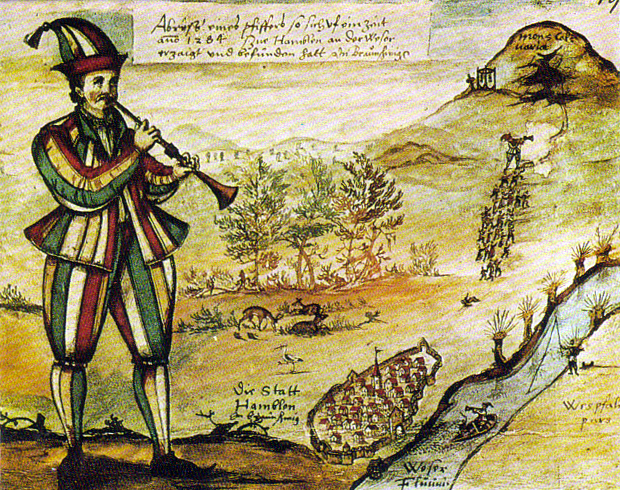
1592 Painting of the Piper, courtesy of Wikipedia
You can see that the instrument in question is long, end-blown, and flares out into a bell.
That’s not really what flutes look like.
Based on the available written and visual evidence, which I have spent at least 10 minutes surveying, I believe that the piper’s most likely instrument is actually the shawm, sometimes called a “folk oboe.”
Here’s why:
- It’s loud. It’s a double-reed instrument with a piercing sound.
- It’s period appropriate. Shawms were popular between the 12th and 17th centuries in Europe.
- It looks like the above picture. Duh.

A modern shawm sold on Amazon
The shawm is much closer in sound and appearance to the aulos, by the way, than it is to our modern idea of a flute.
Even though it’s pointless to debate the physics of a fairy tale, I’m going to do it anyway. From the center of town, the Pied Piper was able to have his fateful song heard by all of the children… who were sitting in their houses. That’s quite a distance. And you can’t do that with a flute.
With a regular flute, you’d struggle to hear it from one house to the next. Consider the difference in volume between flutes and bagpipes — that’s the kind of thing we’re talking about here. Have you ever stood next to a bagpiper? They’re loud! And yes, bagpipes are reeded instruments.
Conclusion
If you ever promise to pay a musician for playing music, then you should pay them — not because they’re going to steal your children, but because it’s good karma to honor your agreements. Also, most musicians need the support.
Don’t miss out. Here’s what’s coming up…

Hey guys, you made it to the bottom of the post. Here’s the fine print. To show you what a shawm actually looks like, I included a picture from Amazon and then linked to it. If you use that link to make any sort of purchase, Amazon will pay me a small commission. But seriously, musicians need support… so that would be a good thing, right?






Leave a Reply