

Home » Music » General Music » Running the Gamut – A Musical Etymology
In the 11th century, Christian monks were facing an interesting problem. Their repertoire of chants, which was passed down orally, was constantly growing. It grew so large, in fact, that it would have taken about 10 years to learn. To top it off, all of the liturgy needed to be kept consistent between churches and orders. Forgetting (or even just misremembering) a song could have meant it would be lost to time forever.
Guido of Arezzo, an Italian monk and music theorist, came up with a solution: four horizontal lines that represented individual pitches. It was the first form of standard music notation. Since music could now be written down, it was protected against failing memories. The real selling point for the church, however, was probably the fact that monks could spend less time memorizing and more time praying. Either way, it was a much needed breakthrough.
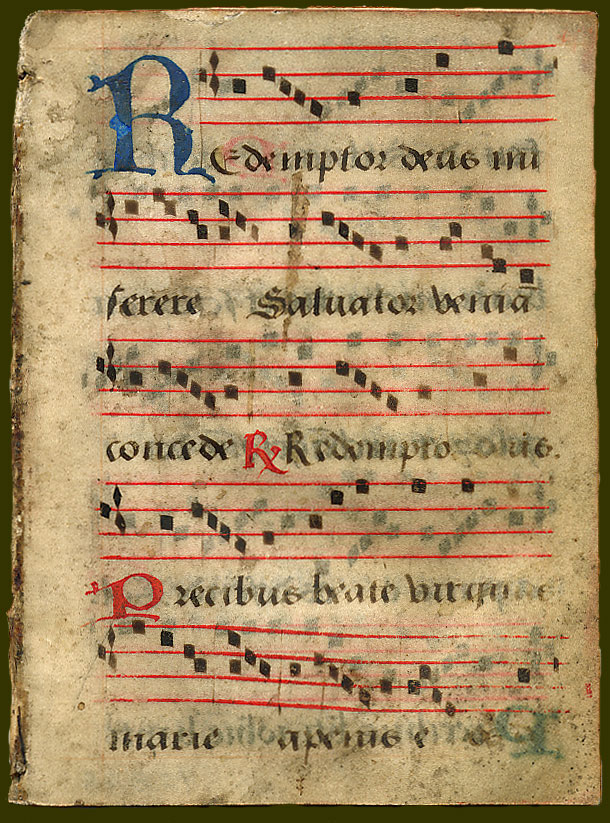
Guidonian notation would have looked something like this, with neumes (early forms of notes) placed on lines or in spaces to represent their pitch. At its core, it’s basically the same system we use today.
Guido’s ideas of music theory centered around a series of hexachords, 6-note scales that could begin on C, G, or F. The scale degrees were named after a Latin poem “Ut Queant Laxis.” From this, he derrived Ut – Re – Mi – Fa – Sol – La, an early solmization method, after the starting syllable of each line in the poem.

The Guidonian Hand was a mnemonic device for helping singers learn these scales. By pointing at a particular part of the hand, the singers would know which note to sing.
The lowest possible pitch, shown as the tip of the thumb, was a “G,” referred to as Gamma. The first note (Ut) of a hexachord starting on this pitch was called Gamma – Ut. Singers began referring to the entire series of notes as Gamma – Ut, which was eventually contracted to “gamut.”
Fast forward through the centuries, and here we are today, where “running the gamut” still means to go through an entire range of something.
Thanks, Guido!





 Aerik Arkadian
Leave a comment