
Summer Solstice happens each year in the Northern Hemisphere sometime between June 20 – 22 (for our friends in the southern hemisphere, these dates mark their winter solstice). It is called by many names: Litha, St. John’s Day, Midsummer, and more. It is one of four solar events on the modern-day Wheel of the Year. Along with Winter Solstice (Yule), Spring Equinox (Ostara), and Fall Equinox (Mabon), it makes up the four Lesser Sabbats.
Summer Solstice marks the point where the sun is at its full power. We say this is the longest day and shortest night of the year — what we really mean is this is the 24 hour period with the most daylight hours and the least night hours. Since most of the associations are based around sun things, you’ll find the correspondences are strikingly similar to Beltane.
- Colors: Yellow, orange, golds
- Flowers: chamomile, sunflower, rose
- Herbs: St Johns Wort, sage
- Crystals: sunstone
- Foods: sun-colored fruits and vegetables (lemons, yellow squash, etc), honey, anything in season locally
- Instruments: drums
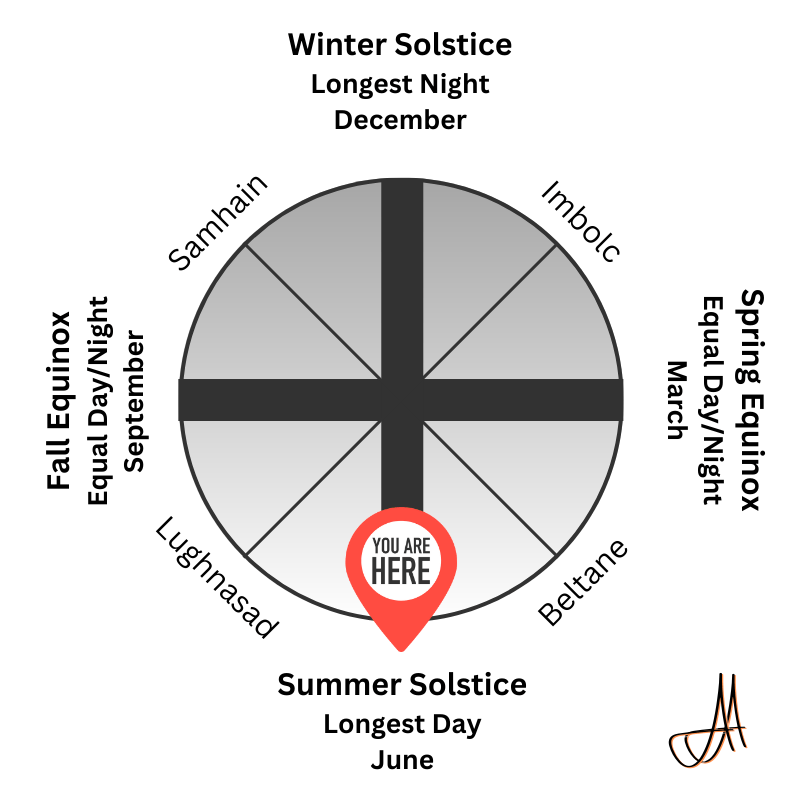
If you are troubled by finding exactly where we are on the wheel of the year, please refer to this handy chart.
The word “solstice” itself comes from the Latin solstitium, from sol ‘sun’ + stit- ‘stopped, stationary.’ Quite literally, it means “stopped sun.” As the sun finishes its southward journey across the sky (where the days grows longer), it appears to take a momentary pause, visibly rising in the same position as the previous day, before returning northward for the remainder of the year. The exact date and time for Summer Solstice (as well as Winter Solstice and the equinoxes) varies each year due to the “wobble” in the earth’s axis.
A Note on Naming
Without getting too much into politics, let’s quickly discuss the Neopagan names for these solar celebrations — Yule, Ostara, Litha, and Mabon. Applying these particular names to the solstice and equinox celebrations is a fairly recent development in neopaganism. Aidan Kelly was instrumental in this naming and you can read his explanation about it here. In some circles, specifically Gardnerian ones, he is Persona Non Grata due to breaking oaths — that is, openly discussing material which was supposed to be oath-bound or initiates only. Due to this, some people react rather poorly to hearing the word “Litha” and will insist you call it “Summer Solstice.”
Why does this matter to you? It probably doesn’t, but it’s still an interesting bit of history. In our coven, we use both names interchangeably. In fact, if I look at our ritual from last year, it very clearly says “Litha.”
Okay, one more little caveat worth mentioning. Midsummer, although usually used interchangeably with Summer Solstice, is technically a different day – June 24 every year – which was due to discrepancy with the older Julian calendar. Okay, now you know enough to be obnoxious.
“Would you like to come to my Midsummer celebration on June 21?”
“Uh, I’m sorry, did you mean Summer Solstice?”
-A conversation you can potentially now have
Solar Deities

Apollo, God of Light, Eloquence, Poetry and the Fine Arts with Urania, Muse of Astronomy, painting by Charles Meynier, 1798, Public Domain. Wikipedia.
If you’re looking for a god or goddess to honor for you midsummer rituals, there is no shortage of solar deities in almost every pantheon.
- Amun – Egyptian god of the sun
- Apollo – Greek god of the sun
- Aten – Egyptian god of the sun
- Ch’aska – Incan goddess of the dawn
- Hathor – Egyptian goddess that gave birth to the sun
- Helios – Greek god of the sun
- Hestia – Greek goddess of the home and hearth
- Horus – Egyptian sky god, his right eye was considered to be the sun
- Inti – Incan god of the sun
- Lugh – Celtic god of the sun
- Ra – Egyptian god of the sun
- Saulė – Lithuanian goddess of the sun
I think that’s enough to get you started. It’s not necessary to go to wikipedia for information on all these deities. If you’d like to keep it direct and simple, just focus on the Sun as an energy source for Mother Earth and the bounty she supplies.
Around the world & Mysterious Megaliths
Since the solstices and equinoxes are events that can be witnessed all over the world, many different ancient cultures each developed their own ways to celebrate. Some even built giant structures that in some way mark the event.
The Sphinx and the Pyramids
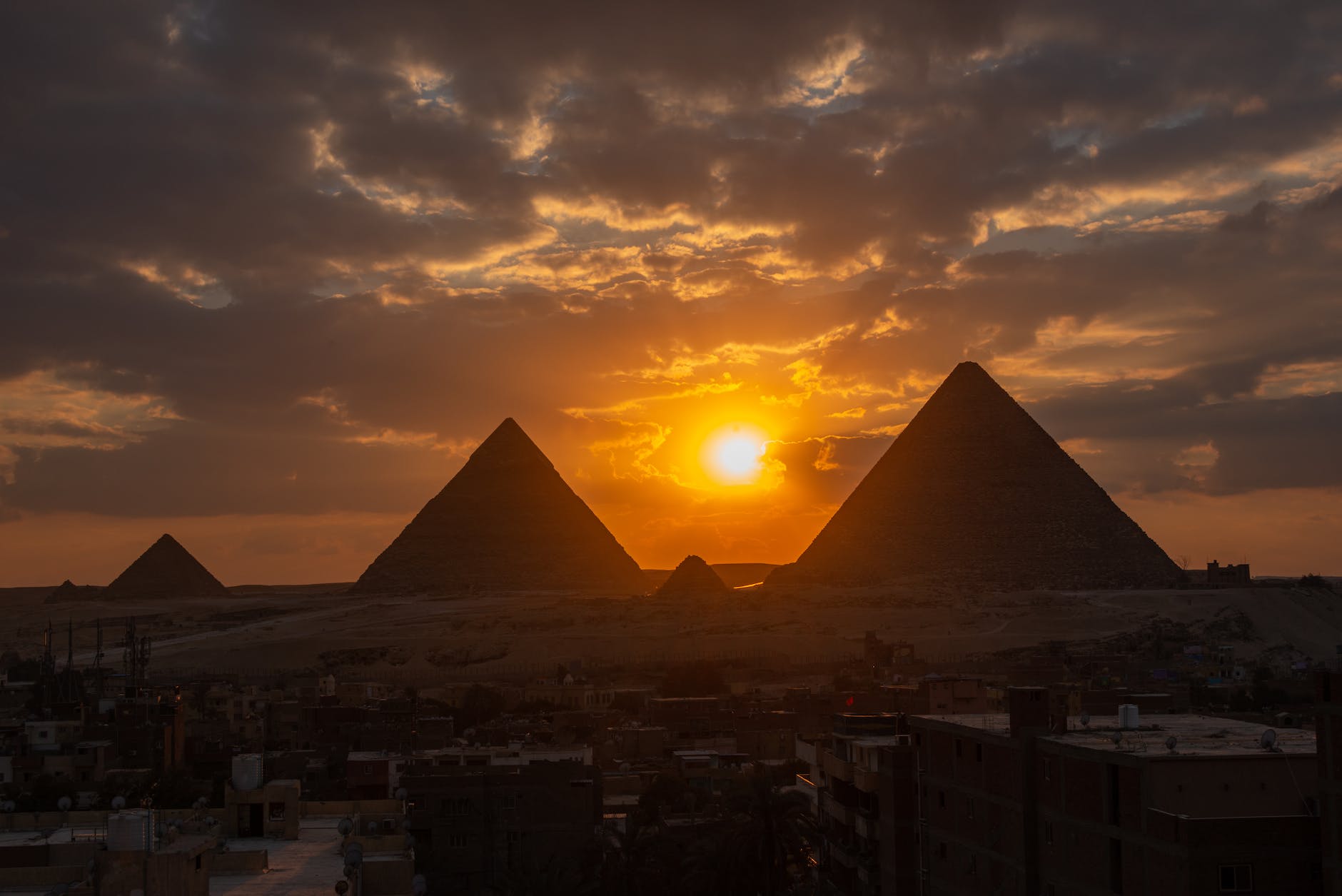
Photo by Diego F. Parra on Pexels.com
When viewed from the Sphinx, the midsummer sun sets directly between two pyramids — specifically, the pyramids of Khufu and Khafre. Whether or not this was intentional is beyond the scope of this discussion, but I imagine it is certainly a sight to behold!
Stonehenge
Stonehenge is another giant monument that aligns with the sun. On Summer Solstice, the sun rises directly behind the heel stone and the rays shine over the heart of the structure. Some say it was an ancient burial site, while others say it was a giant clock. Will we ever know? It’s definitely on my bucket list of mysterious places to visit.
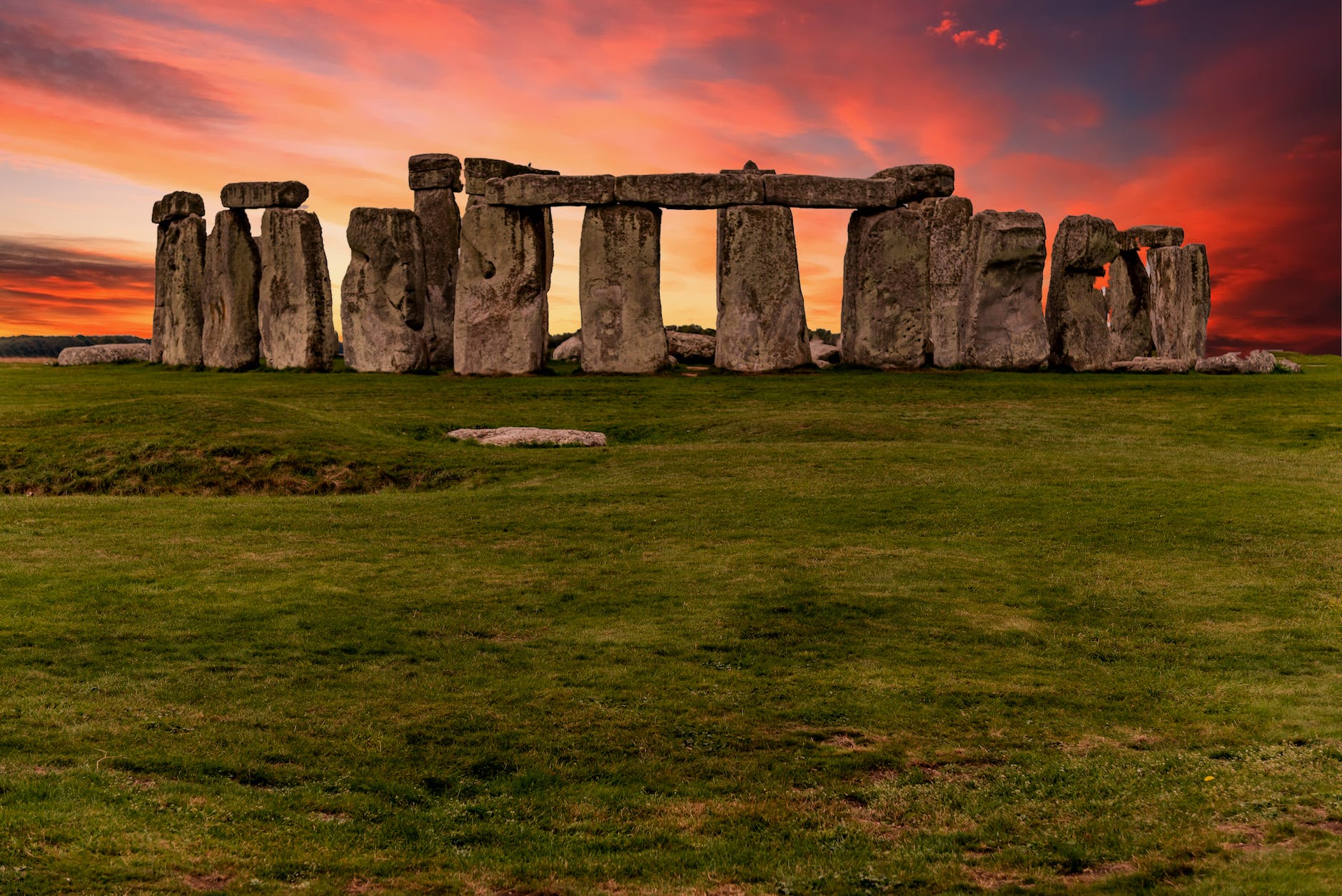
Photo by John Nail on Pexels.com
Celebrations
Egyptian
In Egypt, the Summer Solstice corresponded to the rise of the Nile. This annual inundation, where fertile topsoil would be replenished, was the backbone of Egypt’s wealth and stability.
Greek
For the Greeks, this time of year meant that the Olympic games were only one month away!
Roman
The Vestalia festival in Rome honored the goddess Vesta and included rituals and sacrifices. It took place each year shortly before the Summer Solstice and is still observed today.
Celtic
The Celts probably celebrated with solar wheels and bonfires, which could have brought luck and banished evil spirits. If you’d like to know more about bonfires, you can check out the Beltane post.
Christian
St. John’s day honored John the Baptist. St. John’s Wort was frequently used during this time to ward off evil spirits – the herb still carries associations with both the sun and protection to this day.
NeoPagan
For us modern folks, our Summer Solstice celebrations might include any of the above. Bonfires and solar wheels are still a common practice. Oh, we like to eat, too! None of the sabbats are complete without a feast. Some traditions also incorporate some of the May Day activities (like a May Pole) during the solstice, rather than at Beltane.
The Holly King and the Oak King
The battle of Holly King vs. Oak King is a story that is frequently told at each Solstice. The Oak King represents life and the light half of the year, while the Holly King represents death and the dark half of the year. They battle for the throne twice each year. At Summer Solstice, the Holly King usurps the throne and reigns as the days diminish. At Winter Solstice, the Oak King is victorious and reigns as the days grow.
There are different versions of this myth, sometimes switching up exactly when this battle takes place, but the above tale is the way I’ve heard it most frequently.
Let me say that this story never really sat right with me. The light is strongest at Summer Solstice, so why is the champion of light being defeated on his strongest day by an opponent who is at his weakest? Anyway, that’s my own personal gripe — regardless, it’s a story to be familiar with because it’s told all the time. I even repurposed a popular Christmas song to fit this tale — it might give you Christmas vibes, but the words are about the holly and oak king.
Incense Blends
It’s important to have appropriate incense to set the tone for your Summer Solstice ritual. Here are a couple classics from Scott Cunningham.
Midsummer Incense #1
From The Complete Book of Incense, Oils, and Brews by Scott Cunningham
- 2 parts Sandalwoord
- 1 part Mugwort
- 1 part Chamomile
- a few drops Rose oil
- a few drops Lavender oil
- a few drops Yarrow oil
Midsummer Incense #2
From The Complete Book of Incense, Oils, and Brews by Scott Cunningham
- 2 parts Benzoin
- 1 part Dragon’s Blood
- 1 part Thyme
- 1 part Rosemary
- 1 pinch Vervain
- a few drops Red Wine
Bees, Beeswax, & Honey

Photo by Pixabay on Pexels.com
Beeswax and honey are frequently associated with the sun because sun -> flowers -> bees -> bee byproducts.
Honey is frequently used to make mead and beeswax can be used to make special candles.
The sun is at its highest point at this solstice, so it is said to be capable of seeing both the past and the future. Due to this, beeswax divination is very appropriate to perform during this time. It’s a fun activity, but deserves its own discussion, so that’s something we can save for another day.
The More Candles, the Better
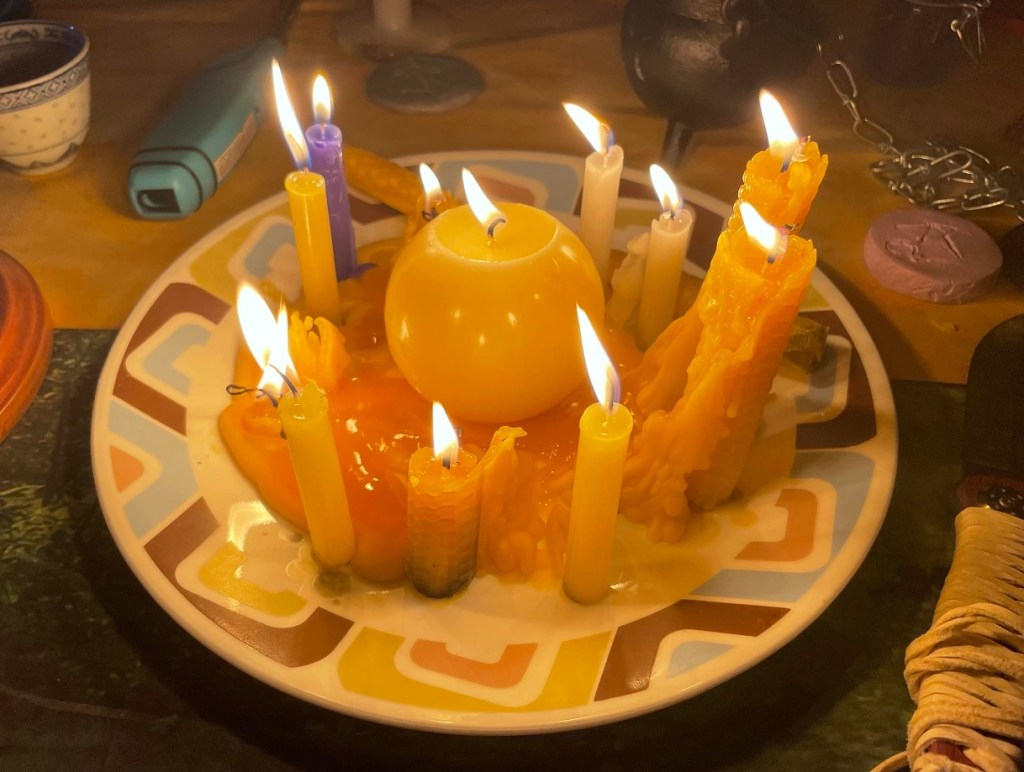
The minimum number of candles required for a Midsummer ritual. Original image.
A lit candle is a perfect proxy for the energy of the sun. Light as many candles as you feel like and sing a song to the sun!
If you can make your own candles, more power to you!
A Little Shakespeare Before We Go
Come and meet Oberon and Titania, King and Queen of the faeries! Did I mention that Summer Solstice is also a high point of activity for the fae? Well, it is, and this belief stretches back a long way, to the time of Shakespeare (1500s) and probably much longer before that. A Midsummer Night’s Dream is a comedic play about romance and trickery, both in the world of men and the world of the fae.
Shakespeare does mention some of the festivities, including the “rite of May” and a “painted maypole” that his viewers at the time would have understood, as you can see in the quotes below.
No doubt they rose up early to observe
The rite of May, and hearing our intent,
Came here in grace of our solemnity.
-Theseus (Act 4, Scene 1)
How low am I, thou painted maypole? Speak!
How low am I? I am not yet so low
But that my nails can reach unto thine eyes.
-Hermia (Act 3, Scene 2)
It is interesting that the play’s name highlights Midsummer, but the festivities described seem to be more reminiscent of Mayday and Beltane. During this time period in England, celebrations probably started on May 1 and continued well into June. But the most interesting takeaway from this play is the portrayal of the fairies. Thanks to Shakespeare, the public view of the fae shifted from fearful creatures to mischievous, sometimes charming ones.




 Aerik Arkadian

Leave a reply to usfman Cancel reply