
Thousands of years ago, Athens was the largest of the Ancient Greek city-states. And if you lived there, you would have worshipped Athena in some way. The attention of a major metropolitan center of the ancient world was certainly enough to sustain a godform into the present day. But exactly how many people are we talking about? Obviously it’s difficult to say for sure, but we do have some estimates.
Warning: This post may contain data and math.
According to a census ordered by Demetrius Phalereus in 317 BCE, Athens had a total population of 431,000 people. If you’re interested in really digging into that, here’s a link to a research paper.
The population counts were broken down in this way:
21,000 citizens (adult males)
10,000 metoikoi (foreign residents)
400,000 oiketai (household members – everyone else including women, children, and slaves)
Can we trust this data? It seems high to me, but let’s assume for a moment that Athens did indeed have over 400,000 people. And let’s further assume that all of these people, including the slaves and children, worshipped Athena. Those are pretty decent numbers for an ancient Deity, right?
Nope. That’s nothing. At least not by today’s standards.

Wait, is that Superman? Okay, I didn’t actually watch this movie.
In 2011, the film Immortals, which features Athena and many other Olympians, had a box office of 226.9 million dollars. The average movie ticket price for that year was $7.93. By dividing those two numbers, we can see that more than 28 million people were likely to have purchased tickets. And that doesn’t include how many people might have grabbed a DVD, streamed, downloaded, rented, or rewatched this 110 minute film.
We might skip on the entrails and burnt offerings, but we still worship. Sitting down and watching screens is a common ritual in many households. What better way to worship than giving the gods and goddesses an hour or two of your uninterrupted time?
Pagan Themes
Back in my day, we had shows like Buffy the Vampire Slayer and Charmed, which presented concepts in a very Judeo-Christian manner. There were witches, sure, but it would be hard to say there were many underlying pagan ideas. Angels were good and demons were bad. Everything was neatly framed within a tight box of “good triumphs over evil.” Eventually, Supernatural came along and extended the roster of typically vampiric “bad guys” to include other mythical creatures like Djinn and dragons. It even named some legit demons and included a character for Lilith. But again, the major deity was God (with a big “G”) and everything (including a scene of pagan gods having a round table discussion) was portrayed through a lens of Christianity.
That’s a pretty hard lens to break, but consciousness has been shifting in that direction for at least the past decade. In fact, Disney even started exploring pagan themes. Coco presented a version of the afterlife that was not Christian heaven, Soul explored reincarnation, Frozen 2 chronicled the power of the elements, Encanto told a story of magical realism, and Elemental made a clear distinction between the elements and elemental beings (water vs a “water person”).
So what can we see from the box office stats?
Coco
$814.3 million at box office
Average movie ticket price of $9.16 in 2019
88,897,379 estimated tickets sold
Runtime: 109 min
Frozen 2
$1.453 billion at box office
Average movie ticket price of $9.16 in 2019
158,624,454 estimated tickets sold
Runtime: 103 min
Soul
$121 million at box office
Average movie ticket price of $9.18 in 2020
13,180,827 estimated tickets sold
runtime: 100 min
Encanto
$256.8 million at box office
Average movie ticket price of $10.17 in 2021
25,250,737 estimated tickets sold
Runtime: 99 min
*At the time of writing, Elemental is too new to retrieve any realistic data
**Movie ticket prices taken from the National Association of Theater Owners
Between these four movies alone, just on their box office numbers, that’s 497,433,978 hours of time (collectively) devoted to pagan themes. That amounts to 20,726,415 days or 56,784 years.
Want to hear about future posts? Subscribe to get notifications delivered straight to your inbox.
Why is this important? Because it shows how highly popular and financially successful these movies are. Seriously, do you think a plot line venerating ancestor worship or reincarnation could have been a blockbuster hit 50 years ago? Those ideas are distinctly non-Christian and would have been rejected by the majority of the population. As those concepts reintegrate themselves more fully into the current collective consciousness, they’re laying the framework for the pagan gods to come back in force.
The Old Gods are Trending
If you don’t believe me, let’s look at a few trends. Specifically, let’s check out how people have been searching for Greek gods on Google.

Data current as of 7/5/2023
The above chart was produced from data courtesy of Google Trends. You can clearly see that the search volume for these Greek Gods has had an overall upward trend since 2004 (which is the earliest that data is available). Yes, I actually plotted the 235 data points for each search term and created a trend line in Google Sheets to show overall movement. “Aphrodite” searches have been trending downward, but I included it out of fairness and in order to not misrepresent the data. My apologies to the Goddess of Love. Don’t we all need a little bit more of her in our lives?
If you’re like me, you prefer raw data, so here are the individual charts.


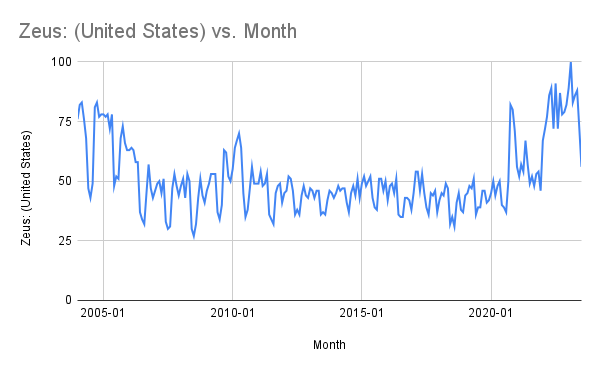
Unfortunately, these trends only show us comparative popularity over time. They don’t tell us anything about real volume. For that, we’ll need to go to another “tool.” Behold: Google Keyword Planner.

This is a free tool available to anyone with a Google Adwords account. You can see each of these terms has an average search volume of at least 100,000 per month. To get more accurate than that, we’d have to use a paid tool like Semrush, but I’m not that invested.
If five Greek gods are pulling in a monthly search volume between 500,000 – 5,000,000, I’d say they’re getting a significant amount of attention. And that’s not including all the rest of gods and goddesses in other pantheons.
The God of FIlm
Speaking of other pantheons, did we forget that the Norse pantheon has been featured in one of the highest grossing movies of all time?

Always aim for the head.
Second only to Avatar, Avengers: Endgame has grossed $2,799,439,100 total so far. Thor was a comic book character, yes, but he’s also a god. The Marvel Cinematic Universe takes us on a journey where you get to see the Aesir up close and personal.
What’s that? You want to see how Thor has been trending as a search keyword? Why didn’t you say so before?

That’s a spikey graph!
Would you believe that each one of those giant spikes, which I noted in large red bubbles, was due to the release of a movie?
2011 – Thor
2013 – Thor: The Dark World
2017 – Thor: Ragnarok
2022 – Thor: Love and Thunder
Thor has definitely gotten some love thanks to those movies. And maybe also thanks to Chris Hemsworth. But definitely because of the movies.
It might be safe to say that Thor is the current patron God of Film.
Gods of TV
But the old gods aren’t limited to reappearing in film. They’ve been making their return in TV series as well.
Child: “Is that Lilith?”
Adult: “Yes… wait, you know about Lilith?”
Child: “Of course I do. She’s one of my favorite characters.”
Haven’t you always wanted to have that conversation with your son or daughter? Well, now you can thanks to Owl House. Whereas Supernatural portrayed Lilith as an evil creature who birthed monsters, Owl House shows her as a positive role model. At the very least, this was enough to cause a ruckus with some conservative Christian groups, the general vibe being that it’s part of an evil plot to attract children into witchcraft.
Stand by. I’m currently having flashbacks to my own childhood where I was forced to sit through a church sermon that explained why Pokémon Cards were stepping stones to Magic: The Gathering, and therefore reeked of witchcraft. You’ll never take my Pokémon cards away from me. Never.
But back to TV, Loki didn’t get left out from his brother’s wake of fame. He got his own TV show (aptly named Loki) that explored a multiverse of alternate timelines. By the way, multiverses might be supported by our current scientific theories, but occult writings hinted at this idea way earlier.
Another worthy mention in this category is American Born Chinese, which came out earlier this year and was a great bit of fun. It tells stories of ancient Chinese mythology while also presenting the goddess Guanyin (also spelled Kuan Yin, Quan Yin, Kwan Yin, etc) as a real person.
Summing It All Up
The point is, gods and goddesses all began as thoughtforms. The mere act of thinking about them supports them and gives them life. When you spend time with them on your mind, even if it’s something silly like watching a movie, you’re actually strengthening their position in the collective conscious mind.
Is there any way to sum up all the time spent on pagan gods between Hulu, Amazon Prime, Netflix, and any other streaming services? I doubt it, but I think it’s pretty obvious that their reach is much more extensive today than it was in the ancient world.
Athena may have once been popular in Athens, but now she’s certainly gone worldwide.
What’s your favorite movie or show that features pagan deities? Tell me all about it!






 Aerik Arkadian
Leave a reply to Mike Bunch Cancel reply