
Jump to Lesson:
- Part 1 – Liquid Condensers
- Part 2 – Solid and Gaseous Condensers (current lesson)
- Part 3 – More Recipes
- Part 4 – Advanced Techniques (coming soon)
In Part 1 of this series, we discussed what fluid condensers are, how to prepare simple versions of them, and some of their possible applications. We also walked through a recipe and created a fire condenser.
In this installment, we will go over condensers in other states of matter — solid and gaseous. We’ll be expanding our general condenser knowledge — and for this, I’ll ask you to keep an open mind.
There are several “advanced” topics that I’m eager to share with you, but they’ll need to wait until later lessons. These are things like complicated recipes and advanced applications. I will, however, be discussing substitutes for gold chloride and the process of warding your creations at the end of this lesson… because realistically, that knowledge will effect any condenser you create.
Before we get into that, you might be wondering how I’m going to use the fire condenser that was made in the previous post. I have two primary ideas:
- Anointing petition papers before burning
- Anointing talismans that will contain fire energy
Although it is appropriate (and fun), you do not have to use a fire condenser in such a way that it combusts. Aside from the above, there are plenty of other potential applications.
Alright, let’s review.
Short Review
Going over that whole “definition” thing one more time…
Fluid Condenser: Any substance or combination of substances, in any state of matter, that have a high capability to conduct energy between planes (ie – the astral and the mundane).
It’s a fair statement that “fluid condenser” is a rather misleading term. They are named for the energy they conduct (electric and magnetic fluids), but this still leads to rather cumbersome nomenclature, especially when we start getting into different states of matter. “Solid Fluid Condenser” sounds like a contradiction in terms, so for sake of clarity I’ll usually be shortening things to just “condenser” as we continue on this journey.
Many people think of condensers as amplifiers, batteries, energy storage reservoirs, magickal conductors, and more — and you are more than welcome to call them that if you wish. I’m rather fond of the term “astral battery” myself.
You know what? You can call them whatever you want. But it’s important to keep this one concept in mind: we’re talking about shit that amplifies your magick.
Modifying an Existing RItual
You did make one of the simple fluid condensers from Part 1, didn’t you? Good. I’m proud of you. I didn’t officially tell you that you needed to, but your keen interest in fluid condensers has already put you ahead of the class. If by chance you didn’t, now is the time to return to the first installment of this series, choose a simple recipe, and prepare it.
It isn’t all fun and games here. Now we’re really getting into it, so I’m afraid I’ll have to give at least one assignment.
ASSIGNMENT #1
Modify an existing magickal ritual, one which you have already performed several times, to include the use of fluid condensers in some way.
There is no right or wrong way to do this, so long as you follow the guidelines. I’m asking you to modify something you’re already familiar with so that you can see how the inclusion of a condenser might change the overall feel or energy. Simplicity is key, we’re not looking for elaborate spellwork.
Simple VS. Compounded
Moving forward, you may notice a couple different adjectives describing condensers. I will refer to some as “simple” and to others as “compounded.” Bardon breaks fluid condensers up into these two categories of complexity. There are the “simple” fluid condensers, which use one ingredient, and the “compounded” fluid condensers, which use multiple ingredients.
On the simple fluid condenser, he writes:
–Initiation Into Hermetics
A simple fluid condenser which is prepared from single species of herbs or plants will serve the purpose for normal use, such as influence through the elements or the development of the astral senses through fluid condensers.
On the compounded fluid condenser, he writes:
–Initiation Into Hermetics
Whenever you have to achieve an especially powerful accumulation of energy or when you have to perform tasks which are to exert a physical influence in addition to a mental and astral influence, as for example the creation of elementaries (clay-wax figure), painting or picture animation, or any other materialization phenomenon, you can avail yourself of compounded fluid condensers.
If we break that down into a comparison chart, we’ll arrive at something like the image below.

For practical purposes, I expect you won’t ever need to refer to this chart. Your magick will never fail because you didn’t use the “proper” type of condenser.
The key takeaway is this: compounded condensers have higher energy potential.
If you’re looking for an explanation of some of these more advanced concepts, you’ll have to refer directly to Initiation Into Hermetics or a later lesson.
For many people (myself included) complexity becomes a necessity for certain magickal operations. The first time you do candle magick, for instance, using one candle seems really cool! It makes you say “wow, I’m doing magick! I feel magickal!” And if one works well, then two must work even better, right? So the next time you perform that spell, you double the number of candles. And that feels magickal until you decide you need candles lining the entire perimeter of a circle. Flash forward ten years and your monthly candle budget has exceeded your mortgage.
This brings us to a fallacy of magick, in which it is thought that complexity is proportional to efficacy. Sometimes the simplest spells can be the most effective. What’s required is the proper mindset, or in other words, the proper feeling.
I’m bringing this up now because in later lessons we’ll be discussing some prohibitively-expensive recipes. And next… we’re going to talk about gold.
Want to hear about future posts? Subscribe to get notifications delivered straight to your inbox.
Solid Condensers
I don’t know about you, but I don’t have any extra gold on hand or lying around. Actually, if you do have extra gold, I hope you keep it buried somewhere safe. Nonetheless, gold is generally regarded as the highest ranking of all condensers. And it usually comes in solid form.
Solid condensers make up an interesting category because many of them require no manipulation on the part of the magician — they simply act as condensers as a natural part of their existence. Gold requires no action to unlock its ability to conduct the electric or magnetic fluid — it is always a condenser.
Now, I take a rather unusual approach to this, but I like to think it is as unusual as it is practical. In my book, a spool of copper wire, a quartz crystal, and a chunk of frankincense resin are all solid condensers. For now, however, let’s just focus on metal condensers — specifically the seven planetary metals mentioned in alchemy. I’ve included a chart that lists the planets, their corresponding alchemical metals, and some possible substitutes.
| Classic Metal | Alternate Metal | |
| Sun | Gold | Brass |
| Moon | Silver | Platinum |
| Mercury | Mercury | Electrum, Aluminum |
| Venus | Copper | Lodestone |
| Mars | Iron | Pyrite, Steel |
| Jupiter | Tin | |
| Saturn | Lead |
By classic interpretations, gold can be seen as a universal condenser; however, many modern practitioners may choose to take a more balanced approach by combining sun and moon energy to represent both the divine masculine and divine feminine. An easy execution of this could involve something like twisting gold and silver wire together.
Extending the planetary correspondences to crystals, you may arrive at a chart like this:
| Crystals | |
| Sun | Diamond, Amber, Sunstone |
| Moon | Pearl, Selenite, Moonstone |
| Mercury | Aventurine, Mica, Pumice |
| Venus | Emerald, Jade, Peridot |
| Mars | Ruby, Garnet, Bloodstone |
| Jupiter | Amethyst, Lepidolite, Sugilite |
| Saturn | Jet, Obsidian, Coal |
And of course, your own personal table of correspondences between planets and crystals might look totally different. That’s the fun part. Not everybody agrees.
The point is that each one of these metals and crystals naturally exists as a simple fluid condenser. They also have elemental correspondences, which you may wish to take into consideration if you are in need of an elemental condenser.
I’ve received quite a bit of feedback after publishing part 1 and I’d like to share my favorite story. One friend explained that she had added a cat whisker to the creation of one of her magickal tools. I believe a cat whisker would qualify as a solid condenser. Fascinating stuff.
By the way, what did you do with the herbs you strained when you made a liquid condenser from Part 1? Did you throw them out? If so, you just threw away condenser. Don’t feel too bad about it though — I usually throw them out, too. Technically, you can dry these herbs and then powder them for later use as solid condensers. Solid herbal mixtures will be an “advanced” discussion for a later lesson.
So what do we do with solid condensers? Well, perhaps now it becomes clear why certain talismans are constructed out of specific planetary metals. In Bardonics, wands can be made out of hollow tubes and filled with solid condenser in the form of metal shavings, powdered crystals, or herbs. These wands are then used to direct energy in a variety of magickal operations. Our coven employs the use of a “coven crystal” which holds the energy of our group, in spite of absences, through each and every ritual. The applications are really limited only by the imagination of the practitioner, but we will discuss some unique ideas in the next installment.
Technically, resins (Frankincense, Myrrh, Copal, etc) are also solid condensers. You may burn resin as an incense, in which case it briefly becomes a liquid condenser, and then a gaseous condenser. That seems like as good of a segue as any to talk about our next state of matter.
Gaseous Fluid Condensers
First, let’s take a look at some resin correspondences.
| Planet | Element | |
| Frankincense | Sun | Fire |
| Myrrh | Moon | Water |
| Dragon’s Blood | Mars | Fire |
| Benzoin | Sun | Air |
| Copal | Sun | Fire |
I love resins. Unfortunately, I don’t have a resin correspondence for each of the 7 classical planets (or even for each of the elements), but I believe it is sufficient for any purpose to create a compounded universal resin incense that combines that power of the sun and moon. Is it any wonder that Frankincense and Myrrh is such a stereotypical incense blend for rituals or services across different religions?
Compounded Universal Gaseous Fluid Condenser Recipe
Wow, what a title for such a simple recipe.
Ingredients:
- 1 Part Frankincense
- 1 Part Myrrh
We typically think of incense as being responsible for providing the proper atmosphere during a ritual. This takes many forms. On a physical level, the scent helps get all the coven members on the same page. You could also even go so far as to imagine that once circle is cast, the aroma of the incense fills the space as a gaseous conductor of energy.
Taking a different approach, especially on the level of conjuration, gaseous condensers provide environmental atmosphere.
Imagine there was a doorway to Mars right in front of you. If you stepped through it, you’d die. The atmosphere on Mars doesn’t have what you need. If someone wanted to bring you there without killing you, they’d need to create an environment where you had access to oxygen.
This concept applies to evoking spirits. A Martian spirit (and of course, I’m talking about a spirit from the plane of Mars, not the ghost of E.T.) can’t easily exist in front of you unless you give it the proper atmosphere. That means having a space on the earth plane that closely resembles their habitat within the martian plane. With a more suitable environment, the spirit can put more energy into communicating with you and less energy into simply trying to exist.
As a final topic of mention within the realm of gaseous condensers, I’d like to briefly discuss the breath. Your breath is always with you. It’s always ready to take a magickal intention, frequently taking the form of speech. It is often dismissed or entirely overlooked as a magickal tool, but rest assured… Every chant, spell, or song begins with the breath.
Plastic: A Condenser’s Opposite
At this point, you might be thinking that my definition of condensers has become too broad. I know what you’re going to ask: “Aerik, is there anything that is not a fluid condenser?” Well yeah, totally. There are plenty of things in life that are not fluid condensers, but I’m not here to tell you what won’t conduct your magickal energy. Except for this one thing. I’ll give you one example of what is definitely not a fluid condenser: plastic.
Plastic is manmade. It takes way too long to decompose. And it’s seriously polluting the earth. Have you ever heard of The Great Pacific Garbage Patch?

A bird surrounded by ocean plastic on the Northwestern Hawaiian Islands. Photo credits: Matthew Chauvin. Image courtesy of The Ocean Cleanup.
It’s everywhere — in our jewelry, our houses, our vehicles. It might even be in some of our food, but it’s definitely in our clothing. Did you know that polyester is basically a type of plastic? You’re probably wearing some right now. Keep that in mind for when I tell you this next part.
Plastic is pretty much the polar opposite of a fluid condenser. It’s an insulator that does not conduct energy, even on the physical plane. As far as I’m concerned, if you’re trying to block astral energy, you might as well hide inside plastic.
I realize I’ve given you a long list of what is and a very short list of what is not. But this is a big one. Please don’t make magickal tools or ritual objects out of plastic.
And now I’ll get off this soapbox and talk about something else.
Substitutes for gold chloride
Gold Chloride is expensive. It can also sometimes be hard to obtain. Luckily, there are substitutions. If you find yourself unable to get your hands on gold chloride, feel free to use one of the following methods to create an alternative gold solution. Three of these methods require having a gold item, such a jewelry, which the first method will destroy. If you have neither gold chloride nor gold, you may use the last method, which is free, and only requires the imagination. They are ranked in order of “energetic potential” with the following caveat: In the hands of an experienced witch, method #5 will be more effective than a neophyte’s attempt at method #1.
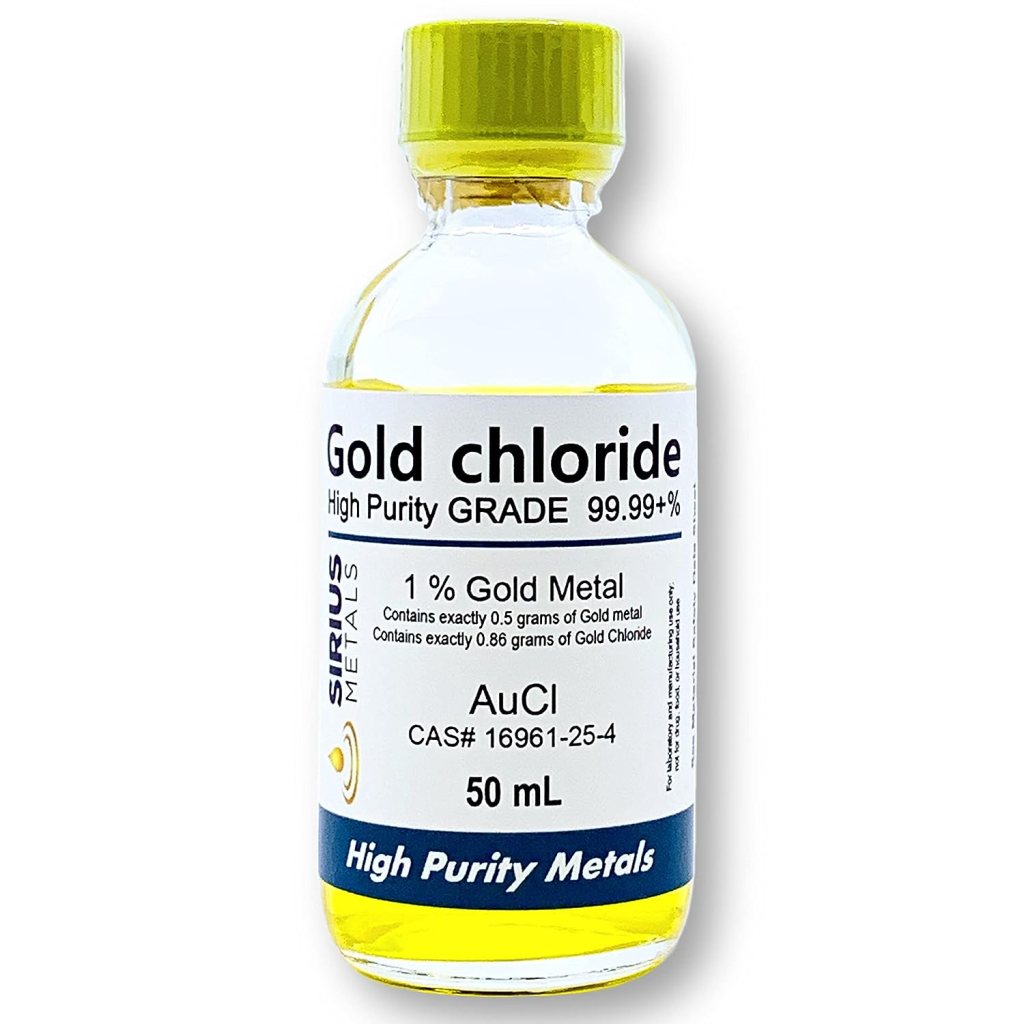
- Quenching Gold – Warning: You could get burned or otherwise seriously injured. This one can get pretty hot. You’ll need a blowtorch, tongs, a safe container, and a piece of gold jewelry that you’re willing to destroy. Fill your container with water. Hold the piece of jewelry with the tongs, then light it up with the blowtorch. Some instructions say to melt the gold until liquid metal drips into the water, but let’s remember that gold melts at 1,948°F (1,064°C). There are significant safety concerns with liquid metal. If you are using a mason jar, for instance, the sudden influx of heat from a drop of liquid gold may cause the glass to shatter or explode. It is sufficient to heat the item until it is red hot, then quench it in the water. Expect fizzles and splashes of boiling water. Do not let the tongs touch the water while quenching. This process should be repeated several times (pick a magickal number, 7 or higher). If necessary, you may add water to replace what boils and evaporates. When finished, bottle and label with the appropriate name and date (“Quenched Gold Solution” or similar).
- Electrolyzing Gold – Warning: You could get electrocuted or otherwise seriously injured. This one is shockingly fun. Get it? The method is similar to the creation of Colloidal Silver. I believe it is sufficient, for our purposes, to pass a current from a gold anode to a gold cathode while they are submerged in water. The actual scientific process of creating Colloidal Gold is quite a bit more involved, but results in gold nanoparticles infusing the solution, which is pretty damn cool. I’ve been reviewing the chemistry, but have yet to move beyond anything theoretical. If anyone with a deeper understanding would care to enlighten me further, please do. You can also purchase colloidal gold online (as a nutritional supplement) for much cheaper than Gold Chloride.
- Sun Infusion – This method is simple, clean, and ingestible. Fill a glass jar with water, place a piece of gold jewelry (as pure as possible) inside, then set everything in the sun for at least a full day. When finished, remove the jewelry and label with the appropriate name and date (“Gold Sun Infusion” or similar). If I was personally creating a “gold solution” for use in a drinkable condenser (such as something to be added to teas or potions) this is the method I would choose.
- Aurum Metallicum – You may obtain homeopathic remedies that contain gold. A common name for these pills is “Aurum Metallicum.” You can crush the pills and dissolve them in water to render a gold solution or simply just add the powder directly to your condenser. Please be aware that many homeopathic remedies only contain infinitesimally small quantities of the labeled substances. Some less reputable brands might contain no gold whatsoever. Make sure you buy from a trusted source.
- Aurum Imaginatum – This is basically Latin for “imagined gold.” You won’t find it in any alchemy texts because it’s my own personal method. When all else fails, you may simply infuse the idea of gold into water. To do so, use your dominant hand (or athame) to draw the alchemical symbol for gold in the air over a container of water. Cup your hands and hold them over top. If you are familiar with the concept of “pore breathing,” use this technique to channel gold energy from the air, into your body, and out of your hands, where it will charge the water. If not, visualize the water glowing brighter and brighter with gold light, until it is like a tiny sun that fills the room with an almost blinding glow. Since this method requires only water and imagination, it is by far the safest and most readily accessible alternative to Gold Chloride. As a bonus, you can add this method to any of the other 4 to strengthen the overall energy.
ASSIGNMENT #2
Choose method either #3 or #5 to create your own gold solution.
You may choose to make a Sun Infusion if you wish, but I will strongly suggest creating Aurum Imaginatum because it exercises strong visualization techniques. You will use this gold solution in later installments of the fluid condenser series.
Regardless of which method you employ, it is important to ward your solution.
Warding Your Creations
With many alchemical products, we want to ward our storage containers. In most cases, we’re talking about keeping energy inside. When I make a planetary incense, for example, one of my last steps is to charge the incense with planetary energy. I then mark the container with the corresponding planetary symbol as a ward to prevent energy loss while stored for long periods of time. If you are creating a gold solution, you should ward the container with the alchemical symbol for gold.
In the case of fluid condensers, which are blank slates of receptivity, the general idea would be to keep energy out. They’re like magnets for magickal ideas.
ASSIGNMENT #3
Ward your gold solution and any condensers you may have made previously.
Warding can be as easy as drawing some sort a symbol on your container with the intention that it becomes a barrier. You can use alchemical symbols, runes, sigils of your own design, or anything else that you feel is appropriate. Even a pentagram will do the trick. This simple act will help ensure the energetic potential of your condensers for long periods of time.
Recap
If you’ve been following along, we’ve discussed things that are condensers, in every state of matter, as well as things that definitely are not. You’ve also had the opportunity to make your own properly-warded condenser, supercharge it with gold chloride (or a substitute), and add it to magick that you’re already familiar with performing. Surely by now, there can be no more to say on the topic, right?
Guess again, friend. We still need to take a look at the original recipes that inspired all of this! And there are also several advanced topics that require more investigation. For all this and more, stay tuned for the next installment of this series.
In the meantime, why not drop me a comment and tell me about your progress. How have you personally used condensers? What sort of magickal ritual did you alter?
Ah, at last you’ve made it to the end. I’m overjoyed — not only that you’ve come this far, but also that you’re reading the fine print. This is where I mention the fact that there are Amazon referral links somewhere within this post. If you use those links to make a purchase, Amazon pays me a small commission. Now that we’ve got that out of the way, you can return to your condenser creation. Thus endeth the fine print.






Leave a Reply