
The dark time occurs between Samhain and Yule. Although it has a rather ominous name, there’s absolutely nothing scary about it. It’s simply a period of increased introspection where we try to turn our attention inward. In our tradition, we choose to not perform any dedications, initiations, or elevations during this time. I also would personally put off the creation of magickal tools, the start of big new projects, or the celebration of any significant rites like handfastings or weddings.
Now don’t get me wrong, this isn’t a hard and fast rule. There’s no governing board for Wicca, so not everyone follows the same idealogy. I’ve seen plenty of covens schedule initiations throughout November and December and that doesn’t in any way threaten the success or legitimacy of those events. I say again: there’s absolutely nothing wrong with it. It’s simply a personal choice, which I’ll attempt to explain.
The Death of the God
Samhain marks the official death of the god. He isn’t reborn until Yule. This means that these ~2 months are particularly lacking in his archetypal energy. That is, at least, according to our “wheel of the year” narrative.
Hmm… how do I explain this one? On one hand, god and goddess energy in all forms, are always present. They are balanced and found within everything — including you. On the other hand, the wheel of the year tells us that the god essentially disappears to the underworld for a while every winter.
Do we actually lose the god at Samhain? No, of course not. And [spoilers] there’s no actual baby god being born at Yule, either. What we’re trying to do with these stories is personify the cycles of nature. We put human faces on concepts like the earth, moon, and sun so that we can better relate to the ideas. During winter, the earth has obviously entered into a time where plants die and many animals hibernate. To embody the spirit of this period, we use the “Lord of Death” archetype.
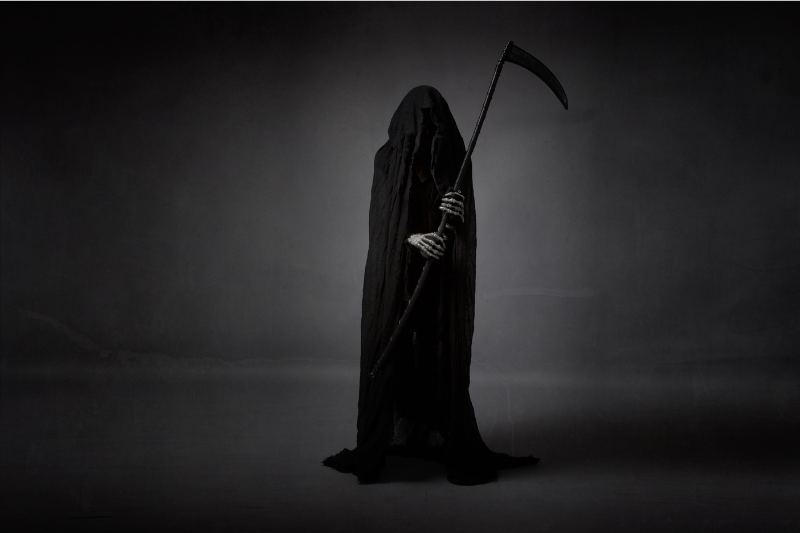
This isn’t really what I picture when I think of “Lord of Death,” but you get the idea.
Please keep in mind the following rule: “As Above, So Below.” In this particular example, your body (the below) is the microcosm and the earth (the above) is the macrocosm. Everything that happens in nature is reflected in your own physical form. Since nature enters a period of dormancy, it makes sense to at least be aware that our bodies, energetically speaking, are feeling this as well.
Does nature typically sew seeds or have beautiful flowers blossom during the winter? No. So we don’t either — we don’t do dedications, initiations, or elevations during the dark time.
But… there is at least one thing that we do do.
Yes, I said do do.
Shadow Work
The dark time is the perfect opportunity for shadow work. If you’re new to this concept, what we’re really talking about is getting in touch with our unconscious mind — aspects of ourselves that we might hide from the rest of the world.
Carl Jung wrote pretty extensively on this subject. It was his viewpoint that we must accept our shadows in order to be whole. Sounds easy, right? Not so much. The shadow self often includes “darker” aspects of our personalities like addiction, greed, jealousy, or anger. These are things that, in order to get along in polite society, we often repress. And that’s where the trouble comes along. The more you try to repress your shadow self, the stronger it will fight.
Want to hear about future posts? Subscribe to get notifications delivered straight to your inbox.
Let’s consider my invented friend, Bob. Bob is a greedy guy. He doesn’t like to admit it, but money is the only thing he cares about. He’s always looking for the next big score and he doesn’t care how he gets it. A few years ago, Bob lost all his money in a poker tournament — he really thought he was going to win. After that, everybody told Bob to quit gambling, so he did. He even managed his money pretty successfully for a while, but then he received an email from a Nigerian Prince. The Prince told him he could receive a major inheritance if he just paid the taxes up front. Everyone told Bob it was a scam, but he couldn’t resist the thought of getting the cash. He wired all his savings and… just like that, lost them. Bob vowed to never make a poor financial decision again… but was desperate to recover what he had lost. He turned to black market deals and the illegal importation of Kinder eggs into America. His last deal went south and now, unfortunately, Bob is dead.

Kinder Eggs were Bob’s downfall. Will they be yours?
What did Bob do wrong? Well, presumably a lot; however, what we’re going to focus on is the failure to address his shadow self. Bob didn’t get in touch with whatever programming he received, perhaps as a child, that caused him to feel this excessive need for money all throughout his adult life. It seemed like Bob was winning the individual battles, recovering each time and making vows against the behaviors, but losing the overall war. Bob’s shadow popped up in the story in various forms — first as gambling, then as an email scam, and finally as a black market candy trade.
That’s the issue. You think you’ve repressed your shadow, but really it’s just gaining strength in another aspect of your life.
Instead of fighting our shadows, we need to nurture them.
Feeding Your Demons
There are lots of different ways to do shadow work, but one of our favorites comes from a book called Feeding Your Demons by Tsultrim Allione. Selene found the book a while ago and it quickly made its way into our coven teachings.
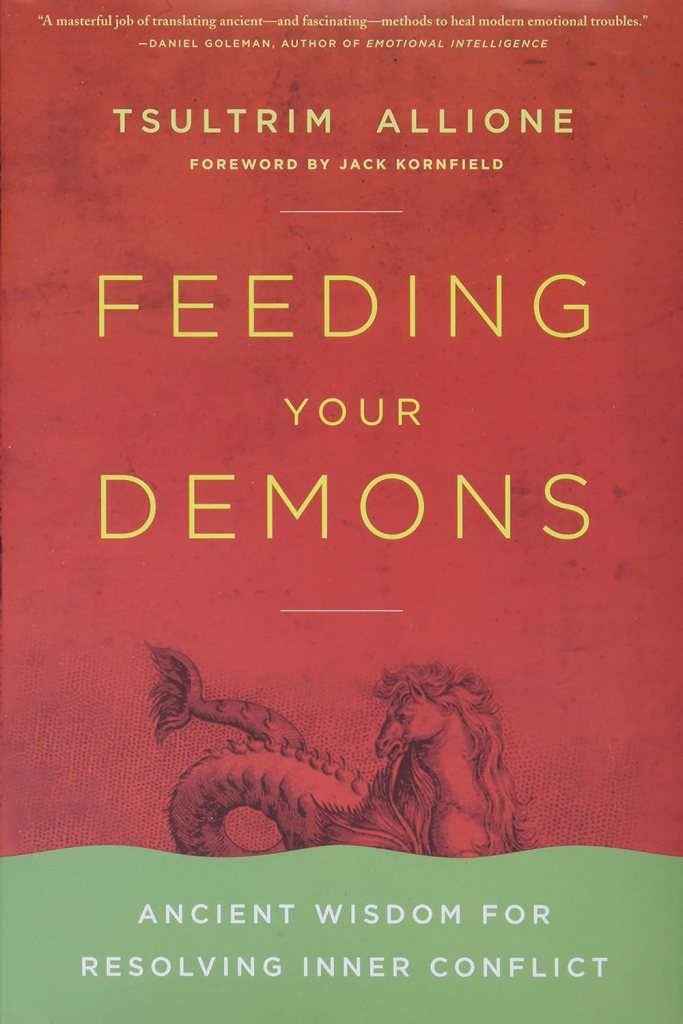
Feeding Your Demons by Tsultrim Allione
The method of shadow work described by the book is based on a particular school of Tibetan Buddhism called Chöd, (pronounced “CHUDD” or “TSHUDD”), which was originated by an 11th-Century female Buddhist monk named Machig Labdrön. One of their meditational practices involves singing, playing a drum, and ringing a bell, while mentally dismembering the body and dissolving the pieces into “nectar” – this nectar is offered to spirits for the betterment of all sentient beings. With all the dismemberment going on, it should come as no surprise that the word “Chod” itself means “to cut through” or “to sever.”
Tsultrim Allione has magnificently adapted all of these practices to be easily digestible by people with a Western mentality. Firstly, demons don’t really exist in Buddhism. The closest thing, as far as I’m aware of, is a “mara,” which is a force that is antagonistic to enlightenment. In the context of the book, “demons” are anything that holds us back from being truly free – obsessions, fears, depression, addictions, anger, etc.
Feeding Your Demons explains how to give your shadow self what it needs so that it quiets down. This does not mean giving yourself license to engage in destructive behavior. Rather, it is an opportunity to treat an underlying condition before it is projected into the world around you.
All of this is accomplished through a pathworking. Instead of focusing on particular people or events, you focus on the way you feel. This feeling is amplified and personified into a creature, who you get to meet, talk to, and learn how to help. You end up talking to yourself from the perspective of your demon, uncovering what it is your shadow really needs. By the end of the process, you convert your “demon” into an “ally” — something that works with you rather than against you.
If you want the whole pathworking, you’ll have to get the book. But it’s worth it.
Conclusions
The dark time gives us a great opportunity to look inward and focus on shadow work. Feeding Your Demons is one method to address the needs of the shadow self, but there are plenty of others!
What’s your favorite way to do shadow work? Tell me all about it!




 Aerik Arkadian
Leave a reply to Dawn Renée Cancel reply