

Ah, Imbolc — the first day of Spring, traditionally celebrated every year in the Northern Hemisphere on February 1 and sometimes through the end of the next day. It’s one of the four Greater Sabbats on the modern Wheel of the Year.
What’s in a Name?
Imbolc, sometimes spelled Imbolg, is derived from an old Irish word that translates to “in the belly” which refers to the ewes (female sheep) that are pregnant at this time and getting ready to give birth. Accordingly, “lambing season” is usually from February to early March — it’s probably a busy time for both the farmers and for the sheep.
We don’t always all agree on the pronunciation. That’s okay — having different ways to say a word just adds to the fun. The most frequent pronunciation that I encounter (and use myself) is “IM-bulk” although “IM-mulg” is definitely an acceptable contender.
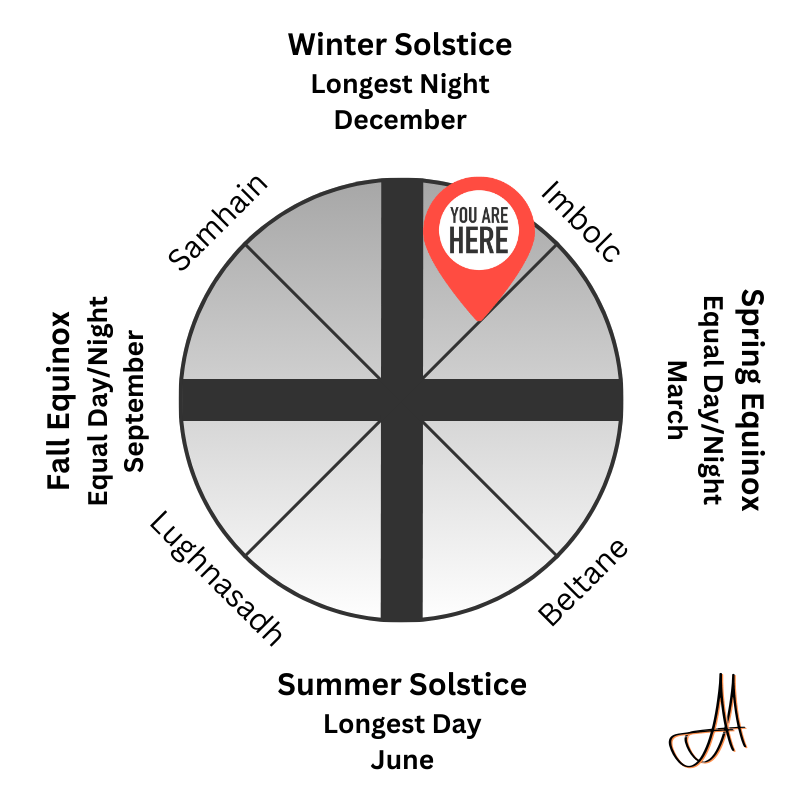
It lies directly between Winter Solstice (Yule) and Spring Equinox (Mabon), but don’t worry, there’s always a handy chart to refer to if you’re lost. You’ll find our location with the giant “YOU ARE HERE” marker.
This is the time of year where the frosts have begun to break and flowers push through, reminding us all that there is life. The snowdrop flower actually has it’s peak season in February — these tiny little bulbs just can’t wait to say “hello!” and often push their blooms through while there is still snow on the ground, hence their fitting name and frequent association with Imbolc.
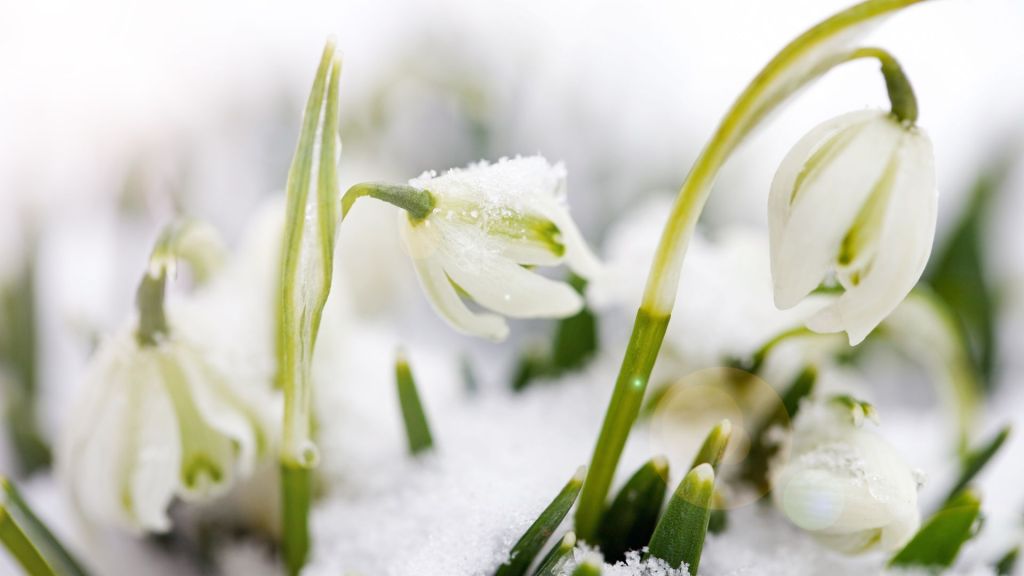
Snowdrop flowers earning their name…
While all of the above is true, yes, I sometimes do find it a little bit hard to relate. I can remember snow from my childhood, but it’s been quite a while since I’ve actually seen any. Where I live now doesn’t get cold enough for frost. Sometimes the weather gets down to a rather intolerable 60 degrees, but that’s about as far as it goes. And… come to think of it, I honestly don’t believe I’ve ever encountered a snowdrop flower in real life either.
So what do we do? We look to the land near us! I’ve touched on this topic before around Fall Equinox, where I muse about missing falling leaves, but it’s important to see what the earth is doing near you. The cycles in nature are reflections of changes in ourselves, and you can certainly mark this with something, even if you don’t have melting snow or pretty white flowers. But we’ll come back to this topic later. For now, let’s finish up with the traditional associations.
Associations
For your quick reference…
- Dates: Feb 1
- Colors: White, Red
- Flowers: Snowdrop
- Herbs: Basil, bay leaf, angelica
- Crystals: Amethyst, moss agate, sunstone
- Foods: Milk, cheese, creamy foods, white foods
- Symbols: seeds, bride’s bed, brigid’s cross
- Instruments: drums
- Deities: Brigid
Brigid and Syncretisms
Brigid tends to be one of the most popular deities during Imbolc season, although you might hear her called by one of many other names including Brigit or Brid. In Irish mythology, she is part of the Tuatha Dé Danann, a daughter of Dagda, wife of Bres, and mother to Ruadán. She is mentioned in writing as far back as the 9th century — Cormac’s Glossary, which was written by Christian monks, even states that she has two sisters with the same name — that does seem a little odd, but it’s probably just evidence of her being seen as a triple goddess.
She has associations with healing, poetry, smithing, and livestock. She is also credited with the invention of “keeling,” a mixture of wailing and singing, which was first heard at her son’s death. To the Celts, she was a warrior, teacher, and solar goddess. Oh, and don’t forget her cow, which is white and has red ears.

St Brigid. Photo by Octave 444, CC BY-SA 4.0. Image courtesy of Wikimedia.
At some point, the goddess Brigid became syncretic with a Christian Saint. Anecdotal stories of the human “Brigid of Kildare” are few, but seem to indicate she was a daughter of a chief and a slave, raised in druidry, and then became a consecrated virgin. In The Witch’s Wheel of the Year, Jason Mankey asserts that there was no real person; rather, it was the idea of the goddess herself that achieved sainthood. Saint Brigid’s Day, which is her feast, is celebrated on February 1.
Brigid is particularly interesting because depending on how you view her, you might see her as a saint, a deity, part of the mighty dead, or just a person! Regardless, it’s probably safe to say that she’s been honored by millions all over the world.
Many people also see links between Brigid, Hestia (Greek), and Vesta (Roman). One pretty obvious similarity is that all three goddesses have perpetual flames tended in their name.
Want to hear about future posts? Subscribe to get notifications delivered straight to your inbox.
Tending the Flame
According to legend, Brigid’s sacred fire in Kildare burned for over 600 years. It was tended by 19 nuns, who took turns watching over the flames. On the 20th night, Brigid herself would return and tend the fire.
Pretty cool story, right? But what’s even cooler is that people still honor this tradition. I know this because my wife is one of them!
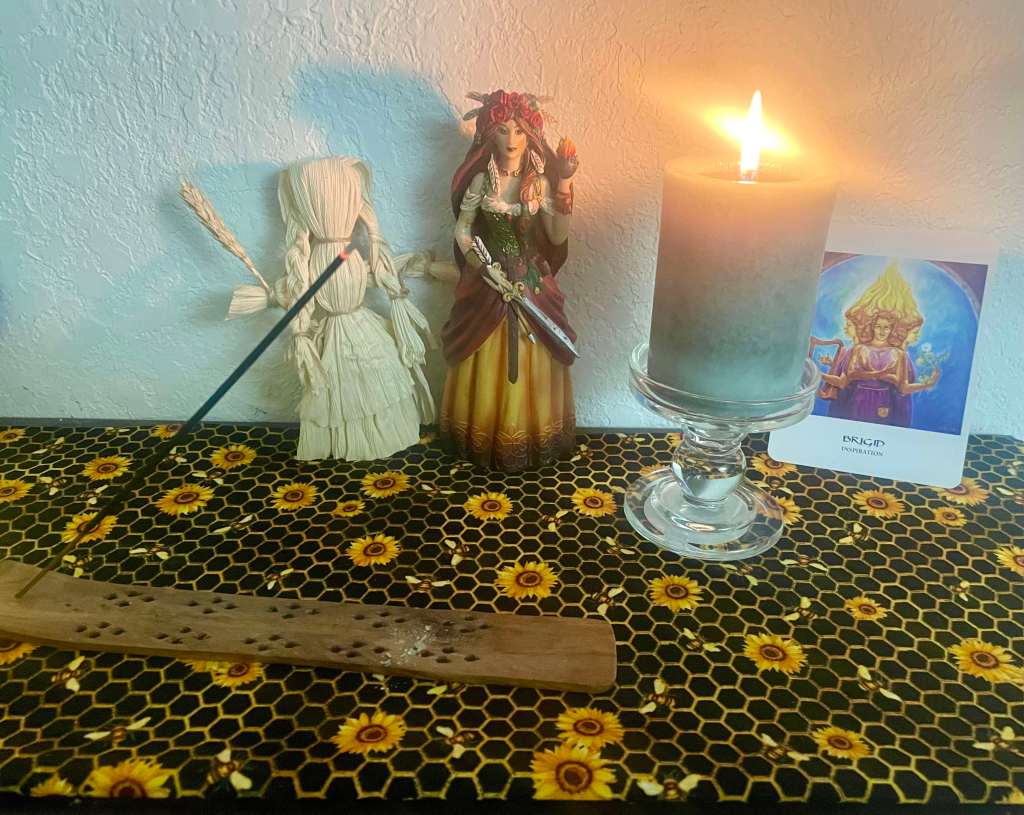
Selene’s Flame for Brigid. Photo Credit: Selene
Selene is part of a group of priestesses who have decided to tend Brigid’s flame all year round. They are each assigned a day of the month to keep a candle lit. The above picture shows the space that Selene has set aside for Brigid, along with a statue and her candle.
Sure, this flame tending isn’t specific to Imbolc, but it is very notable to Brigid. For this reason, a special candle could make a great way to honor the goddess on the night of your sabbat.
Candlemas
Speaking of candles… there’s a large Christian festival around this time that heavily features them.
Candlemas is celebrated on Feb 2 and commemorates the day Jesus was presented at the temple 40 days after his birth. Back in the day, people would light candles and walk around town. Sometimes the candle stumps were even saved and were thought to have protective powers.
Sometimes you will hear people say “Candlemas” when they are, in fact, talking about Imbolc. Make no mistake, these are different celebrations. Candlemas is not Imbolc, just like Christmas is not Yule. It’s more than likely that the church chose this date in proximity to Celtic festivals in order to help people assimilate. If you count the days, you can see that Candlemas takes place 40 nights after Christmas… but try to keep in mind that December 25 was also a “convenient” placement near Yule and that there’s no historical evidence to suggest Jesus was actually born on this date.
What are the God and Goddess Doing?
During Imbolc celebrations, there’s a lot of talk about the goddess and very little talk of the god. This is interesting because directly across the wheel at Lughnasadh, the opposite is true. Brigid is pretty much as highly featured at Imbolc as Lugh is at Lughnasadh. Maybe we should rename Imbolc to “Brigitasadh,” which, if my jestful etymology is correct, could basically mean “feast of the goddess Brigid.” But I jest.
As always, let’s take a moment to stop and think about what the archetypal god and goddess energies are doing at this point in the year.
For starters, the goddess just gave birth at Yule. She’s starting a new cycle. In Wicca: The Old Religion in the New Age, Vivianne Crowley says “at Candlemas the Goddess renews herself once more and re-emerges into the world as virgin again.” (Note: You can’t really find the original publication of this book anymore — it has since been rewritten with less “spoilers.”) It is interesting to think of this concept of renewal as it applies to our own lives.
The god, on the other hand, is continuing his cycle. His journey started at Yule as the promised savior, the sun that could warm the land and bring life again. Around the time of Imbolc, his energy starts to shift from “child” to something that is rather Pan-like. He’s got seeds that will need spreading.
Seeds and Beds
Speaking of seeds, they’re a traditional symbol for Imbolc. As we discussed earlier with the snowdrop, Imbolc is the time when the frosts have begun to break.
Just as the phrase “in the belly” refers to ewes being pregnant with lambs, it also refers to the earth being pregnant with the first seeds of spring.
Some things can be planted at this time, but it might be a bit too early for others. Either way, this is definitely a time to plan out what needs to be planted — and that can refer to seeds in our garden or manifestations in our lives. For this reason, you’ll frequently see seeds featured on Imbolc altars or hear about Imbolc rituals that involve blessing seeds.
You could also keep your seeds in a Bride’s Bed, which is basically a basket lined with white flowers (or fabric) and a corn dolly to represent the goddess. Just a quick note, “Bride” in this particular instance is pronounced as “BREED” and not as “BRYDE.” All of this is kept on the altar until Spring Equinox, which reenacts a time when cold seeds might have been brought inside and warmed on the hearth before being planted. Bride’s Beds can be extremely decorative if you care to put them time into making one! Also, if you’ve made one before, please share a picture.
St. Brigid’s Cross
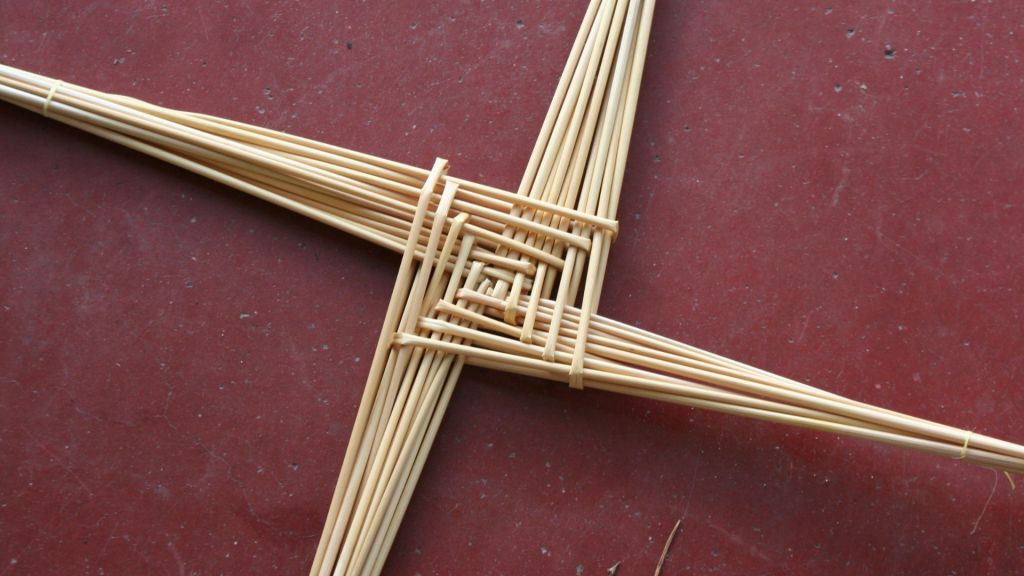
If you’ve never made Brigid’s Crosses at Imbolc time, you’re missing out. It’s a simple craft that everyone can enjoy that doubles as a magickal object. You can leave them around your home to invite Brigid’s protection. Also, they just look cool.
The traditional method of making Brigid’s Crosses uses river rushes, which are flowering plants that grow near or in shallow water and are commonly used in things like basket-weaving or thatching. Look, those are pretty and all, but we really don’t have them locally where we live. I’ve actually tried to order dried river rushes online, but the price was high and the shipping was extremely slow.
I’ve tried out a few alternatives. This is where a local mindset really comes into play. What sort of things grow near you that could be good construction materials? In Florida, we have a surplus of palm fronds, so I’ve used this on at least one occasion.
But if all else fails, you know what works well and can be purchased inexpensively at any grocery store? Corn husks!
For a while, I’ve been telling myself to make a video that shows making a Brigid’s Cross out of corn husks. If you’re seeing this message and there’s still no video, the good news is that I’m at least one step closer to manifesting this goal, since typing out this reminder is clearly the first step. (Note to self: Make video about Brigid’s Crosses)
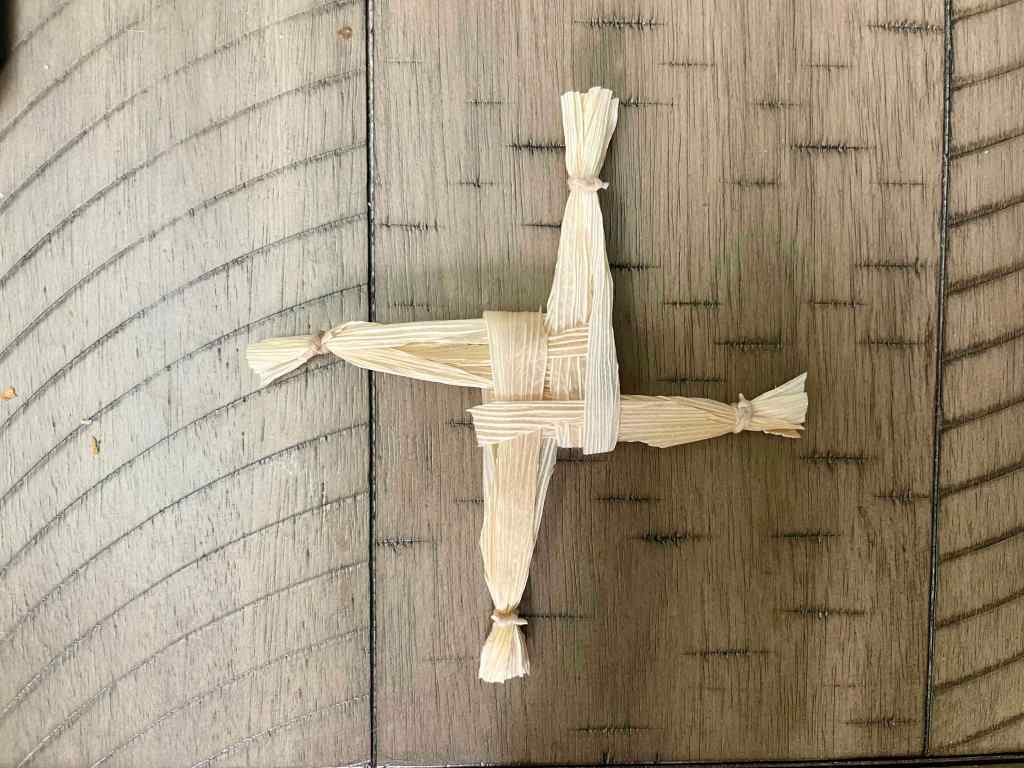
St. Brigid’s Cross made from Corn Husks. Sort of. Original Image.
Update from future Aerik: I did make a video. But instead of corn husks, I used wheat. You can view that here. It only took me a year.
Unique Feasts
We’re almost done. There’s just one more traditional association to talk about: Dairy.
If you again look in Cormac’s Glossary (I’m sure you have a copy nearby), you’ll find yet another curious word: Oímelc. This is supposedly translated to “ewe’s milk” and is frequently mentioned in proximity to Imbolc.
Remember, also, that Brigid has her own associations with dairy, cattle, and milk… and yes, travels with her own pet cow.
For these reasons, Imbolc is often very associated with milk, milking, or dairy products. Sometimes for Imbolc feasts, we have everyone bring white-colored foods. I don’t have a picture of this handy, but it certainly makes for a unique presentation on the table.
Cheesecake, anyone?
Imbolc-Adjacent
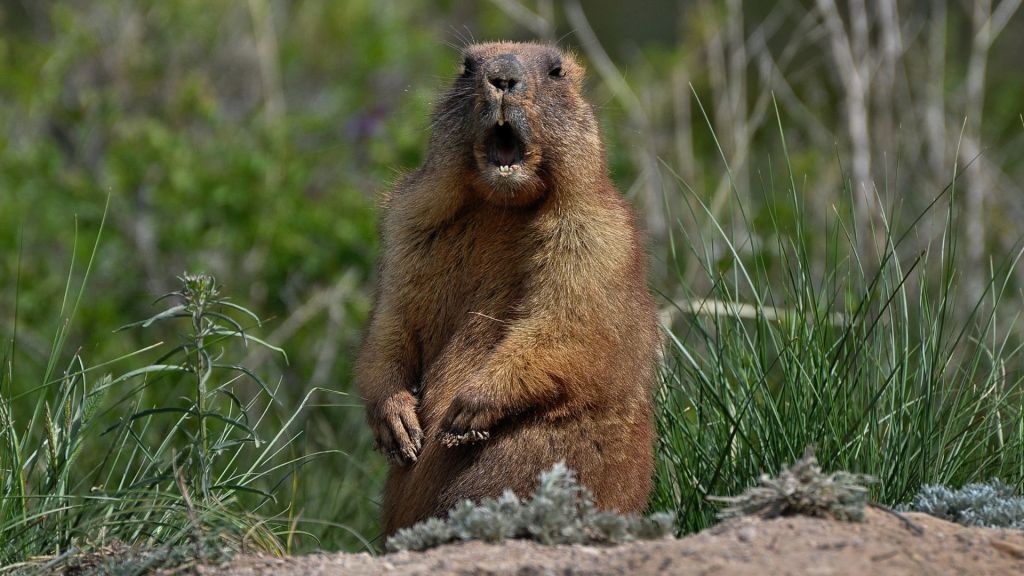
Where’s your shadow, guy?
The beginning of February is filled with other interesting dates that aren’t Imbolc, but still worthy of note. We’ll call these things “Imbolc-adjacent.”
Groundhog Day is celebrated on Feb 2 each year. This is by far one of the strangest customs (or superstitions) still in place in the United States on a national level. It has a history all of its own that would take an entire post to explain, so maybe we’ll talk about it next year.
February 2 is also the feast day for the Orisha Oya.
Music
What sort of music puts you in the mood for the end of winter?
Remember, it’s not necessary that the song itself be specifically about Imbolc. If you search for Imbolc playlists, you’ll find TONS that are filled with traditional Irish music. That doesn’t always resonate with me. What’s important is that you like the song and that it fills you with the feeling of winter being over and the sun growing in strength.
Conclusions
I don’t have any snowdrop flowers and I certainly won’t be milking any cows, but “seasonal” availability of potatoes and papayas begins in the month of February for Florida. If I wanted to inject some local energy into my Imbolc celebrations, I might choose to feature one of those foods either on the altar or in the post-ritual feast.
However you decide to celebrate Imbolc, I wish you a very blessed day. Cheers!
Hey, I really appreciate the fact that you’ve at least scrolled all the way down here. That must have been quite a journey from the top of the page. This is to just let you know that there are a couple of Amazon affiliate links in this post. If you use those links to make a purchase, Amazon will give me a small commission. Have you ever wondered how many books you’d have to buy before the commissions would start to pay for the price of hosting this website? I won’t give you the exact number, but it’s more than 100. Isn’t that fun?






Leave a comment