

The pendulum will always hold a special place in my heart because it was my first form of divination. Actually, I wasn’t even convinced it was truly a form of divination — rather, I thought it to be a tool that operated on subconscious body movements. What do I believe now? Well… we’ll come back to that.
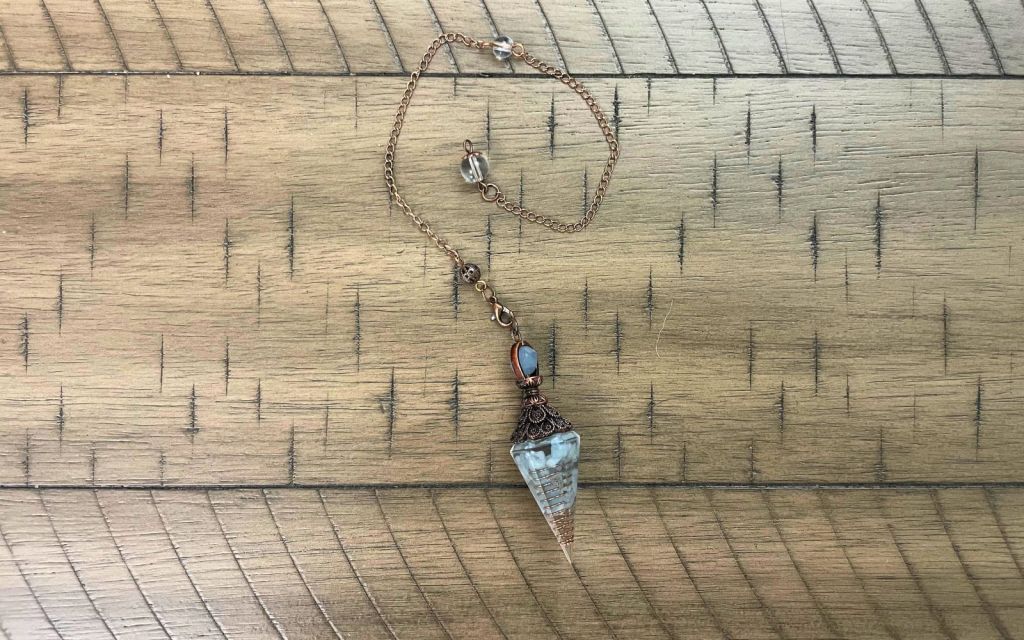
My current pendulum. Well, one of them. Original image.
I can still remember my first pendulum. I used to carry it in a tiny black drawstring bag, gently nestled in my right pants pocket. It was an amethyst point… its silver chain, which was decorated with tiny chakra crystals, ultimately ended at a small amethyst handle.
I used to ask that thing everything. And it was pretty damn easy!
Choosing a Pendulum
The first thing you’ll need to do, obviously, is acquire a pendulum. You won’t be hurting for choices. There’s hundreds available online and they’re frequently found at metaphysical stores or any other shop that happens to sell spiritual books, tarot cards, crystals, or incense.
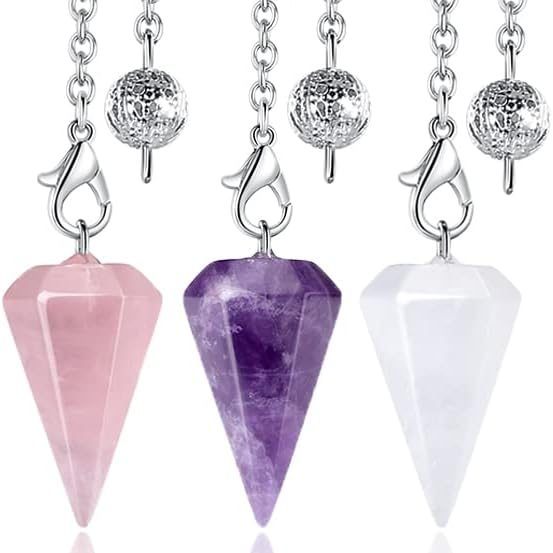
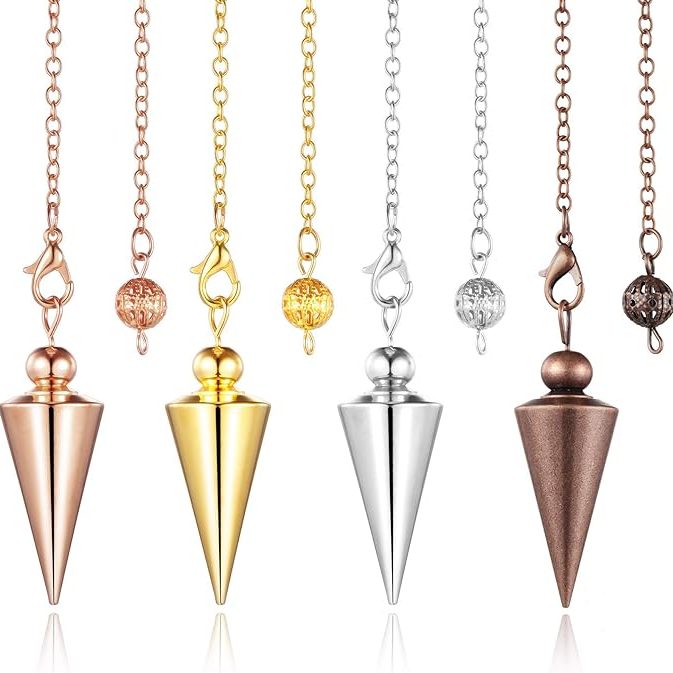
Perhaps the most common choice is a crystal pendulum, but you’ll often find them made of metal as well. Just look for something that calls to you. When you see one you like, that’s the one. Most of them do not require a significant investment and can be purchased for under $20.
Regardless of what material you choose, the underlying concept is the same: a weight is suspended from a string. In a pinch, you could even make your own. Try looping a necklace chain through a ring (the heavier, the better) — boom, you just made a pendulum.
If you spend some time in the Craft, you’ll probably end up acquiring more than one. Pendulums are affordable, pretty, and they make easy gifts. I can’t tell you exactly how many are in our house at the moment, but it’s probably somewhere between 4 and 10.
Pendulum Training
“Yes” and “no” are the most basic responses you can get from divination. With a dice roll, you could assign even values to yes and odd values to no. With a card pull, you could determine this with reversals. But with pendulums, your answer will be based on which way it’s swinging.
When I was first learning pendulum divination, it was recommended that I treat it like an individual with its own feelings and personality. I don’t really vibe with that, but there’s a little science behind the concept. Different weights and materials will cause pendulums to react slightly differently to your involuntary body movements. For that reason, your response patterns can vary from one pendulum to the next, so it’s a good idea to ask what “yes” and “no” answers will look like.
First, let’s talk about basic posture. You’ll hold the non-weighted end of your pendulum chain between the thumb and first finger on your dominant hand, suspending the weight about 1-2 inches above your non-dominant hand. Your non-dominant hand should have the palm open and facing upwards. I usually find that it helps to keep the elbows out to the side rather than in or close to the body. Finally, both hands should be about chest height rather than head height — although sometimes tempting, you don’t need the pendulum right in front of your face. You can do this while standing or sitting. We’ll call this “pendulum posture.”

Pendulum Posture.
Now let’s learn some basic responses.
- Assume the pendulum posture as described above
- State aloud “Please show me yes.”
- Without forcing motion or tensing your muscles, wait for your pendulum to move
- Make note of the motion or swinging pattern
- State aloud “Please show me no.”
- Without forcing motion or tensing your muscles, wait for your pendulum to move
- Make a note of the motion or swinging pattern
Many people will find the two main patterns here are clockwise vs counterclockwise spin. For me personally, clockwise is usually a “yes” and counterclockwise is a “no.” Others may find that swinging front to back means something and swinging left to right means something else. Your mileage may vary and it’s a very individualized thing — that’s why we practice.
You need to be in a relaxed posture. Do not tense your muscles. Do not try to make the pendulum move. Rest assured, if you want the pendulum to move, it’s very easy to do so and skew your results. In fact, don’t even try to keep it still either. Just let it happen.
Optionally, you may wish to ask what a “maybe” or “ask again later” type of answer looks like. Mine usually looks like a scattered zigzag.
Want to hear about future posts? Subscribe to get notifications delivered straight to your inbox.
Build Confidence with Known Answers
Now that you’ve seen what a “yes” and “no” answer looks like from your pendulum, it’s time to build some confidence by divining things you already know the answer to.
These questions should be very black and white — based on clearcut facts. You can ask any series of known questions, but here’s some to get your started:
- Is my shirt red?
- Am I currently sitting down?
- Is my name ______?
- Am I subscribed to Aerik Arkadian’s YouTube channel?
- Why not? Doesn’t he make entertaining content?
- No? Well then why do I even read his blog?
- Is today Tuesday?
- Are the walls in this room white?
It may feel silly, but this is the first step to strengthening an intuitive link between your higher self and your physical body. Don’t worry if you get a wrong answer every now and then, but if you’re regularly getting bad data, try asking what yes and no look like again.
You should repeat this exercise until you feel confident. This might take you a day or it might take you a week — but don’t take it so seriously that you prevent yourself from moving forward. Hopefully you noticed some of the questions in the list were a joke. Try to have fun with this, otherwise you might get bored and lose interest.
Branch Out to Feelings
After you get a handle on factual questions, you can move onto subjective ones that are based on feelings. Am I hungry right now? Am I? Do I want that slice of pizza that’s been sitting in the fridge? Or am I just bored?
Again, you can ask anything, but here’s some ideas:
- Did I have a good day today?
- Do I currently feel upset for any reason?
- Do I like pie?
- Do I like blueberry pie?
- Did I sleep well last night?
- Am I safe?
- Could a tiger win a fight against a lion?
You can repeat this exercise until you feel comfortable with it. Again, it might be a day or it might be a week, but don’t stop moving forward.
Actually Divining Something
By now you should be pretty successful with factual and subjective questions, so it’s finally time to actually do some real divination. What I mean by this is getting an answer to a question that you don’t yet know and you don’t immediately feel.
Try a really simple question like “am I going to be late for work today?” Understand that the answer doesn’t lock you into any type of fate.
Let’s look at why:
“Yes you will be late for work.”
Okay, that means that at my current flow, I’m going to be late. This gives me the opportunity to speed up or skip parts of my routine so that I can get there on time.
“No you will not be late for work.”
Great. I’m going at a good pace! But if I decide to be lazy at this point and take a nap, no answer from any pendulum in the world is going to make me on time.
Think of your pendulum like a friend giving you advice. It’s meant for helpful guidance. It is not meant to hold you back. Also, as a disclaimer (as if I really need to say this), an answer from your pendulum is not a valid excuse for doing stupid shit.
Pendulum Boards
If you’re looking to expand the range of answers your pendulum can provide, you can use a pendulum board. These usually have common responses, letters, and numbers laid out in a circle or half circle pattern.
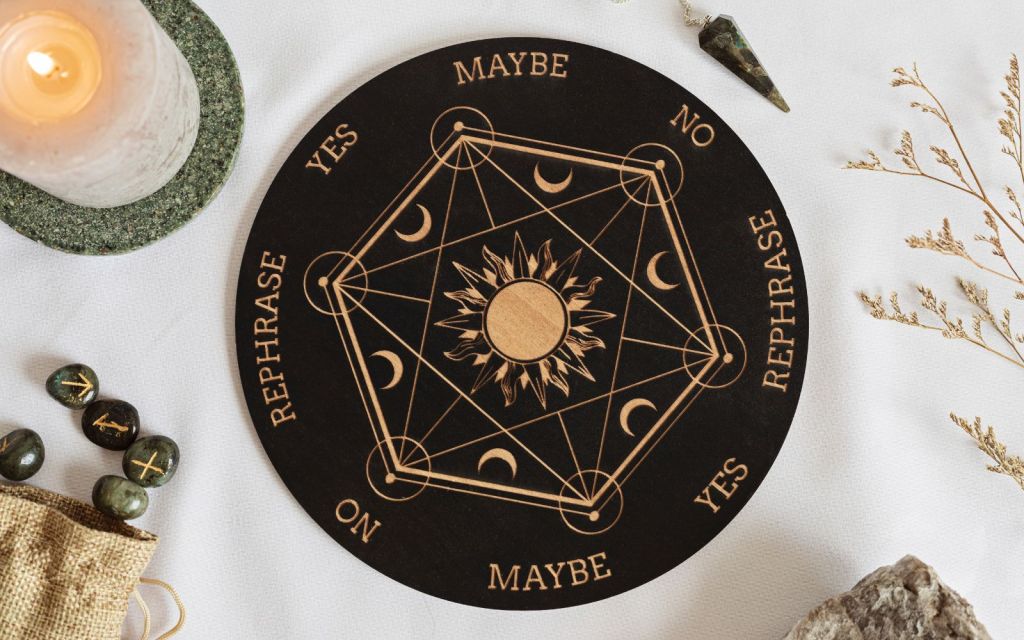
A Simple Pendulum Board – Basic Responses Only
The basic concept here is that you monitor the path of your pendulum’s swing. If it swings over a letter, you mark it down, return your pendulum to a neutral position, and continue until a word is formed.
With few exceptions, I’m not usually a fan of pendulum boards. They always feel a little gimmicky to me, kind of like a ouija board. I guess it’s just like… something I’d expect to see in an episode of Charmed.
Yeah, I’m pretty sure it was Charmed or Supernatural. Someone held a pendulum over a map, swung it around for a few seconds before it was magnetically pulled to a particular location, then of course the entire map caught on fire. Now that’s real magic if you ask me.
Supplementing Other Forms of Divination
One of my favorite ways to use a pendulum is by supplementing other forms of divination. If you’re stuck in a tarot spread or some other divinatory result seems unclear, try using your pendulum to narrow down the possibilities. You can even use it to confirm an intuitive result. I’ll give you an example.
Let’s say I come across a dreaded court card in a tarot spread. These cards are notoriously difficult to read because they can represent so many different things.
Just as a side note, our good friend Christiana Gaudet teaches an amazing class on the court cards.
Anyway, back to our example. Let’s say in particular, the Page of Wands has popped up — and unfortunately, it’s absolutely stumped me and I can’t seem to make any further progress in the reading.
I could pull out my pendulum and ask a few questions, starting from very general. Affirmative answers mean you can continue that line and get more specific. Some possible flows for this card might look like this:
- Does the card represent a specific person in the querent’s life?
- Is it a young person?
- Is it the querent’s son/daughter?
- Is it a young person?
- Does the card represent a message the querent will receive?
- Will the message be received soon?
- Will the message be received tis week?
- Will the message be received soon?
- Does the card represent the querent’s ability to communicate?
- Does the card represent the querent’s feelings of passion?
But perhaps I turned over the Page of Wands and intuitively came to the conclusion that it represented the querent’s youngest son… and then, unfortunately, logic and doubt clouded my mind as I remembered that court cards simply stump the hell out of me and can mean all sorts of different things… suddenly I’ve lost my confidence and the entire flow of the reading.
Not to worry. I’ve got my pendulum handy. I could simply take it out and say “does this card, indeed, represent the querent’s youngest son?” When I get an affirmative answer, I can regain a bit of confidence and continue the reading.
This works for all sorts of things, honestly — runes, automatic writing, whatever form of divination you choose to employ regularly. I’ve even used pendulums in ancestor workings, simply asking reassuring questions like “do you have a message for me right now?” or concluding questions like “is that the end of the message?”
Is It All in My Head?
Finally, we can return to one of the opening questions. What do I believe now? Are pendulums a form of true intuition or are they a tool that simply relies on involuntary body movements? The answer is… yes… to both.
Is it all in my head? Yes!
Am I moving the pendulum? Yes… yes, of course I am!
Is this real divination? Yes!
I think involuntary body movements are ultimately responsible for how the pendulum, but those movements can also be influenced by subconscious cues received from the higher self or spirit or deity or source or whatever you’d like to call it. But you know what? You should come to your own conclusions, so grab a pendulum and start playing around. Oh, and speaking of conclusions…
Conclusions
Once you start to play around with pendulum divination, I’m sure you’ll find all sorts of ways that it can be applied, either as a standalone tool or to supplement other areas of divination and magick. I’d love to hear what you come up with! Let me know in the comments.





 Aerik Arkadian
Leave a reply to Aerik Arkadian Cancel reply