
In modern times, many people will readily recognize the spirit of place (Genius Loci) for just about every location on earth — whether it be rural or urban, ancient or new. Consider for a moment, however, that there are several “places” we frequent every day… but they’re intangible and start with “www.”
There are intelligences and spirits assigned to the planets in our solar system. We have saints and deities deemed as the patrons of concepts like justice and truth, for occupations like blacksmithing or music, and even for major industries like agriculture
Well, you know what makes up another major industry today? Technology.
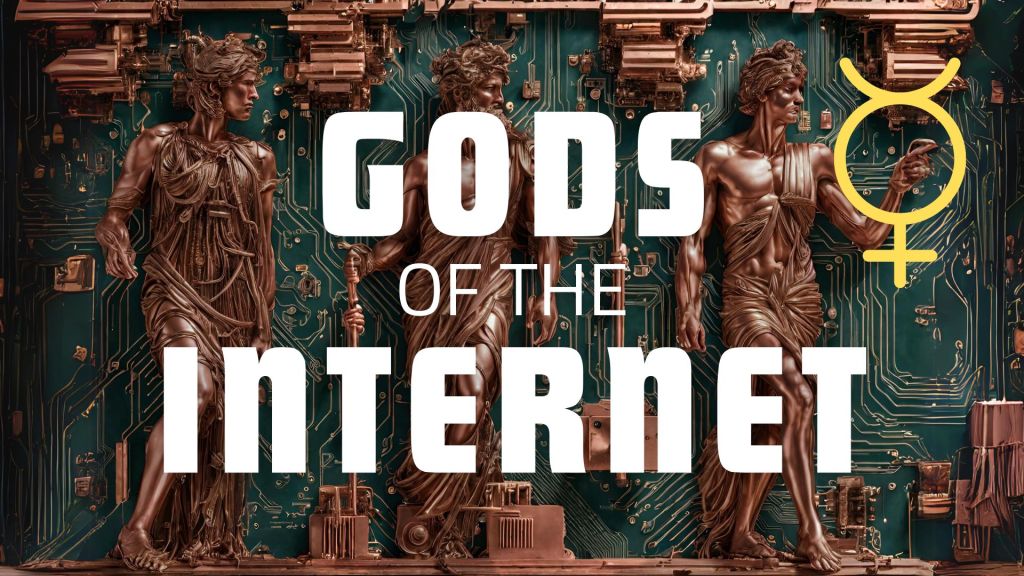
Understanding that we have a god, goddess, or some other sort of entity for almost every major aspect of our lives, it shouldn’t come as a strange jump when I start to speak about the gods of the internet. Maybe you haven’t met them yet. Don’t worry, as far as the timeline of human existence goes, they’re relatively new.
So just how long does it take to fully form a new aspect or face of deity in collective consciousness? The Ancient Egyptians probably had 2700 years or so to give us Isis and Osiris. The Ancient Greeks had at least 1000 years to give us Zeus and friends. By comparison, we’ve had the internet, email, cell phones, and our ridiculous levels of interconnectivity for less than a century. But perhaps time isn’t the only factor… the sheer number of people involved has to account for something, too. It’s estimated that Ancient Egypt had a population of less than 3 million at its height… and less than 10 million for Ancient Greece. So where are we today?
I asked Google what percentage of the world uses the internet… and I was presented with this lovely chart.

Internet Users as a Percentage of Population
Apparently, 59.6% of the 8 billion human inhabitants of planet Earth use the internet. That’s roughly 4.75 billion — I’m rounding for ease of use in the following paragraphs, which will contain math.
WARNING: MATH AHEAD
I’m sorry for making this a little mathy, but this post was titled “Gods of the Internet” so I’m not really sure what you were expecting, aside from lots of weird stuff.
Let’s assume that each person is capable of contributing one “consciousness unit” into collective consciousness per year. We’ll multiply that by the length of time things have existed and this will give us a rough scale of measurement to use for comparison.
Ancient Greece:
1000 years * 10 million people = 10,000,000,000 consciousness units
Ancient Egypt
2700 years * 3 million people = 8,100,000,000 consciousness units
Modern Day (Technologically Unified Civilization)
10 years * 4.75 billion people = 47,500,000,000 consciousness units
Despite our short time frame, we have drastically higher population size, so I’d say the overall net effect is high enough to merit at least the possibility that new deities can easily be formed today. You’re welcome to tweak my numbers any way you want — go ahead and cut the time frame down by half… the end calculation is still greater than that of Ancient Greece and Ancient Egypt combined.
Temporal Analogs
One of my favorite things about reading complicated rituals and recipes in ancient grimoires is trying to reimagine how they might be performed if they were re-written for today’s environment.
You see… ancient people were connected to the land in a very different way than we are now — they just had access to different materials and resources as part of their day-to-day life. Sorry to say, but animal entrails were probably a lot more routine for a group of folks who regularly slaughtered livestock as part of survival. If you’re alive today, you’re probably so far removed from the process of your meat getting to your plate that you don’t even know the name of the butcher, the cow, or the farm where it came from. But yeah, strange animal parts are a common mention, especially in Medieval Grimoires, but what do they mean exactly?
No, no, don’t worry. I’m not getting sidetracked. I’m going to [hopefully] reel it all back in, you just have to give me a moment.
So for instance, let’s say that some strange incense recipe from 1500 years ago calls for the ground hooves of a horse. First of all, gross, yeah. But what did a horse represent to that practitioner and to their community at the time? Perhaps it was a symbol of status or wealth. But it could have very well represented transportation.
As a “temporal analog” (and by this I mean ingredients that represent the same concept, but in another time), maybe our closest substitute today would be rubber shavings from the tires of a car.

Y’all got these new spell ingredients?
Is that a weird idea? Hell yeah, it’s a weird idea. But my point is that we’re not “locked in” to how someone wrote something a thousand years ago. Our craft is supposed to grow and change with us to reflect our time. And it does — sometimes. That means the gods can change with it.
Sometimes that means one deity absorbs another deity, but throughout time, we’ve also expanded the domain of gods and goddesses to include new and “related” areas as they develop. Hermes is a great example of this.
Hermes, Mercury, and More
Hermes and Mercury, two syncretic gods, have an unbelievably vast area of patronage. They are associated with things like luck, commerce, eloquence, speed, travel, communication, transportation, and trickery… and with people such as shepherds, athletes, thieves, messengers, and merchants. Hermes, who was known to be the “messenger of the gods,” was frequently depicted speeding around wearing winged sandals and also ferried souls to the underworld.
It’s those aspects of “communication,” “transportation,” and “messages” that I want to focus on right now. We live in a world where communication doesn’t just happen via raven — it happens over cables and airwaves. Transportation doesn’t just mean physically hauling goods, either — it also includes transportation of data through a network.
It’s only natural, then, for people to start invoking Hermes or Mercury when they need help with anything electronic. As we expand our methods of communication, we’re also expanding the domain of these communication-oriented gods.

Hermes statue. Public Domain. Courtesy of Wikipedia
But honestly, the internet isn’t just some sideline phenomenon anymore. It’s the backbone of industry and our lives. It’s almost alive itself — and someday it might be. It seems to have surpassed just being the “domain of communication gods.” It’s time to have gods of the internet — the “tech gods,” you might even call them.
The Tech Gods
My first experience with the “tech gods” was when Selene and I were invited to attend a ritual with our good friends at Beachfyre, an eclectic coven in Miami, FL. Their rituals are a little bit different than ours, so Canu Nodiad and Rayna Templebee, the coven’s HP and HPS, gave us a quick lesson before everything got started.
Of particular interest to me was the inclusion of the “tech gods,” which were represented in the ritual space by a glass bowl that was filled with copper trinkets. I don’t really remember exactly what was in there, but the picture in my memory says there were pennies, pieces of a circuit board, and other technology-themed objects.
At a certain point in the ritual, these tech gods were invoked and their blessing was requested in order to keep the remote coveners connected. This was a hybrid circle — there were probably about ten people physically present along with a handful of people on video chat. Everyone, regardless of where they were, contributed to the group energy and participated in the process of building the temple. And it worked!
Beachfyre suffered the same issues as just about every other coven in the world when COVID hit — we all had to stop meeting in person. For some people, this meant ceasing their practice entirely. For others, this meant adapting it. The inclusion of the tech gods “was inspired by the pandemic,” says Rayna. They missed each other and wanted to keep meeting, even if it was only virtually. Once they got into a flow, they decided to start working with gods of technology to help keep it all together.
I found it all quite interesting, to say the least, but didn’t feel there was much use for it within our own coven circles. That is… until some of our coveners moved away.
So what happened? Well… pretty much the same story as above. We missed our remote coveners and wanted to keep having their energy in ritual. Hybrid circles adds an entirely new set of difficulties, so we figured we could use all the help we could get. We decided to take a cue from Beachfyre and include the tech gods. Today, we’ve got our own little glass jar on the altar filled with pennies, lengths of copper wire, and some mercury-blend incense.
Around the World and More
When I asked Canu to tell me more about the tech gods, he reminded me to think in broad terms. Hermes and Mercury are great examples coming from one area of the world, but there are plenty more.
Head on over to the ATR and you’ll find that Elegua owns roads and doors. In fact… he’s known to connect things. That sounds a lot like the internet to me. Similarly, Ogun is associated with all forms of technology.
You could also view the internet as a repository of knowledge, in which case you might appeal to Athena, Minerva, Saraswati, or Thoth.
But humans aren’t the only creatures with knowledge. And we’re certainly not the only ones on this tiny little space rock who are interconnected. Actually, it seems like we’re just starting to catch up. Plants have been connected to each other through complex, underground networks since… forever. If you cut down a tree, the other trees know it.
Obviously there’s lots of ways to view this.
Faceless and Unnamed
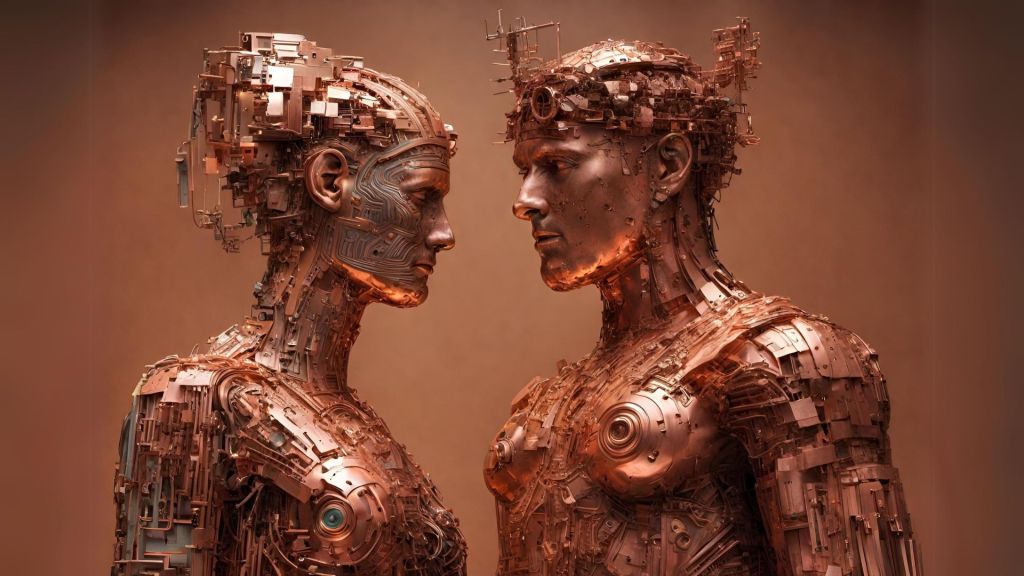
I doubt anyone will carve any marble statues and give our tech gods a face within our lifetime. Likewise, I doubt anyone will ever have the audacity to give them a proper name either.
“This new god’s name is Techonnectivius — Patron of the internet, computers, screens, and those with bent necks. You may them “Nectivius” for short.”
-Me, rather audaciously
Just because we don’t have a face or a name for a thing doesn’t mean that thing isn’t forming, developing, or growing right under our noses. And honestly… we kind of have named it, haven’t we?
Alright, this may be somewhat chaos-magicky of me, but as soon as you start referring to anything as a particular something, you’re on the road to giving it consciousness. “Tech gods” is enough. At the very least, it’s a growing egregore.
The Fight Against Tech
Despite all the good it can do, there’s always been a significant push against incorporating technology with our magick — I can at least say this is true within the British Traditional Witchcraft community.
A common rule in many covens is “no cell phones in circle,” but it can go a lot broader than that… no watches either! I’ve also heard stories warning newer witches to never load up the ritual script on a tablet or kindle — always print it on physical paper! It seems convenient, yes, but the energy of circle can interfere with the tablet, potentially turning it into a brick — or so the stories say. For some, this type of anti-tech can even extend to the use of electric candles.
These are fair cautions. After all, we don’t really have a map of how etheric energy might interact with digital devices — and while I’ve never actually seen a ritual shut off a laptop, I do kind of believe that bad moods can block WiFi signals. Suffice it to say, I have mixed feelings… but I’m keeping an open mind. When we integrate technology, it should be controlled and in small increments. I’m also more inclined to say it should also lean toward the side of necessity rather than ability. Just because you can do a thing doesn’t mean you should.
Getting digital with our circles was definitely a thing we said “we’ll try it and see.” Setting up a camera for a good view of the altar over Zoom, honestly, felt super weird. But you know what? It worked. We felt the energy of our remote coven members. We had a successful ritual. Unfortunately, those are just subjective statements. In order to find out for yourself, you’ll have to try it out, but rest assured there are plenty of other witches going through the same thing.
An Technology Invocation
There’s lots of ways to look at all of this. Here’s a few:
- View technology as the realm of existing gods or goddesses, like Hermes
- View technology itself as a new and evolving deity or egregore
- View technology like an additional element (air, earth, water, fire… internet)
Personally, I feel like approaching technology in one of these ways tames the “scariness” and fears of things breaking. Instead of random, undirected energy, you can channel it into something effective. Remember that fire is dangerous too… it can burn your house down if it isn’t controlled, but we still use it for magick.
In order to channel or control an intangible thing during ritual, we often only need to invoke it and tell/ask it do something. This is true of deities, spirits, elementals… and more. So why can’t it be true of the energies fundamental to technology?
And of course, the real question then… is what do you ask technology godforms to do?
“Oh mighty tech gods, unite us virtually as we will be united in the astral. Keep our devices error-free and our connection speeds high!”
Tweak that to your own liking. Warning: It may sound ridiculous the first time you say it.
Conclusions
Since this is a fairly new discussion, almost any approach is valid. Personally, I’m starting to see “tech gods” as its own thing and not as a subdivision or patronage of a pre-existing deity.
I would love to hear other thoughts on this topic. Have you ever participated in a hybrid or virtual ritual? How did it feel? How would you personally view gods of technology? Let me know about it in the comments.




 Aerik Arkadian

Leave a reply to Aerik Arkadian Cancel reply