
Home » Music » General Music » Understanding the Science of Binaural Beats
A binaural beat is an auditory illusion where your brain splits the difference between two similar tones played separately in each ear. They’ve been said to alter moods, increase cognition, enhance meditational or trance experiences, and even to amplify specific brain wave frequencies… but do they really work or is it all just New Age mumbo jumbo?
In order to understand the science behind binaural beats, we need to study some of the properties of sound waves themselves. And to save you some time, I’ve compiled all of this information into a 10 minute YouTube video.
But for the most daring and brave among you, let them read!
Before we begin, you can listen to this audio clip to get a feeling for what a beat sounds like. Headphones will be recommended for later on, but your computer speakers will do just fine for now.
The above clip sounds rhythmic, but it’s actually two static tones being played at the same time. Their similarity in frequency causes weird things to happen to the sound wave and results in the pulsating effect that you hear.
And that’s why we need to talk about sound waves first.
Sound Wave Interaction
Sound waves are pressure waves. They’re basically just patterns of disturbances that move through a medium. They can propagate through solids or liquids, but we most frequently encounter them traveling through the air to our ears.
Although we can’t see sound waves, we can draw them. We usually do that with a graph of a transverse wave, with peaks and troughs that represent the areas of high pressure (compression) and low pressure (decompression/rarefaction) in the air.
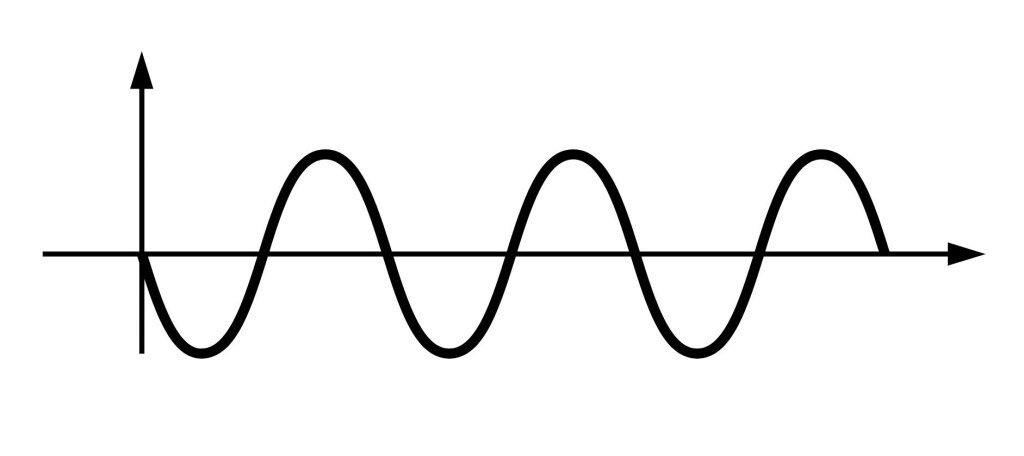
It looks like a sine wave, right?
Note for Nerds: Sound waves aren’t actually transverse waves. They’re longitudinal waves. That means that their displacement runs parallel to the direction of wave travel.
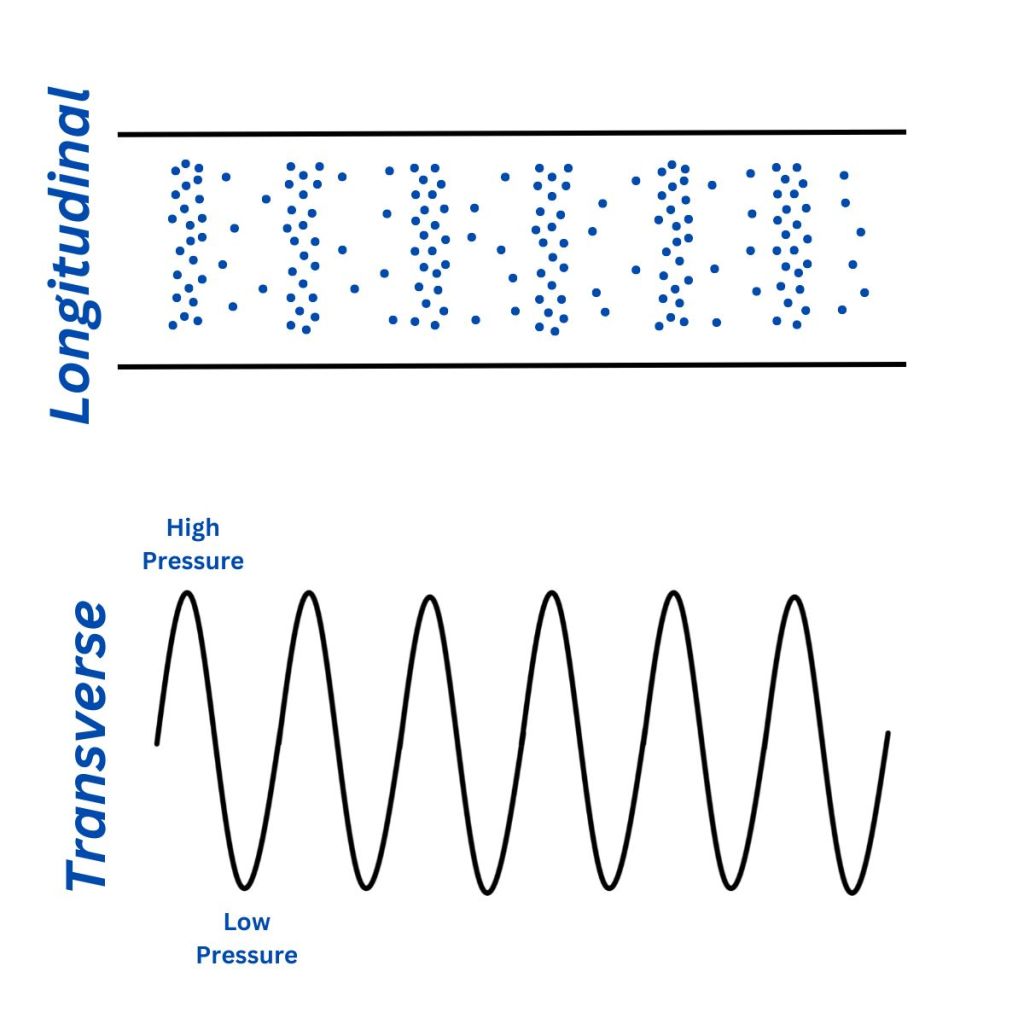
Longitudinal vs. Transverse Wave
Regardless, we still use the transverse wave graph to represent sound waves because it’s a lot easier to understand.
An interesting thing happens when two sound waves cross paths with one another. You have areas of high pressure and low pressure interacting with other areas of high pressure and low pressure. This produces what is technically called an “interference pattern.”
If a high combines with a high or a low combines with a low, they amplify each other and it results in constructive interference — everything gets louder. But if a high combines with a low, it results in destructive interference. When there’s two much destructive interference, you wind up with cancelation… or no sound at all.
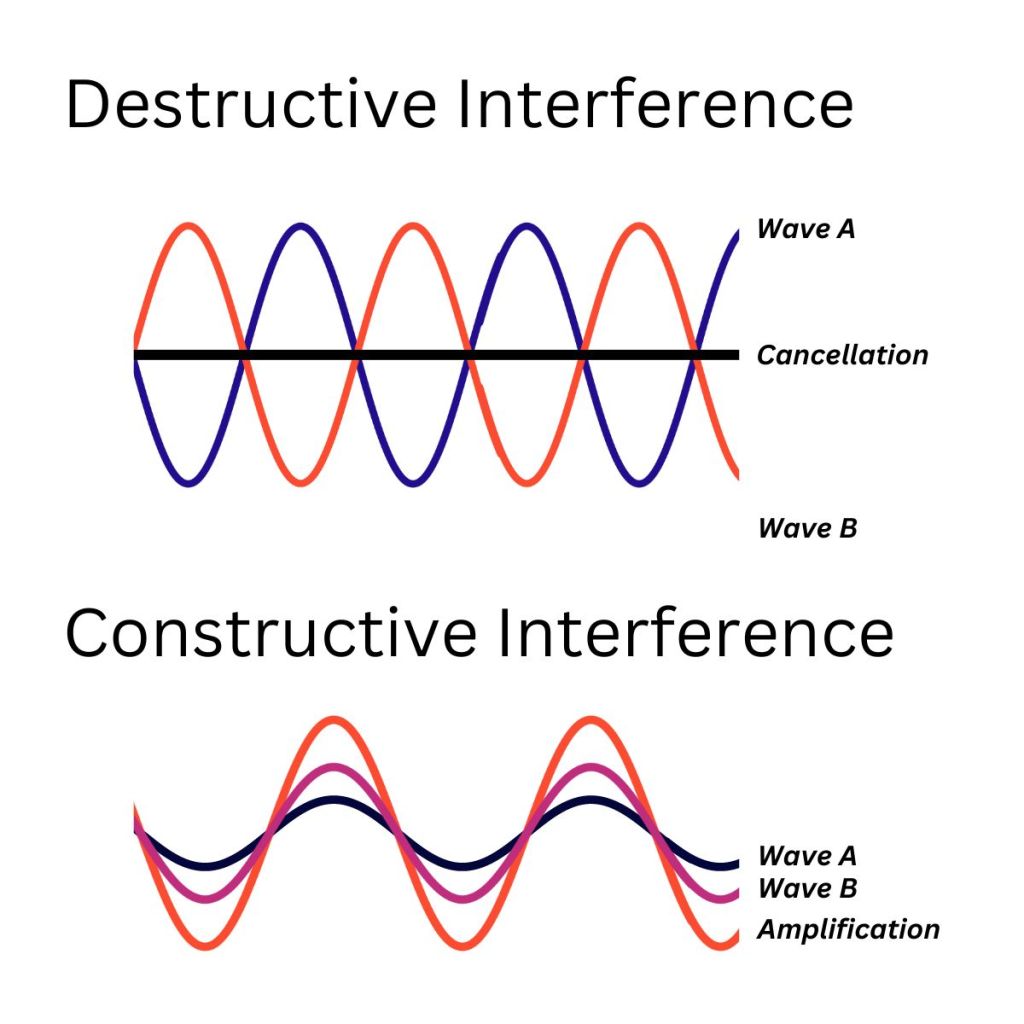
Types of Interference
And that’s how noise-canceling headphones work. They use a microphone to analyze the ambient sounds around you, generate an opposite sound wave, and the two cancel each other out. Even though you might not be hearing anything, there are still sound waves interacting.
Want to hear about future posts? Subscribe to get notifications delivered straight to your inbox.
Beats
A beat is a phenomenon that occurs when two sound waves of slightly different frequency interact.
Note for Nerds: Frequency is measured in Hertz (Hz), which is a fancy way of saying “cycles per second.” It tells us how many wavelengths will occur in one second of time.
Want to make a beat with me? All you need is something that can generate sine waves. Most audio software can do this, but if you don’t have that, there’s tons of free online tools that can, like this one or this one.
Let’s make a 440 Hz wave and a 432 Hz wave. Since these two frequencies are very close together, they’re going to produce a beat when you play them simultaneously. If you’re using an online tool, just open two tabs to play both notes.
Or you can just listen to this audio clip that I made for you.
To illustrate what’s happening here, let’s look at another graph.

A changing interference pattern…
I made the above graph using Desmos’s Calculator, which isn’t specifically made with sound waves in mind, but let’s you change the parameters of sine waves. It should provide a good visual reference.
Each of our wave’s is similar… but not quite exact The peaks and troughs start out lined up, but then get out of sync. That means we have constructive interference (amplification) that transforms into destructive interference (cancelation) and then back again. It’s a pattern that repeats over and over again.
The closer two frequencies are together, the longer or slower the beat will be, until eventually you reach perfect unison — where there’s no beat at all.
And that’s why musicians can use beats to help tune their instruments. If a note is further out of tune, the pulses of the beat will be rapid, but they slow down once we get closer to the target pitch.
Binaural Beats
Binaural means “with both ears.” This is when a beat is created by playing one frequency in the left ear and another frequency in the right ear… except this time, the interference pattern doesn’t happen in the air around you — it happens in your brain.
Yep. In your brain. It does not work if you are not using headphones. Each tone needs to be isolated and panned separately to either the left or right.
Our ears are incredibly fine tuned instruments, arguably one of the most precise senses we have in these 3 dimensions. With a binaural beat, your brain splits the difference between the tones heard in each ear and generates a new frequency internally. So for instance, if you listen to 440 on the left and 432 on the right, the resulting internal wave would be 8 Hz, which would match up to a high theta or low alpha brain wave frequency.
I made a handy chart for you that shows roughly where the frequency ranges fall. Please try to remember that all of this is still within the realm of soft science, so there is a lot of discrepancy and disagreement on each range.
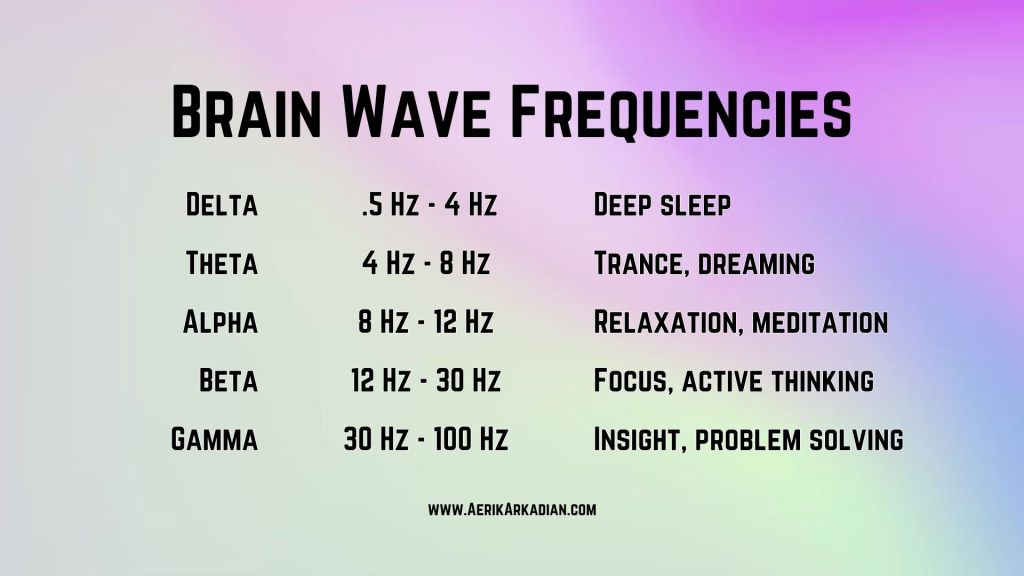
Brain Wave Frequency Chart
Have fun experimenting and find out what works for you!
Examples
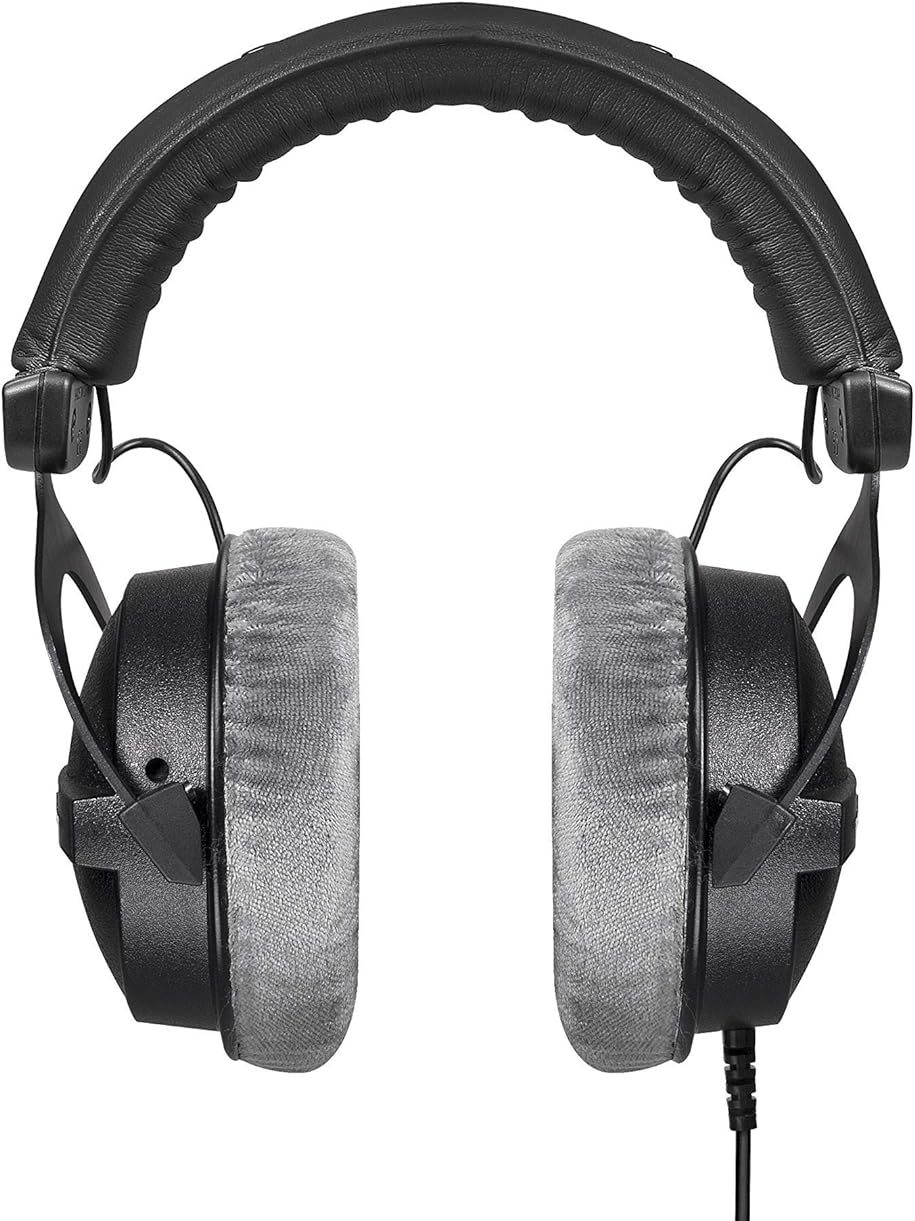
I also made some samples so you can hear each range. These use lower frequencies to give it heavier bass and will start at the lower end of the range, slide up to the top, and then come back down again. You’ll need headphones to experience them properly.
Delta
90 Hz played with 90.5 - 94 HzTheta
90 Hz played with 94 - 98 HzAlpha
90 Hz played with 98 - 102 HzBeta
90 Hz played with 102 - 120 HzGamma
90 Hz played with 120 Hz - 190 HzTips and Caveats
As you go forth to explore your own binaural beats endeavors, keep a few things in mind:
- It doesn’t work without headphones. You can still hear a beat without headphones, but it won’t be a binaural beat.
- Binaural beats can’t be perceived by everyone
- After about 30 Hz of separation between tones, it becomes very difficult to hear the beat effect and your brain will naturally start to perceive each sound as separate notes
- For a deep and meditative experience, beats produced using lower tones work well
- For a more active and intense experience, beats produced using high tones work well
- There are lots of playlists on YouTube and Spotify where you can listen to different tones, just search for it
- Experimenting is fun
- Don’t take other people at their word — try it yourself before you make a judgment
And now… let me tell you my final thoughts.
What’s the Verdict?
There’s obviously lots of debate in this realm. I’ve read plenty of far out, completely unprovable claims regarding the use of binaural beats. It’s definitely up there with Atlantean rings, magnet bracelets, colloidal silver, and gold nanoparticles.
Hang on, hang on. I’m not knocking any of those things. In fact, I’m all for them. It’s just that they’re uhhh… not very scientific. But neither is a lot of the stuff I do in the magickal world.
One of the biggest claims by many advocates of binaural beat is that they actually entrain specific brain wave frequencies. That almost seems plausible, but let me give you a quick comparison: that’s very much like saying that staring at two similar colors of paint in the hardware store will also entrain specific brain waves. And I mean, maybe it can, but to me that sounds more like a recipe for a headache. Color is just as much of a frequency as sound — it’s just that the vibrations are interpreted by the eyes, whereas sound is a vibration that is interpreted by the ears.
So, can binaural beats really increase brain wave levels? I don’t know. But if you have a spare EEG, I’m totally down to hook myself up to it and find out. Most scientific studies are unfortunately inconclusive.
What I do know is that I have enough personal experience with binaural beats to say, rather definitively, that they increase my own meditation and trance states. My first intentional out of body experience (almost 20 years ago at this point) was thanks to a computer program called BrainWave Generator that ran through custom sequences of binaural beats. That might work for you and it might not. My definitive verdict only applies to me.
At the very least, the sounds are pretty trippy. If that’s the kind of thing you enjoy, it should be a good bit of fun.
Further Reading
If you’d like to learn more about this type of phenomenon or other properties of waves in general (including earthquakes and the ocean), then you’ll need to turn to a handy dandy physics textbook.

Understanding Physics by Isaac Asimov is a classic. It’s kind of vintage, but he explains things in a way that is easily comprehendible.
I honestly think that every human should go back and read this (or a book like it) in their adult life. There are so very many physics topics that get glazed over or skipped in school — or just things that we didn’t quite understand when we were younger, that explain exactly how things that we encounter in everyday life work.
Want to know how light works? Want to know why the sky looks blue and changes to red, yellow, orange, or pink as the sun sets? That’s all related to waves. And… yep… it’s in a physics book.
Now, go experiment, but please come back later and tell me what worked or didn’t work for you. Have they enhanced your magick or your meditations? I’d love to hear all about it.
There are a lot of links in this post. Some of them go to online tools that should further your research, some of them go to other blog posts, some of them go to Amazon, and others might take you to Narnia or something. It’s the Amazon links I want to specifically mention here. If you use one of those links to make a purchase, Amazon will pay me a tiny commission. There, that’s the entire disclaimer. You know what’s funny though? Narnia never makes me put a disclaimer. They’re just totally happy with people randomly falling through wardrobes.






 Aerik Arkadian
Leave a reply to marvellousnightmare Cancel reply