
The legendary Prima Materia (“first matter”) in Alchemy is as elusive as it is important. It makes up literally everything and is required in the alchemical magnum opus: the creation of the Philosopher’s Stone.
Some philosophers say it is everywhere, hiding in plain side, yet completely invisible to the uninitiated. So what exactly is it? How do we get it?
I’m about to profane a number of ancient mysteries by answering these questions and revealing precisely what the Prima Materia really is. Read on!
History
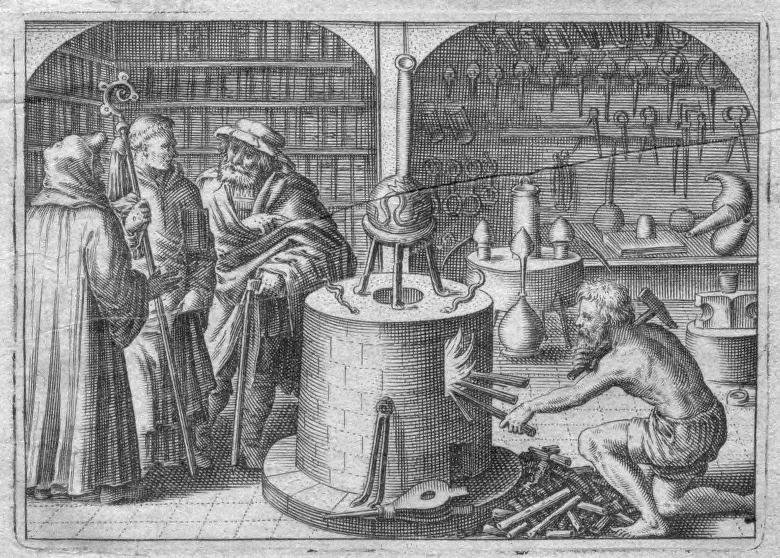
Title page of Tripus Aureus
The concept of Prima Materia is usually attributed to Aristotle, but he probably didn’t come up with the idea himself. His philosophy of hylomorphism basically states that everything in existence is comprised of two things: matter (hyle) and form (morphe).
There’s not really one place where Aristotle defines Prima Materia or says exactly what it is. It’s more or less a concept that is understood while you’re reading his famous work, Metaphysics.
Think of it this way… your matter is like liquidy muffin mix… and the form is like your muffin tin. You need both to make muffins, right?

If you are looking for quotes, however, consider this:
“The theory of Alchemy, though arcane, is very simple; its basis indeed may be comprehended in that only statement of Arnold di Villanova, in his Speculum, — That there abides in nature a certain pure matter, which, being discovered and brought by art to perfection, converts to itself proportionally all imperfect bodies that it touches.”
-Mary Anne Atwood, A Suggestive Inquiry Into the Hermetic Mystery
Side note: the full name of the above work is actually “A suggestive inquiry into the Hermetic mystery : with a dissertation on the more celebrated of the alchemical philosophers being an attempt towards the recovery of the ancient experiement of nature” … boy, they really knew how to title things back in the day, didn’t they? It just rolls off the tongue.
Key takeaways regarding the Prima Materia:
- It is found in nature and is natural – “abides in nature”
- Its manipulation is considered an art – “brought by art to perfection”
- Some things have more of it than others – “converts to itself proportionally”
Want to hear about future posts? Subscribe to get notifications delivered straight to your inbox.
Uses in Alchemy
Alchemy is the “art” referenced above, of course.
The purpose of the obtaining the Prima Materia is to use it for other alchemical endeavors, including the creation of the Philosopher’s Stone. But wait… I haven’t really even told you what [in theory] the Prima Materia is yet. Drum roll, please…
The Prima Materia is a primitive and formless base of everything in the universe. It is ancestral to all physical things. Everything contains at least some of this mythical substance, but the exact amount will depends on purity, which for now we’ll call “vibrational level.”
Frater Albtertus, in The Alchemist’s Handbook, states that “Alchemy is the raising of vibrations.” Such a simple definition for such a complex art! Lead into gold, therefore, can also be said to be a raising of vibrations.
An important thing to remember is that the Prima Materia is formless. Alchemical teachings say that divine will, at some point or another, was able to act upon this raw material to impose a form, which essentially created the universe — and that’s where the value comes in. Since our minds are microcosms of the universal mind, we should be able to do the same thing (if only on a lesser level).
Lead is actually never directly turned into gold. There’s an important step missing there. Lead is first reduced to the Prima Materia, then the form of gold is imposed upon it by will of the Alchemist. This is why stages of purification and refinement are so often stressed within Alchemy — the alchemist must ensure that their will does not falter.
Comparatively speaking, lead is the most impure of the planetary metals, so it will contain the least amount of Prima Materia. Gold, on the other hand, is of the highest purity, so it will contain the most amount of Prima Materia. If we could actually turn lead into gold… well, let’s just say that it would take a lot of lead to produce a little gold.
Qabalistic Perspectives
In some models of Alchemical Cosmology, you have one circle representing the Prima Materia that branches off into two: salt and nitre. In others, you have chaos splitting into matter and energy.

This pattern of one becoming two is seen elsewhere in the occult. I’m sure there are several other examples, but for now I’m just going to focus on the Qabalistic Tree of Life, where Kether (unity) becomes Chokmah (force) and Binah (form).
If you ask me, most of these occult and esoteric sciences are really just trying to say the same thing. They use different metaphors and approaches, sure, but they are identifying the same fundamental processes.
Mixed Metaphors
Unfortunately, there are never any explicit statements that tell us exactly what the Prima Materia is. That would be too easy and much less mysterious. Instead, we’re given a bunch of different metaphors. A very popular example in alchemical writing and artwork is that of a slain dragon.

Sol and Luna slaying the dragon
It’s often frequently associated with mercury… but specifically referred to as “the mercury of the philosophers” — an idea that represents the essence of mercury being freed or detached from the typical Four Elements (adjacent posts on the elements here and here and here).
And that’s just the tip of the iceberg.
Here are some other things that might be used as metaphors for the Prima Materia in alchemical writings:
Microcosmos; The Philosophical Stone; The Eagle Stone; Water of Life; Venom; Poison; Chamber; Spirit; Medicine; Heaven; Clouds; Nebula or Fog; Dew; Shade; Moon; Stella Signata and Lucifer; Permanent Water; Fiery and Burning Water; Salt of Nitre and Saltpetre; Lye; Bride, Spouse, Mother, Eve; Pure and Uncontaminated Virgin; Milk of Virgin, or the Fig; Boiling Milk; Honey; A Spiritual Blood; Bath; A Syrup; Vinegar; Lead; Tin; Sulphur of Nature; Spittle of the Moon; Ore; The Serpent; The Dragon; Marble, Crystal, Glass; Scottish Gem; Urine; Magnesia; Magnet; White Ethesia; White Moisture; White Smoke; Dung; Metallic Entity; Mercury; The Soul and Heaven of the Elements; The Matter of all Forms; Tartar of the Philosophers; Dissolved Refuse; The Rainbow; Indian Gold; Heart of the Sun; Chaos; Venus; Healer; Angel of violet light
Was that enough for you? And to make matters worse, many of the above terms can be used to describe other things, depending on the context. If it all seems very confusing, that’s because it was designed to be confusing.
So What is It, Really? (Spoilers)
Let’s drop all of the metaphor for a minute.
Maybe you’ll walk away from this conversation thinking that the Prima Materia is some super subatomic particle that future technology will allow us to harness, unlocking the ability to transform or fabricate matter just like the replicators in Star Trek — and maybe it is. Maybe we’ll get there some day.
But for now, I think the true explanation is quite a bit simpler than that. It’s so simple, in fact, that it had to be dressed up all cloak-and-dagger style to make sure it wasn’t lost to time.
Also, it’s more of a process and less of a substance. And it takes place somewhere that you’re already pretty familiar with: your brain.

Yep. Your brain.
You see, the true Prima Materia is perception.
My perception is the thing that defines the entire universe around me. My perception manifests my reality. My perception can change lead into gold. Just think about that for a minute.
Alchemy is really about hacking your brain — the one thing that can reliably impose form on what might otherwise be a pretty empty universe. If you can control the process of your perception, then you’re one step closer to mastering your reality. It’s a personal process, however. I can only change things for myself. I can’t change your reality for you.
And that’s why you’ll never find a true recipe for the Prima Materia. It’s not something that can be written down. It’s something that has to be sought after. But if there was a recipe, the process of seeking would be a key ingredient. It’s a mystery, guys. You have to experience it. It’s not supposed to make complete sense… and it’s even okay if it contradicts itself.
Conclusion
Some folks will say that my defining the Prima Materia as perception here is quite controversial. Some will disagree with me completely. And that’s okay. I’m not trying to win any arguments. I’m just sharing my perception.
But real quick, before I go… let me validate my conclusion by checking it against the “key takeaways” I told you earlier:
- It is found in nature and is natural – my brain and my perception are found in nature, yes.
- Its manipulation is considered an art – honing my perception, or raising my own personal vibrations, is an art
- Some things have more of it than others – certain people perceive better than others, especially at higher vibrational levels
Seems to tick all the boxes, yes?
Oh, and although I came to these conclusions on my own through meditation, Descartes might have beaten me to the finish line about 400 years ago — by some interpretations of his work, that is.




 Aerik Arkadian
Leave a reply to Aerik Arkadian Cancel reply