

For millennia, the idea of turning lead into gold has mystified the human imagination. And while the physical attainment of this goal may seem to solely be the domain of alchemists as they whisper unintelligible secrets in the dark corner of a smoky laboratory, the underlying notion of transmutation has long been a symbol of the “impossible” dream: changing that which is impure into that which is perfected.
What we’re talking about here is called chrysopoeia: creating gold from something that was not gold — not just in appearance or surface-level characteristics, but in true chemical and molecular structure… down to the very atoms.
It sounds like a fairy tale, right?
In a modern twist of fate, the likes of which would have probably made Hermes Trismegistus himself utter a deep and gutteral laugh, physicists at the world’s most powerful laboratory have done literally that. They’ve turned lead into gold.
With science, man.
Warning: This article contains science.
CERN, the LHC, and ALICE
The transmutation from lead to gold took place deep underground at CERN’s Large Hadron Collider (LHC), a 17-mile-long ring of superconducting magnets that are buried beneath the French-Swiss border.

LHC: The Large Hardron Collider at CERN. (Image ©CERN)
If you’re not familiar with CERN, they are the European Organization for Nuclear Research. The acronym itself is based on the French name, Conseil Européen pour la Recherche Nucléaire, but we’ll just be calling them “CERN” for the purposes of this article. Some of my most treasured conspiracy theories revolve around CERN, but we won’t get into that here.
CERN does science at a level that will make your head spin without a doctorate or two. I don’t have one myself, so I’m sure some of the deeper mysteries are lost on me, but what I understand is this: they have a really big machine that can make tiny things go really fast. Like, really, really fast. Almost the speed of light. And they frequently use this machine to cause head-on collisions between particles.
Interesting things happen when you slam things into one-another at [almost] the speed of light. But in order to see those things happening, you need another really big machine that can detect stuff.
Meet ALICE – the really big machine that detects stuff.
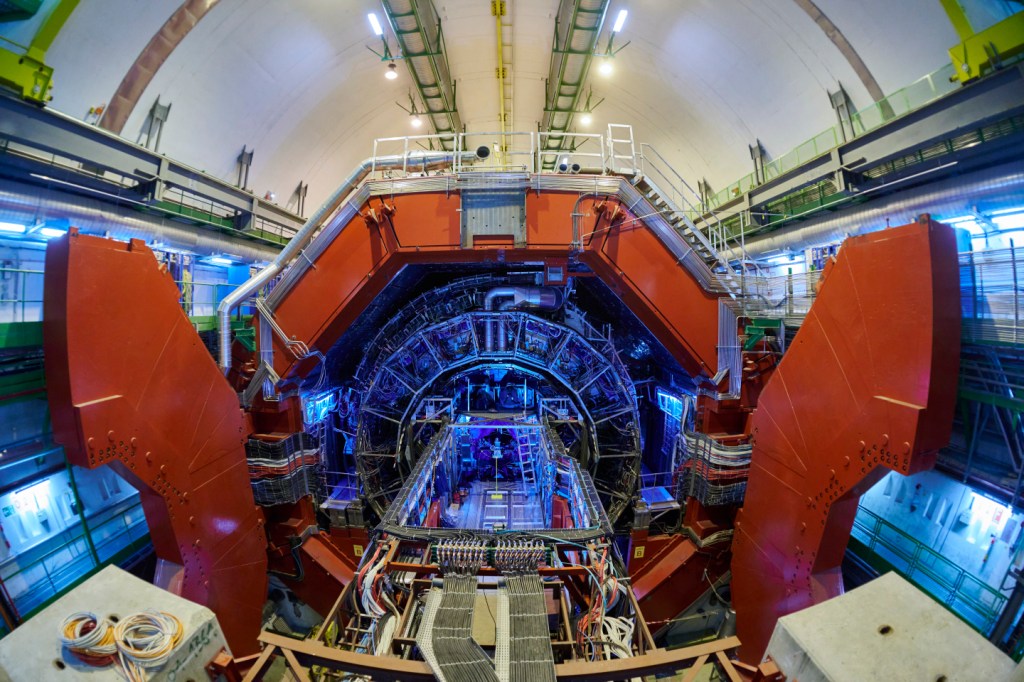
ALICE: A Large Ion Collider Experiment. (Image ©CERN)
ALICE stands for A Large Ion Collider Experiment, and according to CERN’s website, it is a “detector dedicated to heavy-ion physics.” They also say that “ALICE detects quark-gluon plasma, a state of matter thought to have formed just after the Big Bang.” Pretty cool, right? Beyond that, it gets a little technical.
The Experiment
Physicists used the LHC at CERN to accelerate atoms of lead to 99.999993% of the speed of light and then slam them into one another.
When the atoms collide, it creates quark-gluon plasma, which if you remember from literally 30 seconds ago, is what is believed to have filled the universe a millionth of a second after the Big Bang happened. This substance may have formed all of the other matter in the universe. It’s all very interesting, but that’s not what we’re talking about today.
We’re more concerned with what happens when the atoms miss each other — a “near-miss,” actually.
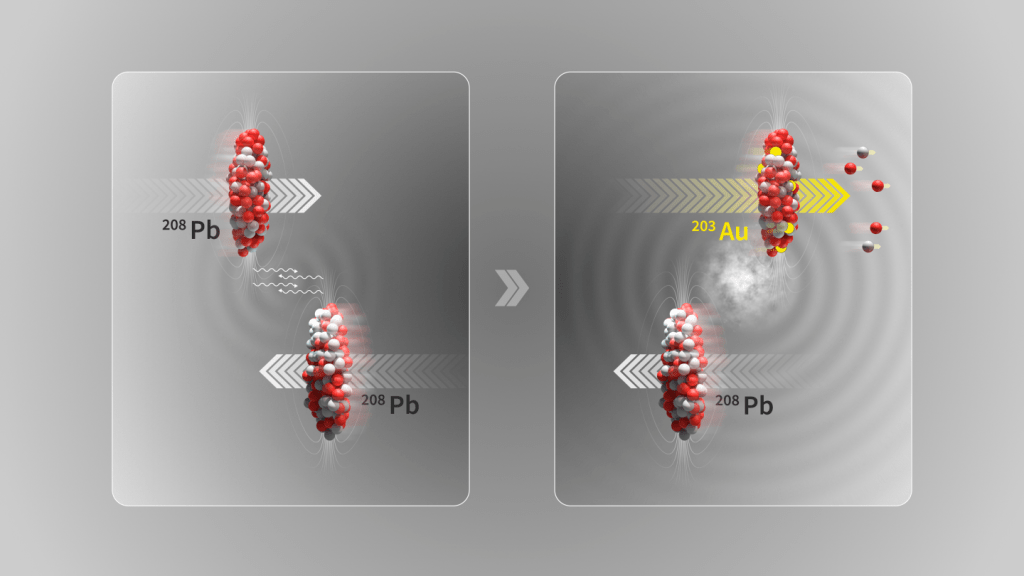
CERN’s illustration of the experiment (Image ©CERN)
When the nucleus of one atom just nearly misses the nucleus of the other, it creates a powerful electromagnetic field — so powerful, in fact, that it can rip out neutrons or protons. And certainly, this can happen in a variety of ways that do not produce gold. But at least one of those ways does produce gold.
To quote CERN: ” To create gold (a nucleus containing 79 protons), three protons must be removed from a lead nucleus in the LHC beams.” (read the full explanation here if you’d like)
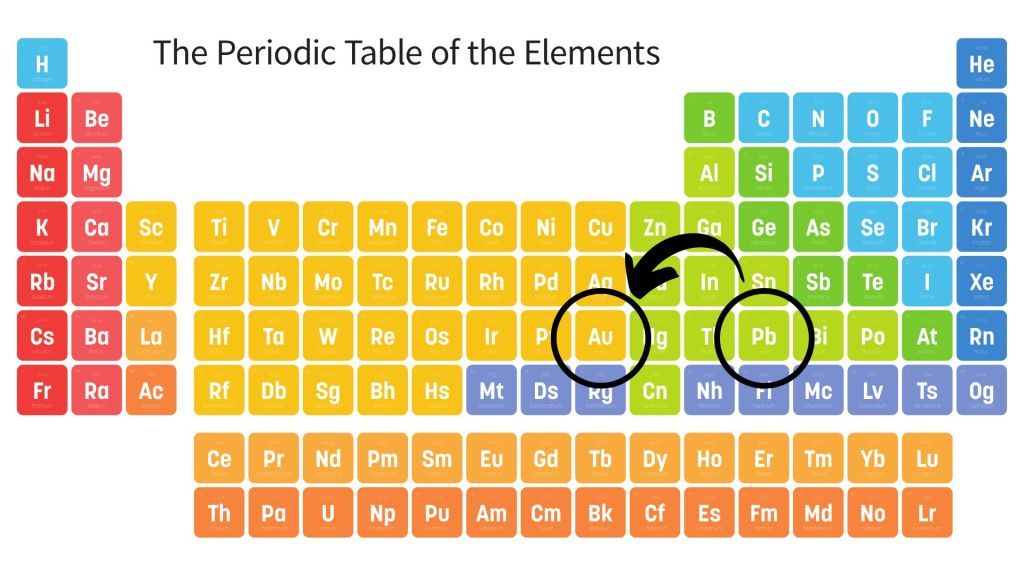
Although this is a rare case, according to ALICE and recently published papers, it happened. Gold was created from lead.
So, More Gold?
Let’s be clear. We’re not talking about any sort of industrial-level gold production. The amount of gold produced by these experiments is infinitesimal and exists only for a fraction of a second. Even if we could hang onto those small amounts of gold, the overall cost of energy to run the experiment in the LHC would far exceed its worth, resulting in a net loss.
To give a clearer perspective on exactly how much gold is created each time, one account stated that it would require trillions (not millions or billions – trillions) of times more to produce one wedding ring.
So Who Cares?
I’m sure that some people have been laughing at the idea of Alchemy since the very first day someone said “hey, let’s try to turn lead into gold!” And we’re never short on the naysayers in the modern age, either. Folks love to say it’s impossible.
Well… everything is always impossible until someone figures out how to do it.
In fact, someone once said: “The impossible is not always unreachable—it is simply misunderstood.” I’m not sure who said it, though. It might have actually been ChatGPT. But it applies here.
The Great Work of Alchemy has finally been proven, scientifically. We’re no longer talking about mysticism or mysteries. We’re talking about quantifiable data and repeatable experiments. The fundamental ideal of transmutation is real.
But here’s the thing…
Don’t miss out. Here’s what’s coming up…
Transmutation was never really just about metals. Gold and Lead are metaphors for spiritual conditions. Lead represents unrefined chaos and disorder. Gold represents perfection and divine illumination. And the true Great Work of Alchemy, in which the Laboratory and the Temple are one and the same… actually involves refinement of the self.
The Hermetic axiom “that which is above is like that which is below,” reminds us all that the universe is like one big mirror for the divine. The actions we undertake in the physical realm have direct correspondences to others in higher dimensions.
It was Eliphas Levi who said, “In the past we created gold with science, today we must remake science with gold. We fixed the volatile, now we must make volatile the fixed; in other terms, we materialized the spirit, we must now spiritualize matter.” He was referring, quite assuredly, to the successes of ancient Alchemists, but urging us to shift our focus. It’s almost as if we were once able to reach up into the heavens, grab a piece of Spirit, and bring it back down to the material plane as physical gold. Our goal, however, should be to learn this process in reverse — transcending that spiritual barrier ourselves, or rather… elevating the self with the qualities of spiritual gold. From below to above.
So I’d like to update that quote, if I could. In the present, we create gold with science. But we must now learn to create gold of ourselves.
You see? It’s a cycle of shifting focus. It’s been going on for thousands of years. And regardless of how far advanced our technology becomes, it’ll probably never stop.
Just as we’ve allowed Spiritual Alchemy to inform Physical Alchemy for probably the past 1000 years, it’s time to turn to the next chapter and let success in this new phase of Physical Alchemy to inform our Spirit. If we can do it in the physical plane, we can for sure do it in the spiritual plane.
Am I repeating myself? Maybe. I’ve said pretty much the exact same thing at least three different ways, but words are funny like that. Maybe one of them will click.
Conclusion
In conclusion, and because a strong argument must always include a conclusion, Alchemy was never a dead art — it just needed a different lab.
It doesn’t matter if we’re talking about particle physics or spiritual growth — transformation is real. And the things that seem impossible today might only be one step away from becoming inevitable tomorrow.
If you’re interested in learning more about the science involved here, feel free to check one of my source articles. But if you’re looking to dive deeper into the spiritual side of Alchemy, you’ll probably enjoy one of my classes.
Sources:




 Aerik Arkadian
Leave a reply to satyam rastogi Cancel reply