
What would happen if you lived an entire lifetime in the span of five minutes?
Well, that’s exactly what happens in The Inner Light, which… okay, look… it’s an episode of Star Trek (The Next Generation, Season 5, Episode 25, to be specific), but I promise I have a good reason for bringing all of this up. If you’ve never watched Star Trek before, I recommend you start here. Even if you’re not a fan of science fiction, I think you’ll be able to appreciate this story on a philosophical and metaphysical level. Just give me ten minutes of your time.
Fun Fact: This title of this particular episode, which was written by a freelancer, was inspired by a song by The Beatles, which bears the same name (George Harrison’s The Inner Light) — and that song itself was at least partially based on Chinese philosophy in the Tao Te Ching. See? I’m going somewhere with this. A fine thread runs through it all.
Let me tell you about it.
The Inner Light episode… in brief…
Jean-Luc Picard, captain of the Enterprise, is hanging out on the bridge of his spaceship with his crew. Everything seems find and dandy, but then, all of a sudden, they’re approached by some sort of alien probe.

A harmless probe.(Image © Paramount and taken from IMDB)
It appears to be harmless. It’s an unmanned vessel — no bad people to worry about. It has no noticeable weapons — no fighting to worry about. So they do what they usually do in such situations: wait to see what happens.
And what happens? Well, the probe sends out some “beam” of energy (let’s not get hung up on the technical details, okay?) that goes right through the hull of the ship and makes a connection to Captain Picard — he passes out. Everybody freaks out. Panic ensues.

The doctor’s face screams “I don’t have any current medical advice.” (Image © Paramount and taken from IMDB)
Picard wakes up, but he’s not on the Enterprise. He’s in bed… in some room… in a house. He’s being lovingly tended to by a woman who is overjoyed to see that he has finally woken up. He’s pretty startled, obviously, and requests to be returned to his ship.
But from the woman’s perspective, that ship doesn’t exist. She explains that he’s been ill with a fever and lost his memory. She’s his wife, Eline. And his name is actually Kamin.
That’s a pretty rough change of reality. To be honest, it’s not the first (or last) time that someone in the Star Trek universe goes through some type of identity crisis — usually it’s the result of a nefarious holodeck simulation, an elaborate Romulan or Cardassian plot to overthrow governments, a vision from extra-dimensional “gods,” or some other sort of malicious trickery. In this case, however, it’s quite different.
Want to hear about future posts? Subscribe to get notifications delivered straight to your inbox.
Rather unsurprisingly, Picard doesn’t accept any of Eline’s explanations at face value. He decides to wander around town. He runs into a man named Batai who claims to be his best friend. Batai is also happy to see that his fever has broken and that he’s back up on his feet.

Kamin meets Batai, his best friend. (Image © Paramount and taken from IMDB)
Everyone in the town seems to be genuinely nice and caring. Everything feels very real. Maybe the Enterprise was just a fever dream.
Meanwhile, on the Enterprise, everybody is still freaking out. They don’t know what to do, but the general consensus is that they should find a way to revive their captain. They figure out a way to block the probe’s energy beam for a moment, but that sends Picard into shock and almost kills him. Destroying the probe or permanently severing the signal doesn’t seem to be a viable option. They’ll just have to let it run its course.
Cut back to Picard/Kamin. With no immediate hope of returning to his former reality, he begins to assimilate into the surrounding culture. He learns that the planet is in bad shape — climate shifts are causing severe droughts, which threaten agriculture, crop production, food supplies, and overall life in general (wait, does this sound familiar?), so he uses his Starfleet science skills to study the environment. He writes reports of his findings, detailing ways that the civilization needs to change in order to ensure their future. He even sends those reports to the village leaders, but they mostly ignore him (wait, is that also somewhat familiar?).
In the first few years, Picard/Kamin doesn’t want to give up the memories of his “old” life. Even if it was just a fever dream, the Enterprise (and all the people he knew), felt real to him still. He spends most of his free time wandering off and mapping the stars, trying to search for signs of his long-lost ship.
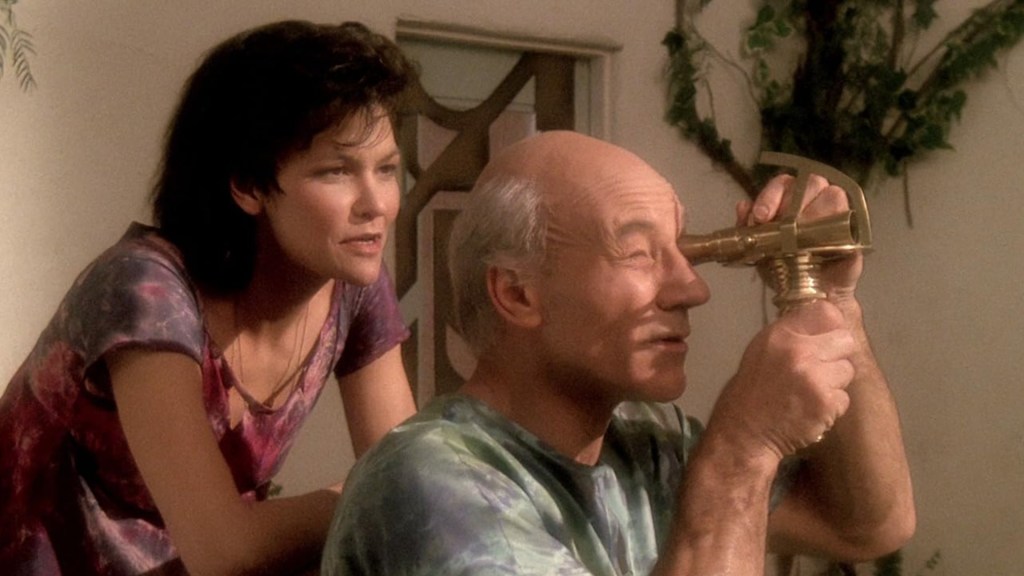
Eline finds Kamin mapping the stars with primitive tools. (Image © Paramount and taken from IMDB)
Eline is supportive — about as supportive as a person can be if their spouse suddenly becomes a completely different person, but she obviously misses her husband. Picard/Kamin realizes he’s not being totally fair to her, so he hangs up the “dream” of his old life and focuses on things in present. Over time, he falls in love (or back in love, depending on your perspective of reality) with Eline — they have children, too. And in his spare time, he learns how to play the flute.

Kamin and Eline celebrate the birth of their first child. (Image © Paramount and taken from IMDB)
Years pass. His children grow up. They have children of their own. He watches Eline die. He watches Batai die. And through it all, he continues with his love of science… and his newfound love of the flute. He plays the flute a lot — and although he never gets very good at it, music becomes deeply meaningful to him.
By the way… the entire planet, at this point, is doomed. They’ve ignored the idea of change for long enough… it is now evident that everyone will die, probably within the span of a single generation, and there’s nothing that anyone can do about it. The grandchildren will not have the opportunity to grow up or live full lives of their own.

A grandchild without a future. (Image © Paramount and taken from IMDB)
Kamin is now an old man. As he reflects on his life, and his own fragility, he offers a piece of advice to his daughter, Meribor:
“Seize the time, Meribor. Live now. Make now always the most precious time. Now will never come again.”
In one of the last scenes, Meribor ushers him to some sort of important town event. All of the people have gathered to celebrate something. But… what? What is it they’re so excited about?
“You remember, don’t you?” They ask him.
And then the climax. It’s revealed that the town’s final act was to commission… wait, get this… a probe — something to contain their collective memories. And its mission would be to find someone to give them to… so that they wouldn’t be forgotten. So that their story would be told. Certainly so that others could learn from their mistakes, too… but mainly, I think they just wanted to be remembered.
It tugs at my heartstrings as I type it all out.
And yes, if you need it spelled out, it’s the same probe that the Enterprise encountered.
Picard laughs. “Oh, it’s me, isn’t it?”, he says, “I’m the someone… I’m the one it finds.”

Kamin’s last memory. The probe is launched. (Image © Paramount and taken from IMDB)
And then he wakes up on the Enterprise.
So now we’re all back to regular reality. The probe shuts down and the crew decides to bring it on board so they can study what happened. You know what they find inside? A freaking flute.
The last thing you hear before the credits roll is Picard playing one note on the flute. One single, mournful note.

Picard plays a single note of remembrance. (Image © Paramount and taken from IMDB)
It’s a note that says, “I remember.” Powerful stuff.
Philosophy, Butterflies, and The Beatles
George Harrison’s song, The Inner Light, which at least in part inspired this Star Trek episode, was based on a verse of the Tao Te Ching. It reads:
Without going outside his door, one understands (all that takes place) under the sky; without looking out from his window, one sees the Tao of Heaven. The farther that one goes out (from himself), the less he knows. Therefore the sages got their knowledge without travelling; gave their (right) names to things without seeing them; and accomplished their ends without any purpose of doing so.
You’re welcome to reflect on that as much as you like, but let me explain the fascinating juxtaposition that I see.
Picard’s character in Star Trek is the ever-persistent explorer. He simply explores for exploration’s sake. And only through charting the galaxy will humanity ultimately develop a better understanding of itself.
As Kamin, however, there was no exploring. He couldn’t even go beyond his small village! Kamin was the “sage” who got his knowledge without traveling. He learned of the power of now — that this present moment is precious.
Don’t miss out. Here’s what’s coming up…

The notion in the Tao Te Ching that “The farther that one one goes out, the less he knows” is highly reminiscent of a portion in the Charge of the Goddess: “If that which thou seekest, thou findest not within, thou wilt never find without.” At least, in my view, these are all just different ways of saying the same thing.
But perhaps another story to bring up is Chinese philosopher Zhuangzi’s parable of the butterfly. It goes something like this: “Zhuangzi dreamt he was a butterfly, flitting and carefree, unaware of his human self. Upon waking, he questioned whether he was a man dreaming he was a butterfly, or a butterfly now dreaming he was a man.”
For a time, Picard couldn’t tell the difference in his own reality. Was he was Picard dreaming of being Kamin or Kamin dreaming of being Picard?
Picard’s Flute
Yesterday, I was sitting on the couch fumbling around with my guitar, trying to work out a chord-melody for a tune that I just couldn’t seem to get out of my head.
Selene heard me playing. “What is that?” she asked.
“It’s pretty, right?”
She nodded.
And in that moment, a passion flared within me. I suddenly knew that I had to explain how this is the song that Captain Picard plays on the flute when a random alien probe sends a beam of energy into his head and makes him think he’s lived an entire lifetime on a random alien planet and after accepting his new reality and falling in love and having children and becoming an old man and finally having all of that ripped away when he returns to his normal reality he only has this flute and this song to remember things by.
I’m pretty sure it might have all come out like that. Sometimes I get excited about Star Trek, guys.
And I’m not the only one who gets excited by it. People even made replica flutes.
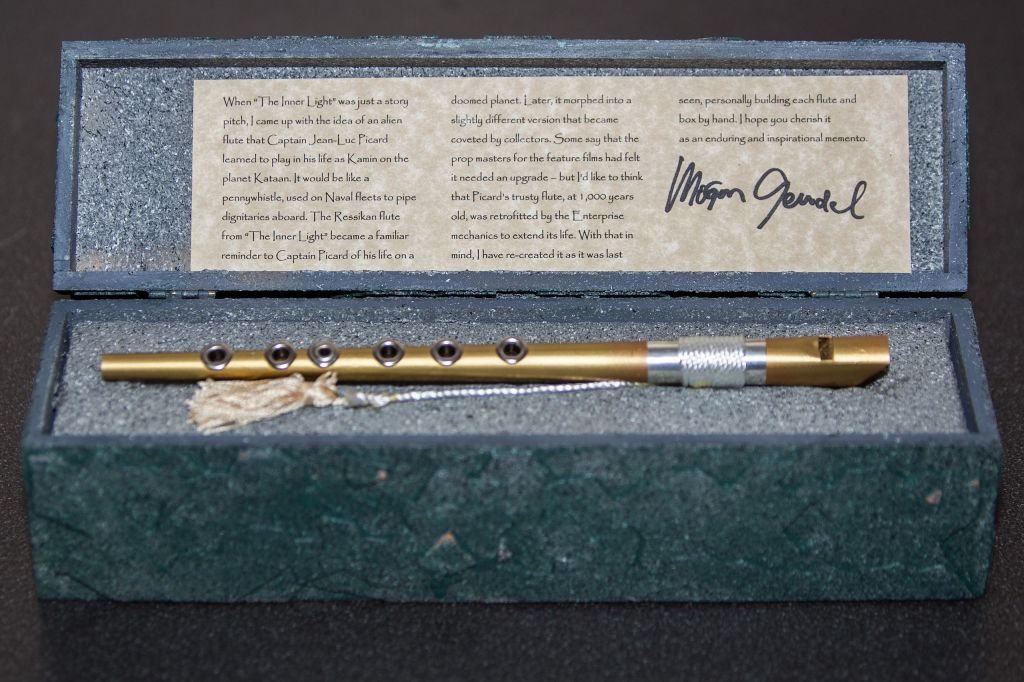
A replica of Picard’s flute. Photo by Eckhard Henkel. Courtesy of Wikimedia Commons. CC BY-SA 3.0 DE
You’ll hear The Inner Light’s theme, which features the flute, at several different points throughout the episode. In some scenes, Picard plays its simple melody by himself. In others, there is a fully orchestrated version playing in the background. It’s a beautiful song.
The flute itself, which resembles the basic design of a tin whistle or penny whistle, makes multiple appearances in later episodes of Star Trek, even all the way through to the more recent series, Star Trek: Picard. It’s often used as a focal point for Picard’s innate humanity — the side of him that lies beyond the call of duty and the drive to explore. It’s a physical manifestation of his need to express himself. But that’s a whole different story.
Conclusion
It was reported (although I have no means to verify this) that when questioned about his favorite episode of Star Trek, Patrick Stewart answered “The Inner Light” without hesitation. Presumably, it gave him the opportunity to add depth to the character of Picard — it has to be an incredible amount of work to act out 30-40 years of life in one 40 minute sequence. Personally, I think the philosophical and metaphysical undertones of the episode were radically ahead of their time.
The Inner Light is truly a masterpiece of television. There are moments like this that I treasure when Star Trek deviates from the usual space battles and begins to explore the deeper meaning of existence.
It begs the question: Are we Picards dreaming of being Kamins? Moreover, are we butterflies? Are we humans dreaming of being gods? Or are we gods dreaming of being human?
But seriously. Are we?
Now you know the fine thread that runs between the topics of Star Trek, The Beatles, and Chinese Philosophy. At the very least, it should make for some lovely and polite conversation at your next dinner party.
And if this doesn’t convince you to watch Star Trek, then I don’t know what will.




 Aerik Arkadian
#/media/File:2014-05-26_Replica_of_'Ressikan_flute'_by_Morgan_Gendel_IMG_1458.jpg)
Leave a reply to gc1963 Cancel reply