
Many of our modern instruments today have their roots in mythology. Deities can be both virtuosos and inventors! Hermes created the lyre. Pan created the syrinx (or panpipe). But did you know that Athena made the first flute?
That’s the story, at least according to the poet Pindar. Let’s check it out and see more about Athena’s legendary instrument.
Key Players
You’ve probably heard about most of the folks involved in this myth, but just so we’re on the same page, these are the key players:
- Athena – Goddess of wisdom, supporter of heroes, and owner of a shiny shield
- Perseus – Epic hero, slayer of monsters, and son of Zeus
- Medusa – Scary monster, snakes for hair, and turns people to stone
Alright, now to the story!
The Story
Due to a somewhat hasty promise, Perseus was dispatched to retrieve a grisly wedding gift: the head of Medusa. This was no simple task, as Medusa was one of three Gorgons (monsters with fangs, snakes for hair, and a terrifying gaze that turns victims to stone).
But it was, at least, possible. Unlike her sisters, Stheno and Euryale, Medusa was mortal.
Like many things in Greek mythology, this turned into an epic quest. And… as it often does, it involved praying to the gods for aid. Hermes offered his winged sandals for speed and a sharp sword for battle. Hades lent his cap of invisibility for stealth. But Athena gave perhaps the most important item: her polished shield.
Perseus entered the Gorgon’s cave while they slept. He avoided being turned to stone by walking backwards and using the shield as a mirror to see where he was going, then beheaded Medusa.
When Stheno and Euryale were woken up by all the commotion, they were understandably upset that their sister had just been murdered. They tried to chase after Perseus, but he escaped due to his newfound speed and invisibility buffs. Returning to Medusa’s body, they wailed and unleashed cries of anguish over her death.
Pindar says…
[Athena] wove into music the dire dirge of the reckless Gorgons which Perseus heard pouring in slow anguish from beneath the horrible snakey hair of the maidens … she created the many-voiced song of flutes so that she could imitate with musical instruments the shrill cry that reached her ears from the fast-moving jaws of Euryale.
Basically, Athena decided to mimic their cries with an instrument, and thus the aulos was born. According to other sources, she may have fashioned it out of a deer bone.
She thought it was a great instrument… until she caught her own reflection. She didn’t like the way her cheeks puffed out while playing, so she threw it away — and some say she cursed anyone who would have found it.
(Marsyas, a stayr, happened to find this discarded aulos later on… but that’s a whole other story. In summary, however, it did not end well for him.)
The Aulos
The double flute of Ancient Greece was called an aulos — an instrument that is quite different from what we would picture as a flute today. For starters, it was a reeded instrument.
The modern woodwinds category is split up into two sections: reeded, like a clarinet, and non-reeded, like a flute — that is, what we call a flute now. Perhaps a picture would be better suited to this task of explaining.
When I say “flute,” it might conjure up an image of one of these…

And any of those would be correct.
You might also be thinking of a Pan Flute. Or maybe an ancient, Paleolithic bone flute. Or heck, you might even picture the tin whistle-style instrument that Captain Picard played in The Inner Light.
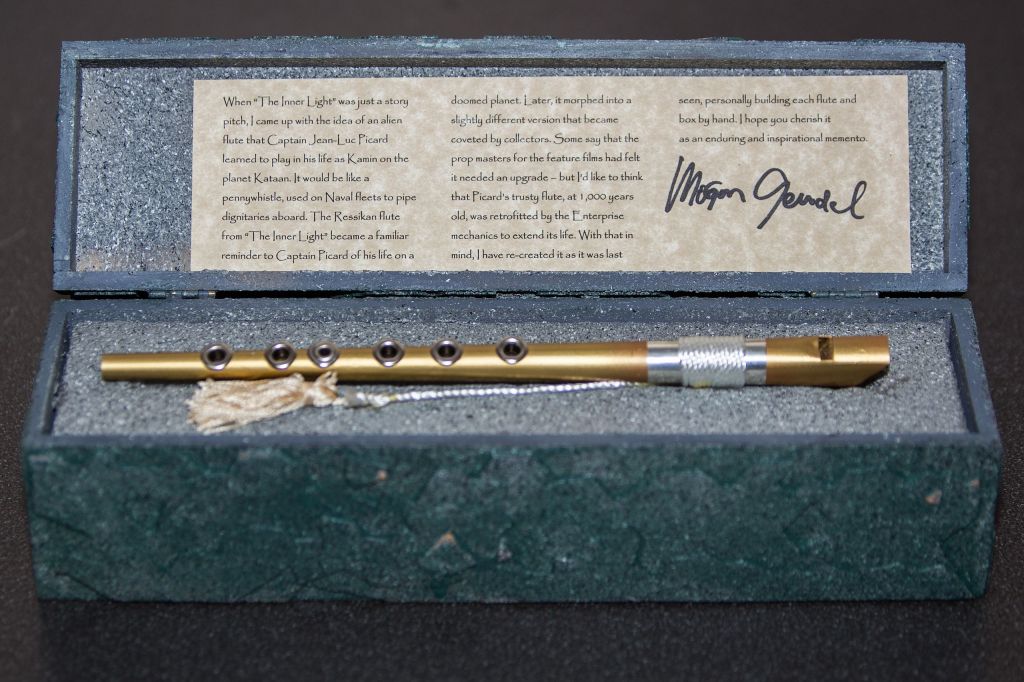
And all of those would be correct, too!
But you’re most likely thinking of this…

A concert flute — this variety is made of metal and has a complicated system of tone holes and keys, something that slowly evolved over the past 200 years or so.
My point is… the term “flute” can be pretty wide and encompasses many different instruments.
But to the Ancient Greeks, a flute would have probably looked like this.
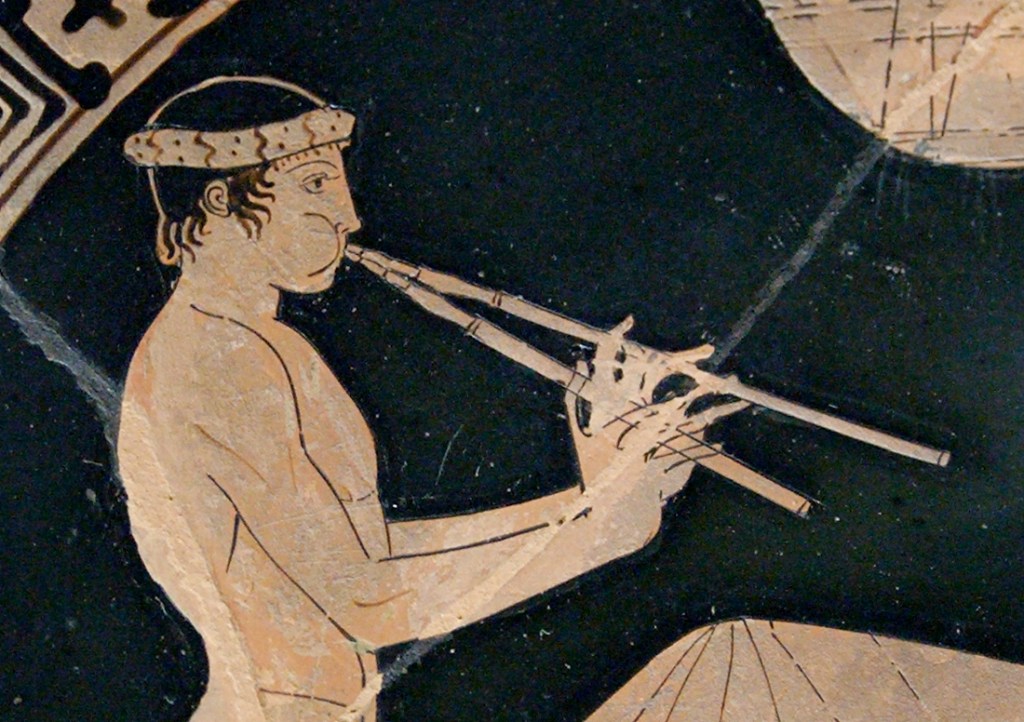
The aulos was a reeded instrument. There was a hollow tube affixed to some type of mouthpiece, which allowed the musician to blow air over a carved piece of wood or cane (the reed), which caused vibration. Two of these were frequently lashed together and both would be played simultaneously — one side emitting a drone note and the other playing a simple melody.
Since most of these instruments were made out of wood, there are very few surviving pieces from antiquity; thus, some of our best representation is found in Greek iconography. You’ll frequently see them depicted on amphorae.
The sound of the aulos has been described as penetrating… but I think, honestly, most people would find it to be whiny in comparison to the smooth tone of instruments we are used to today. After all, according to mythology, it was supposed to mimic the wailing of the Gorgons.
Around the World
Despite the fact that some older poems use the word “flute,” it seems like the aulos is more closely related to a clarinet or oboe. The inclusion of a reed is fairly definitive in the classification process, and in fact would place the aulos in the “reeded aerophones” family (which does not include the modern concert flute).
But the Greeks were not alone in this invention. You can find folk instruments like this all over the world.
There’s the Roman Tibia…
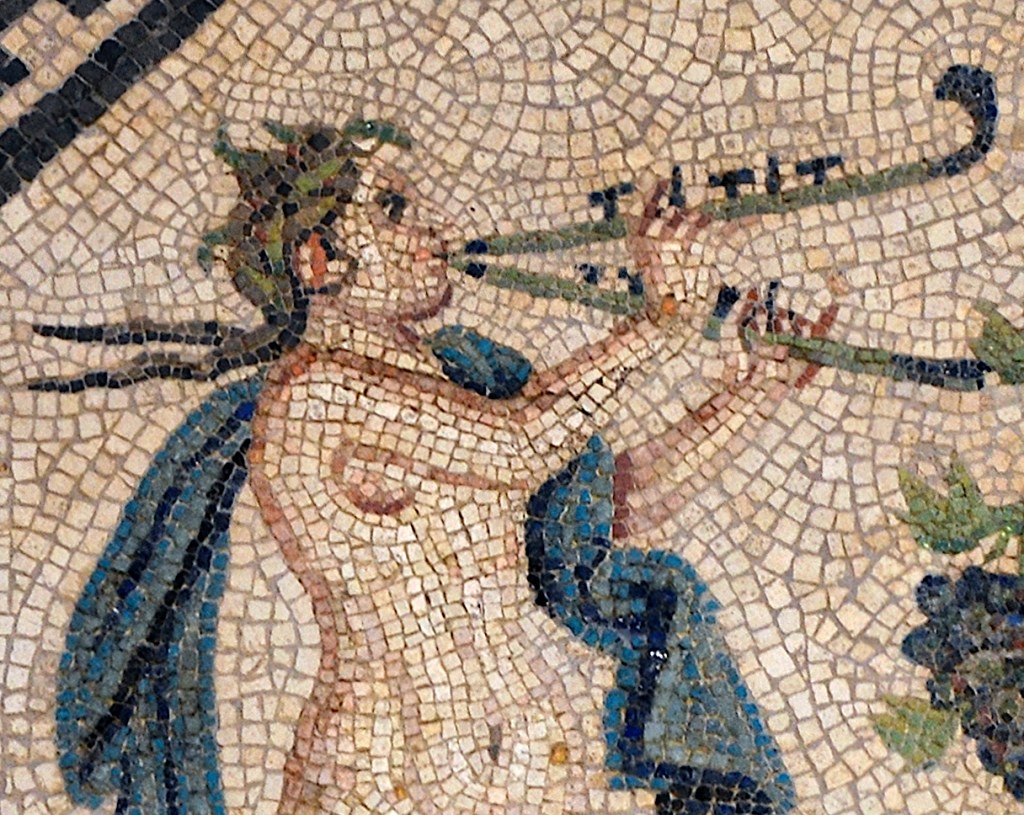
The Egyptian Arghul…

There’s the Iranian Dozaleh, Albanian Zumare, and the Ibizan Reclam de Xeremies.
And of course, sometimes musicians just play two clarinets at once.
Conclusions
I always find the mythic origins of instruments to be a fascinating topic. And I love the fact that cultures around the world independently developed their own versions of similar instruments.
And now you know who invented the flute! At least… according to Greek mythology.





 Aerik Arkadian
Leave a comment